Weird Medical History · Medicine
When Doctors Recommended Cigarettes
"More Doctors Smoke Camels Than Any Other Cigarette." That wasn't a satirical headline — it was a real advertising slogan, splashed across American magazines in the late 1940s, with a smiling physician in a white coat to sell it. For a few strange decades, the cigarette wasn't a vice to hide. It was something your doctor might appear to bless.
By the Curiosities Desk · · 8 min read · Filed under Medicine · Today’s round
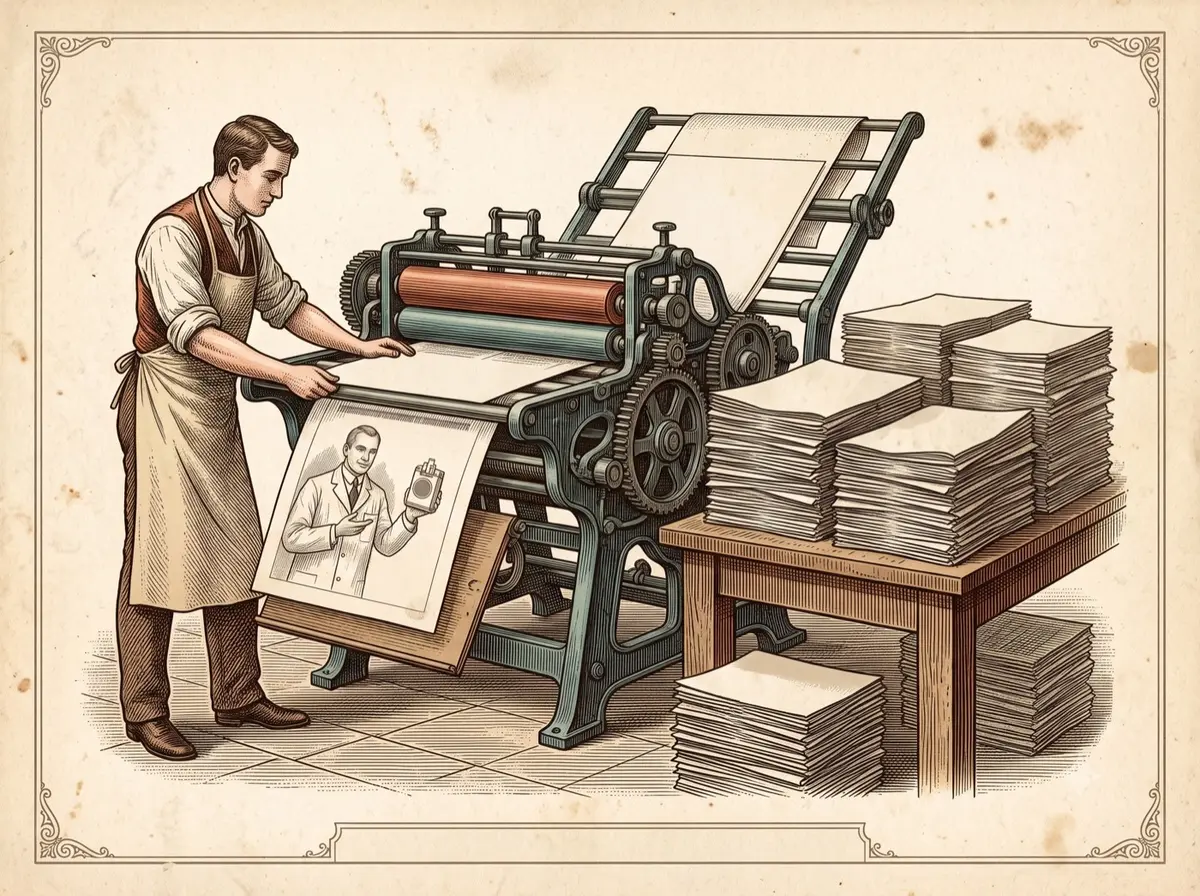
What happened: When Doctors Recommended Cigarettes
From the late 1920s through the early 1950s, U.S. tobacco companies leaned on the authority of medicine one brand at a time. The slogans people still search for — “more doctors smoke Camels,” “20,679 physicians,” “not a cough in a carload” — were specific campaigns, with a year and a company attached. “4 out of 5 doctors recommend” is the stock phrase that survived in memory. The ads that actually ran preferred an exact count, which sounds harder to argue with than a fraction.
This sat on top of an older medical tradition. In the 19th and early 20th centuries, “asthma cigarettes” — often containing stramonium or other plant compounds — were genuinely prescribed and sold in pharmacies to relax the airways of asthma sufferers. When mid-century advertisers wrapped cigarettes in a lab coat, they were borrowing a thread of real, if misguided, medical practice.
Lucky Strike, 1930: "20,679 physicians"
American Tobacco, maker of Lucky Strike, was the first of the big brands to put a physician in the ad. Company president George Washington Hill and ad man Albert Lasker had already sold Luckies with “Reach for a Lucky instead of a sweet.” Alongside that, a 1930 advertisement stated that “20,679 Physicians say ‘LUCKIES are less irritating.’” The number had been climbing for years: Stanford’s tobacco advertising archive holds a 1927 ad claiming 9,651 doctors, and another from the same year claiming 11,105. The count was the product of a mailed survey. Physicians received Lucky Strike cartons and a leading question about throat irritation. Many answered the way the question was built to be answered, and the replies became the headline.
The doctors in the artwork were actors. A physician who advertised risked his license, so the white coat in the layout was a type, not a named endorser.
Camels, 1946: "More doctors smoke Camels"
In 1946, R.J. Reynolds launched the line that outlasted all the others: “More Doctors Smoke Camels Than Any Other Cigarette.” The company said the claim rested on a survey of 113,597 physicians. The first ad in the series, dated January 1, 1946, included a letter from Camel’s Medical Relations Division praising its own survey. The slogan ran in Life, Time, and The Saturday Evening Post, and on radio, including programs children listened to. A television version from around 1950 asked, “What cigarette do you smoke, Doctor?”
How the sample was gathered is the part the slogan leaves out. Reynolds representatives handed physicians free cartons of Camels — at conventions, and by mail — and then asked which brand they smoked. The Center for the Study of Tobacco and Society notes that the published ads never described the method. Martha Gardner and Allan Brandt’s history of the physician in cigarette ads records the same pattern: the “finding” was collected from doctors who had just been given the product.
Philip Morris, 1937: doctors who "kept a record"
Philip Morris, newer to the market, cited research rather than a head count. A 1937 Saturday Evening Post ad, spoken by the brand’s bellhop Johnny Roventini, said that “a report on the findings of a group of doctors” showed that “when smokers changed to Philip Morris, every case of irritation cleared completely and definitely improved.” The copy described physicians keeping a day-by-day record. What it did not say in the same type size was that Philip Morris had sponsored the work. The same claim ran in magazines aimed at the public and in journals aimed at doctors.
Old Gold: "Not a cough in a carload"
Lorillard’s Old Gold spent the 1930s and 1940s on a different medical costume. The slogan was “Not a cough in a carload.” In medical journals the company also ran “For a treat instead of a treatment,” a line aimed at readers who had begun to hear that smoking was something a doctor might need to address. The last cigarette advertisement in the New York State Journal of Medicine — January 15, 1955 — was Lorillard’s, by then selling Old Gold as a filter. The cough-in-a-carload era was over. The brand was still buying the physician’s attention.
Chesterfield, 1931: a number that was not an endorsement
Chesterfield’s 1931 ads skipped the survey and printed a different kind of precision. One layout listed 110,108 pharmacists and 152,503 physicians — the totals then claimed for each profession in the United States — beside a scene that could be read, at a glance, as those people standing behind the brand. Another showed a doctor appearing to prescribe Chesterfields to a patient. No survey was offered. The trick was the number itself, sitting where an endorsement count would sit.
Why it was strange: When Doctors Recommended Cigarettes
By the time these ads were running, the evidence against smoking was already mounting. German researchers had begun linking smoking to lung cancer before World War II. Then in 1950, two landmark studies — one by Ernst Wynder and Evarts Graham in the United States, another by Richard Doll and Austin Bradford Hill in Britain — provided strong statistical links between cigarettes and lung cancer. The strange part is that physician-endorsement advertising kept running anyway, with the imagery of medical authority pointed in exactly the wrong direction.
It shares a shelf with The Everlasting Pill That Families Fished Out of the Chamber Pot and Passed Down, in Cures That Were Worse Than the Disease.
What scientists learned: When Doctors Recommended Cigarettes
The 1950s were a turning point. Reader’s Digest published its widely read “Cancer by the Carton” piece in 1952, and the epidemiological case kept strengthening. The decisive moment came in 1964, when U.S. Surgeon General Luther Terry released a landmark report concluding that smoking causes lung cancer and is a serious health hazard. Beyond tobacco itself, scientists learned a broader and more uncomfortable lesson: the trappings of expertise — a white coat, a survey, a confident statistic — can be borrowed to sell almost anything, and the public has to look at who funded the science, not just whether science-looking language is present.
Also in Cures That Were Worse Than the Disease: The Watch Painters Who Glowed in the Dark.
How it reaches us today: When Doctors Recommended Cigarettes
The backlash reshaped public health and advertising law. The 1964 report led to mandatory warning labels on cigarette packs, and in 1971 cigarette advertising was banned from American television and radio. The episode became a foundational case study in conflict-of-interest research and helped establish the modern expectation that health claims should disclose their funding. Every time you see a “this study was funded by…” disclosure, you’re seeing a lesson learned the hard way.
Another from Cures That Were Worse Than the Disease: The Doctor Who Toured America in a ‘Lobotomobile’.
Fun fact: When Doctors Recommended Cigarettes
Many of the “physicians” in those ads were models, and the surveys behind the slogans were often conducted moments after the doctors had been handed free cigarettes — a textbook example of a rigged sample.
Sources: When Doctors Recommended Cigarettes
- Martha N. Gardner & Allan M. Brandt, “‘The Doctors’ Choice Is America’s Choice’: The Physician in US Cigarette Advertisements, 1930–1953,” American Journal of Public Health, 2006 — https://www.ncbi.nlm.nih.gov/pmc/articles/PMC1470496/
- Stanford Research into the Impact of Tobacco Advertising, “20,679 Physicians.”
- Center for the Study of Tobacco and Society, “The ‘More Doctors Smoke Camels’ Campaign.”
- “Cigarette,” Wikipedia (history and health sections) — https://en.wikipedia.org/wiki/Cigarette
- U.S. Public Health Service, Smoking and Health: Report of the Advisory Committee to the Surgeon General (1964)
- E.L. Wynder & E.A. Graham, “Tobacco Smoking as a Possible Etiologic Factor in Bronchiogenic Carcinoma,” JAMA, 1950
This article touches on tobacco and cancer. If you’re trying to quit smoking, your doctor or a national quit-line can help you find support.
Related stories: When Doctors Recommended Cigarettes
- Eben Byers and the Radium Water That Dissolved His Jaw — Eben Byers and the radium water that took his jaw
- The Goat-Gland Surgery That Ended Up Rewriting American Radio Law — Goat glands, quack surgery, and the reason radio has rules
- The Doctor Who Toured America in a ‘Lobotomobile’ — Walter Freeman’s lobotomobile
- Part of Cures That Were Worse Than the Disease