The Goat-Gland Surgery That Ended Up Rewriting American Radio Law
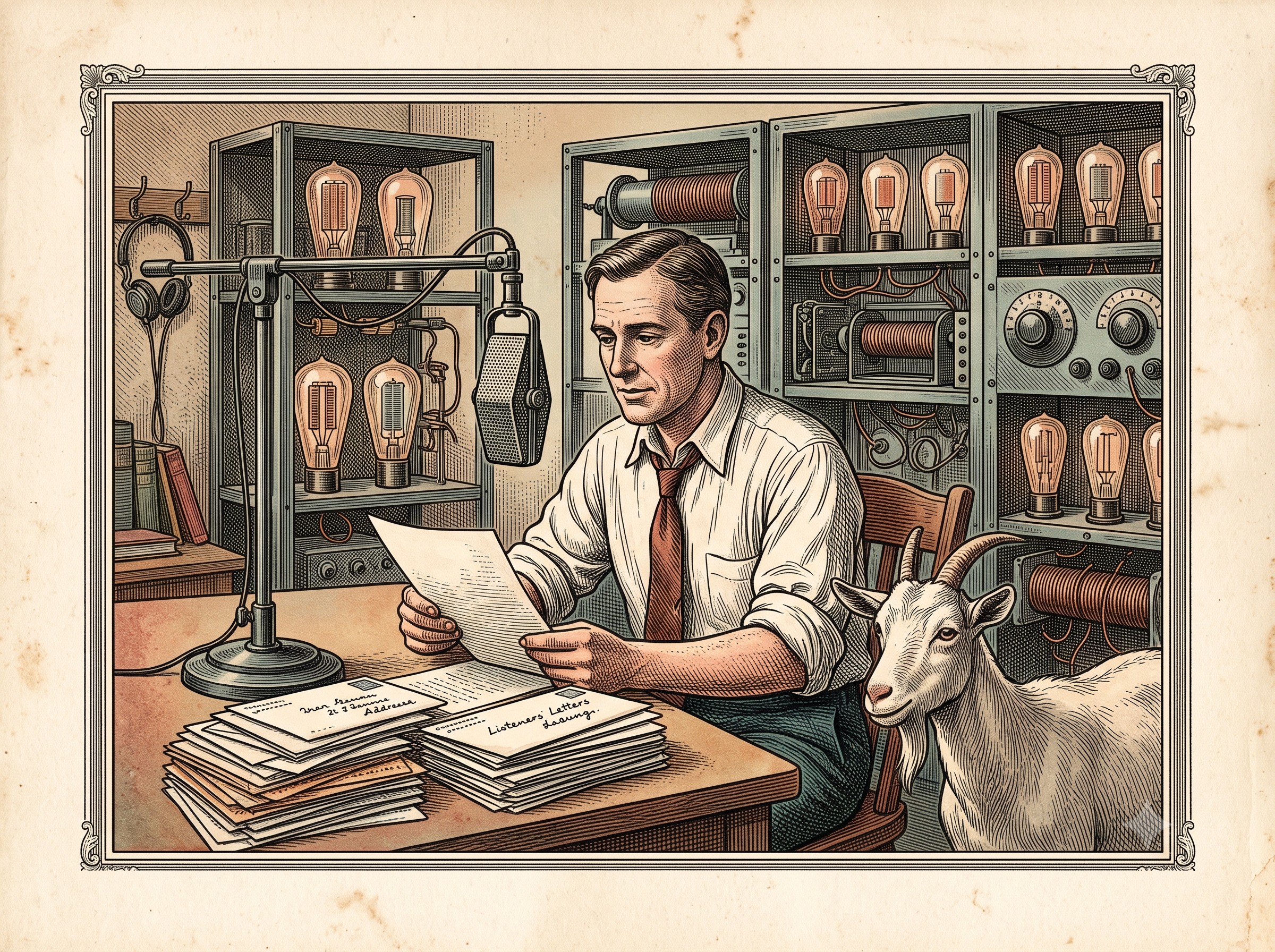
Three times a day, in a Kansas farm town of a few hundred people, a man sat down in front of a microphone and diagnosed strangers he had never met. Listeners mailed in their symptoms under a code name; he read the codes on the air, named their diseases, and told them which numbered prescription to buy. The rest of the day he ran a hospital whose marquee procedure was implanting slices of goat testicle into men.
John Romulus Brinkley was born near Beta, North Carolina, on July 8, 1885, and orphaned by the age of ten. He attended several medical schools without graduating from any of them, collected credentials from what the Kansas Historical Society flatly calls diploma mills, and used the reciprocity agreements between states — under which one state honored another’s license — to get himself legally licensed. He settled in Milford, Kansas, in 1916 and, by his own later testimony, was practicing there by 1917.
Around 1918 he began performing what he called the goat gland operation: implanting goat testicular tissue into men who came to him complaining of lost vigor or infertility. Accounts of the first patient diverge in a way worth flagging. Brinkley told the story of a local farmer who begged him to try it; descendants of that farmer, Bill Stittsworth, told a different version, in which Brinkley offered money to secure a volunteer. Both are secondhand, and no contemporaneous record settles it.
What is documented is what came next. Testifying under oath in 1939, Brinkley said he had treated between 5,000 and 6,000 people and charged many of them $750 — roughly the price of a new car — and that his gross income ran about
00,000 a month. He built a hospital, a mail-order medicine business, and, in the early 1920s, KFKB, one of the first radio stations in Kansas. Between the country music and the sermons came the “Medical Question Box,” his on-air diagnosis segment.
The financial architecture is spelled out in the federal record. Brinkley organized a druggists’ group whose members dispensed medicines made to his formulas and known to the public only by number, paying him a fee on every sale. For February through April of 1930, the Federal Radio Commission found that KFKB took in $37,901.33 — of which
7,856.40 came from that druggists’ association and $6,500 from his hospital. The station was, in effect, a funnel.
Organized medicine came after him. The American Medical Association’s Morris Fishbein made Brinkley a target, and in 1930 the Kansas State Medical Board revoked his license for what it called “an organized charlatanism.” Months later the Federal Radio Commission refused to renew KFKB’s. Brinkley’s answer was to run for governor as a write-in candidate — if he could not keep his license, he could appoint the board that took it — and he pulled close to 30 percent of the vote. He lost, ran twice more, lost again, and moved to Del Rio, Texas, broadcasting from a colossal transmitter across the river in Mexico. He sued Fishbein for libel and lost, declared bankruptcy in 1941, and died in San Antonio on May 26, 1942.
Why was it strange?
The strangeness is not that a man sold a ridiculous surgery. It is that the surgery was never really the product. The goat glands were the loss leader for a radio-and-pharmacy machine, and the machine worked so well that a man with no medical degree nearly became governor of a state whose medical board had just declared him a fraud. His listeners knew he had been stripped of his license. Many voted for him anyway.
There is also the matter of who was harmed. Wrongful-death suits followed Brinkley for a decade; Pope Brock’s Charlatan, the standard modern account, puts the number of death certificates Brinkley signed in Kansas before 1930 at forty-two. The true figure is unknowable, since patients who fell ill after leaving Milford were counted somewhere else, if at all.
What did scientists learn?
Brinkley was not working in a vacuum. In 1889 the physiologist Charles-Édouard Brown-Séquard, then 72, injected himself with extracts of animal testicles and announced he felt rejuvenated, launching a long vogue called organotherapy. In 1920s Paris, the surgeon Serge Voronoff grafted thin slices of monkey testicle into wealthy men. The idea that the gonads secreted something vital was correct. Everything downstream of it was guesswork.
Two bodies of research closed the door. The first was immunology. Moving tissue between species is called xenotransplantation, and a graft from a goat into a human is attacked almost immediately by antibodies the human body already carries — the tissue is destroyed and reabsorbed within days. Peter Medawar’s work in the 1940s and '50s explained rejection as an immune response, earning a share of the 1960 Nobel Prize in Physiology or Medicine. No goat gland ever “took.”
The second was endocrinology. In May 1935 a Dutch group — Károly Gyula David, E. Dingemanse, J. Freud, and Ernst Laqueur — isolated testosterone itself. Within months Adolf Butenandt and Leopold Ružička independently synthesized it from cholesterol, work recognized with the 1939 Nobel Prize in Chemistry. Once the hormone could be named, measured, and made, gland grafting had nothing left to stand on.
Why, then, did patients say they felt better? Placebo response, regression to the mean — people seek help at their worst and tend to drift back toward baseline — and the sheer weight of having paid $750 all point the same way.
How does it affect us today?
The court fight over KFKB became a foundation stone of American broadcast regulation. In upholding the Commission’s refusal to renew the license, the record laid out a principle still quoted: “A license to operate a radio broadcasting station is a franchise from the public, and the licensee is a trustee for the public.” Regulators could not censor content in advance, but they could look at what a station had actually broadcast when deciding whether renewal served “public interest, convenience and necessity.” Every later argument about what a broadcaster owes its audience runs through this case — a case that exists because of goat glands.
Fun fact
Brinkley’s Mexican border station needed programming to fill all that wattage, so it hired musicians. Among them were the Carter Family, whose broadcasts across the American heartland helped turn regional string-band music into a national genre. Country music’s early mass audience was assembled, in part, to sell rejuvenation surgery.
If any of this touches something you’re dealing with, a licensed clinician is the right place to start — and treatments that are sold rather than prescribed deserve a second opinion.