Weird Medical History · Biology
The Frog in the Hospital Basement That Told You If You Were Pregnant
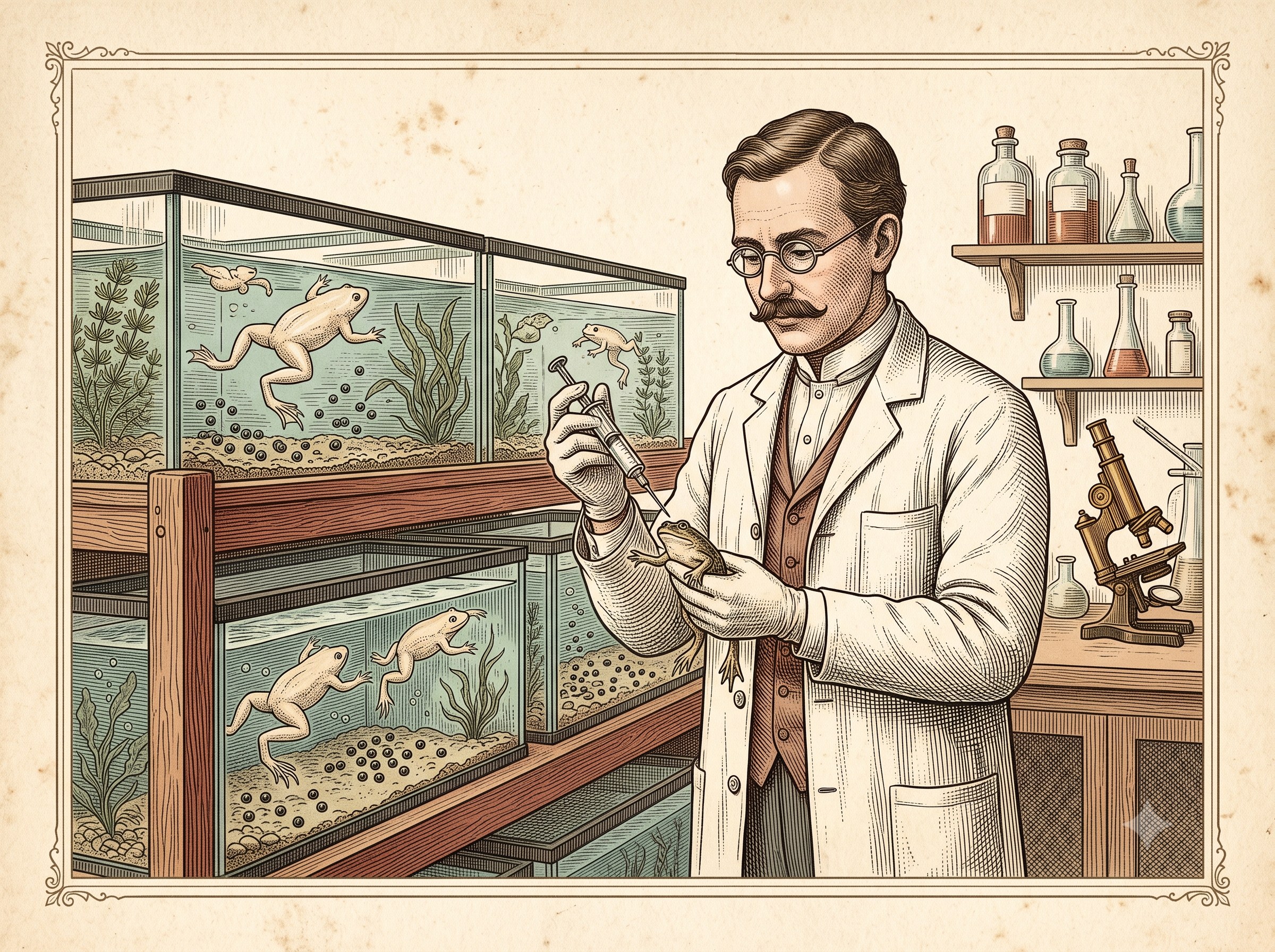
For about thirty years, the answer to "am I pregnant?" lived in a tank in the hospital basement. A technician drew up a syringe of a woman's urine, injected it under the loose skin on the back of an African clawed frog, and put the frog back in its water. In the morning someone came down to look. If the bottom of the tank was scattered with tiny black-and-white eggs, the answer was yes.
By the Curiosities Desk · · 5 min read · Filed under Biology · Today’s round
What happened?
The frog’s career in obstetrics began with a question about skin color.
In the late 1920s the British zoologist Lancelot Hogben was working in South Africa, studying Xenopus laevis — a flat, tongueless, fully aquatic frog whose name means “strange foot,” after the black claws on its hind toes. Hogben noticed the frogs went pale or dark depending on their surroundings and suspected the pituitary gland was running the show. So he removed the gland from several frogs, which confirmed his hunch, and then tried to patch up the side effects by injecting them with pituitary extract from an ox.
The frogs started laying eggs. This was not supposed to happen. Female Xenopus held in captivity, with no males around, normally keep their eggs to themselves. A drop of ox hormone and they released hundreds.
Hogben understood immediately what he was looking at. Pituitary gonadotropins — hormones that tell ovaries to release eggs — are chemically close cousins of human chorionic gonadotropin, or hCG, which the body starts producing once a fertilized egg implants in the uterine wall. Since a person who isn’t pregnant doesn’t make hCG, it is close to an ideal signal. The frog was, in effect, a living hCG detector.
Two hCG tests already existed and both were grim. In the Aschheim–Zondek test, developed in Berlin in the late 1920s, urine was injected into several immature female mice over several days; the mice were then killed and dissected so their ovaries could be inspected. Maurice Friedman’s 1931 variant used rabbits. Either way you waited days, and either way the animal died — which is where the American euphemism “the rabbit died” comes from, though the phrase gets the science backwards. The rabbit died no matter what the result was.
The frog test was published in 1934 by two of Hogben’s former students in South Africa, Hillel Shapiro and Harry Zwarenstein, in a one-page Nature note titled “A Rapid Test for Pregnancy on Xenopus lævis.” Injected frogs extruded ova through the cloaca within eighteen hours. Nothing had to be killed, and the same frog could go back to work a couple of months later. (Who deserved the credit became a lasting sore point: Hogben later claimed the clinical idea was his and that his students’ papers had actually delayed its adoption, and Shapiro and Zwarenstein published a pointed reply disputing his account. The disagreement was never settled.)
Adoption was fast. Hogben had already brought clawed frogs with him to London, and in 1937 he and the geneticist F. A. E. Crew arranged for a shipment of roughly 1,500 more from South Africa; Crew’s Edinburgh institute went on to run tens of thousands of tests for clinicians. Edward Elkan laid out the method for British doctors in the British Medical Journal in 1938. By the late 1940s hospitals across Europe and the United States kept frog rooms staffed by teams of technicians — mostly women — injecting mail-in urine samples into amphibians.
In 1947 the Argentine physician Carlos Galli Mainini found that male toads would release sperm into their urine within about three hours of an hCG injection, which turned an overnight wait into an afternoon. Chemical immunoassays arrived in the 1960s and quietly retired the whole amphibian workforce.
Why was it strange?
Set aside the frogs for a second and look at the logistics. For three decades, a routine medical result depended on an animal in a tank being alive, healthy, in season, and correctly fed. A hospital’s diagnostic capacity was limited by how many frogs it could keep. Somewhere in most large hospitals there was a person whose job title, functionally, was frog keeper.
The strangeness cuts the other way too. This was one of the rare moments when the humane option was also the faster, cheaper, more sensitive one. Hospitals switched to frogs not out of tenderness but because frogs were better.
The same thread — Endocrinology — continues in The Goat-Gland Surgery That Ended Up Rewriting American Radio Law.
What did scientists learn?
The immediate lesson was about hormones. The frog test worked because a signaling molecule made by a human placenta fits a receptor in an amphibian ovary — two lineages separated by hundreds of millions of years, still speaking a compatible chemical language. That deep conservation is why animal bioassays worked at all before anyone could measure a hormone directly.
The longer lesson was accidental. Because hospitals worldwide had suddenly ordered clawed frogs by the crate, biology labs found themselves with a cheap, hardy, egg-producing vertebrate that lived happily in tap water. Xenopus became a founding model organism. John Gurdon used its eggs in 1962 to show that a nucleus from a specialized adult cell could still build a whole animal — the cloning experiment that won him a share of the 2012 Nobel Prize. In 1974 a Xenopus ribosomal gene became one of the first eukaryotic genes spliced into bacteria. Frog egg extracts later cracked open the machinery of cell division.
Another treatment that history kept the receipt for: The Roman Doctor Who Prescribed a Live Electric Fish for Your Headache.
How does it affect us today?
Every drugstore pregnancy test is doing what the frog did: hunting for hCG. The plastic stick just uses antibodies on a paper strip instead of ovaries, which is why it takes three minutes instead of eighteen hours.
The other legacy is harder. In 2004 Ché Weldon and colleagues, testing archived southern African museum specimens, found the amphibian chytrid fungus Batrachochytrium dendrobatidis in a Xenopus laevis collected in 1938 — and proposed that the global trade in clawed frogs had carried the fungus out of Africa into populations with no defenses against it. Chytrid has since been implicated in catastrophic amphibian declines worldwide. It is worth being careful here: the out-of-Africa hypothesis is contested. Chytrid has been detected on a Japanese museum specimen from 1902, and genomic surveys have concluded it is premature to name a single geographic origin. What is not in doubt is that moving live animals around the planet moves their pathogens too.
Escaped clawed frogs, meanwhile, are still out there — in California waterways, Dutch canals, and the underground cisterns of Welsh castles.
Another odd chapter in medicine: The Senator Who Went to Space and Came Back as a Unit of Nausea.
Fun fact
The frogs eventually outdid the astronauts’ résumés too. In 1992 four Xenopus laevis flew aboard Space Shuttle Endeavour to see whether fertilization and development worked in microgravity. They laid eggs, and the eggs became tadpoles.
Sources
- H. Shapiro and H. Zwarenstein, “A Rapid Test for Pregnancy on Xenopus lævis,” Nature 133, 762 (1934) (primary source)
- C. Weldon, L. H. du Preez, A. D. Hyatt, R. Muller, R. Speare, “Origin of the Amphibian Chytrid Fungus,” Emerging Infectious Diseases 10, no. 12 (2004), CDC
- C. Galli Mainini, “Pregnancy Test using the Male Toad,” Nature 161, 676 (1948)
- Sam Kean, “The Birds, the Bees, and the Froggies,” Distillations, Science History Institute (2017)
- Eben Kirksey et al., “The Xenopus Pregnancy Test: A Performative Experiment,” Environmental Humanities 8, no. 1 (2016), Duke University Press
Related stories
- The Goat-Gland Surgery That Ended Up Rewriting American Radio Law — Endocrinology’s stranger commercial detour
- The Woman Who Convinced the King’s Surgeon She Gave Birth to Rabbits — An earlier, far less reliable rabbit-and-pregnancy story
- The Toad Australia Released to Fight a Pest — and Turned Into a Bigger One — What happens when amphibians get shipped somewhere new