Weird Medical History · Physics
The Roman Doctor Who Prescribed a Live Electric Fish for Your Headache
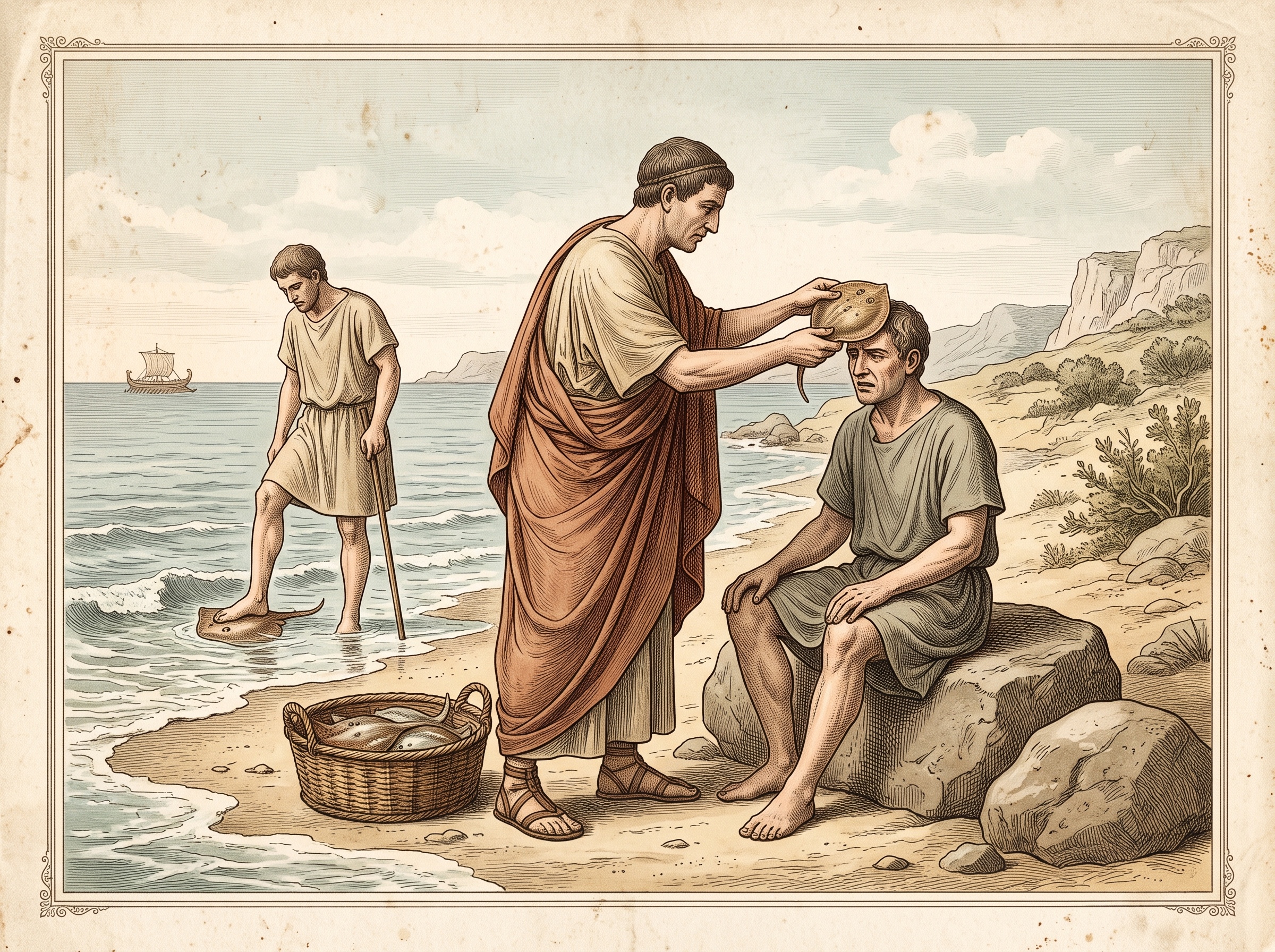
Around 47 AD, the Roman physician Scribonius Largus wrote down a cure for a pounding headache. Step one: get a live black torpedo, a flat, round fish that can deliver an electric shock. Step two: press it against the spot that hurts and hold it there until the pain stops and the skin goes numb. Step three, and this is the part that makes you picture a very busy kitchen: have several more fish on standby, because sometimes the first two or three don't do the job.
By the Curiosities Desk · · 5 min read · Filed under Physics · Today’s round
What happened?
Scribonius Largus was a physician and pharmacologist who treated members of Rome’s imperial household. He travelled with the emperor Claudius on the invasion of Britain in 43 AD, and a few years later he finished a handbook called the Compositiones, a collection of 271 remedies arranged roughly from head to toe. He dedicated it to Gaius Julius Callistus, a powerful freedman in Claudius’s administration. Most of the book is what you’d expect: plasters, salves, antidotes and herbal mixtures, several of them recipes Scribonius said had been used by the imperial family.
Two entries stand out. In chapter XI, on headaches, he recommends the torpedo ray. His claim was bold: even chronic, unbearable headache could be “taken away and remedied forever” by a live torpedo placed where the pain was. He added practical advice. Take the fish off once numbness sets in, so the patient doesn’t lose feeling in that spot. And keep a supply ready, since the cure sometimes only worked after two or three fish.
In chapter CLXII, on gout (a painful swelling of the joints, often in the feet), the instructions move to the beach. “For any type of gout,” he wrote, “a live black torpedo should, when the pain begins, be placed under the feet.” The patient was to stand on wet sand washed by the sea, keeping a foot on the fish until the foot and leg were numb up to the knee.
Scribonius said he had a success story to back it up. A man named Anteros, a freedman connected to the household of the emperor Tiberius, was said to have been cured of his gout this way. Later retellings sometimes describe it as a lucky accident on the shoreline, with Anteros stepping on a ray and finding his pain gone. Scribonius’s own text is brief, so how the discovery happened is best treated as a story rather than a documented event.
The fish themselves were real and well known. Mediterranean fishermen had long felt the jolt of rays in the genus Torpedo, and the name comes from the Latin torpere, “to be numb.” Greek and Roman writers wondered how the ray could stun a hand through a fishing line or spear. Nobody in Scribonius’s day called it electricity. To them it was a mysterious numbing power that happened to live inside a fish.
Not everyone was convinced it helped. About a century later the Greek physician Galen discussed the torpedo remedy and reported that when he tried it himself, it did not work for him. He believed the fish released some kind of cold, numbing quality rather than anything we would recognise as a current.
Why was it strange?
Look at it from the patient’s point of view. You come to a court physician with a splitting headache, and the treatment involves a wet, living animal strapped to your forehead, plus backup animals, plus the instruction to stop before your face goes permanently numb.
And yet the strangest part is that the idea wasn’t entirely wrong. Scribonius was using a natural power source to send current through the body to blunt pain, without having any word for what that power was. He was 1,700 years too early for batteries, and more than 1,700 years ahead of anyone proving the fish’s shock was electrical.
Another odd chapter in medicine: The Shoe-Store X-Ray Machine That Kids Begged to Use.
What did scientists learn?
The torpedo’s secret is its electric organs, a pair of kidney-shaped structures on either side of the head. They are built from stacks of flat cells called electrocytes, which are modified muscle cells that produce a small voltage each. Because thousands are stacked and fire together, the voltages add up, the same way batteries in a flashlight do. Depending on the species, a torpedo ray’s discharge is roughly 30 to 50 volts, and the large Atlantic torpedo can approach 220.
The question of whether this was true electricity took until the 1770s, when the Englishman John Walsh experimented with live torpedoes and concluded the effect was “absolutely Electrical.” Anatomist John Hunter then described the organs as stacked columns of discs. Around 1800, Alessandro Volta built the first battery, the voltaic pile, from stacked discs of metal and moistened card, and he himself compared it to the fish’s electric organ.
As for why the shock might ease pain, the modern explanation is cautious. Electrical stimulation of nerves can interfere with pain signals and produce numbness, at least temporarily. There is no good evidence that a torpedo ray cures headaches “forever,” and Galen’s failed trial is a useful reminder that one physician’s success story is not proof.
The same thread — Bioelectricity — continues in The Horses That Battled an Army of Electric Eels.
How does it affect us today?
Scribonius is often credited as one of the first people to describe electrotherapy, using electric current as medical treatment. Today, transcutaneous electrical nerve stimulation (TENS), in which small pads on the skin deliver mild pulses of current, is a common option for some kinds of pain.
The connection to headaches is closer than you might expect. In March 2014, the U.S. Food and Drug Administration allowed marketing of the first TENS device for preventing migraine. It is a headband worn across the forehead that stimulates a nerve just above the eyes. Same spot as the fish, minus the fish.
Another treatment that history kept the receipt for: The Year in Space That Turned Twin Astronauts Into a Living Experiment.
Fun fact
Naval torpedoes are named after the fish. In the early 1800s, the inventor Robert Fulton borrowed “torpedo” for his underwater explosives, so a weapon designed to disable ships carries the Latin word for “numbness” from the animal Scribonius once pressed to aching foreheads.
Frequent or severe headaches and joint pain are worth taking seriously. If you’re dealing with either, a doctor can help you find out what’s behind it and which treatments, electrical or otherwise, are right for you.
Sources
- Tsoucalas G, Karamanou M, Lymperi M, Gennimata V, Androutsos G. “The ‘torpedo’ effect in medicine.” International Maritime Health 65(2): 65–67 (2014). https://journals.viamedica.pl/international_maritime_health/article/view/38809
- Finger S, Piccolino M. The Shocking History of Electric Fishes: From Ancient Epochs to the Birth of Modern Neurophysiology. Oxford University Press (2011). https://academic.oup.com/book/26948
- Grout J. “Scribonius Largus.” Encyclopaedia Romana, University of Chicago. https://penelope.uchicago.edu/encyclopaedia_romana/aconite/largus.html
- Long Now Foundation. “The Shocking Medical History of Electric Fish.” https://longnow.org/ideas/the-shocking-medical-history-of-electric-fish/
- MD+DI. “FDA Clears First Medical Device for Preventing Migraine Headaches” (March 2014). https://www.mddionline.com/regulatory-quality/fda-clears-first-medical-device-for-preventing-migraine-headaches