Weird Medical History · Physics
The Shoe-Store X-Ray Machine That Kids Begged to Use
A boy stands on a wooden cabinet the size of a phone booth, his sneakered feet tucked inside a slot near the floor. He leans over a porthole at the top and peers down at a glowing green skeleton — his own toes, wiggling inside the shoe, bones lit up like something out of a comic book. His mother looks through a second porthole. The salesman looks through a third. Everyone is delighted. No one in the room is thinking about the X-ray tube humming directly beneath the boy's feet.
By the Curiosities Desk · · 5 min read · Filed under Physics · Today’s round
Part of Medicine, Before It Was Sure
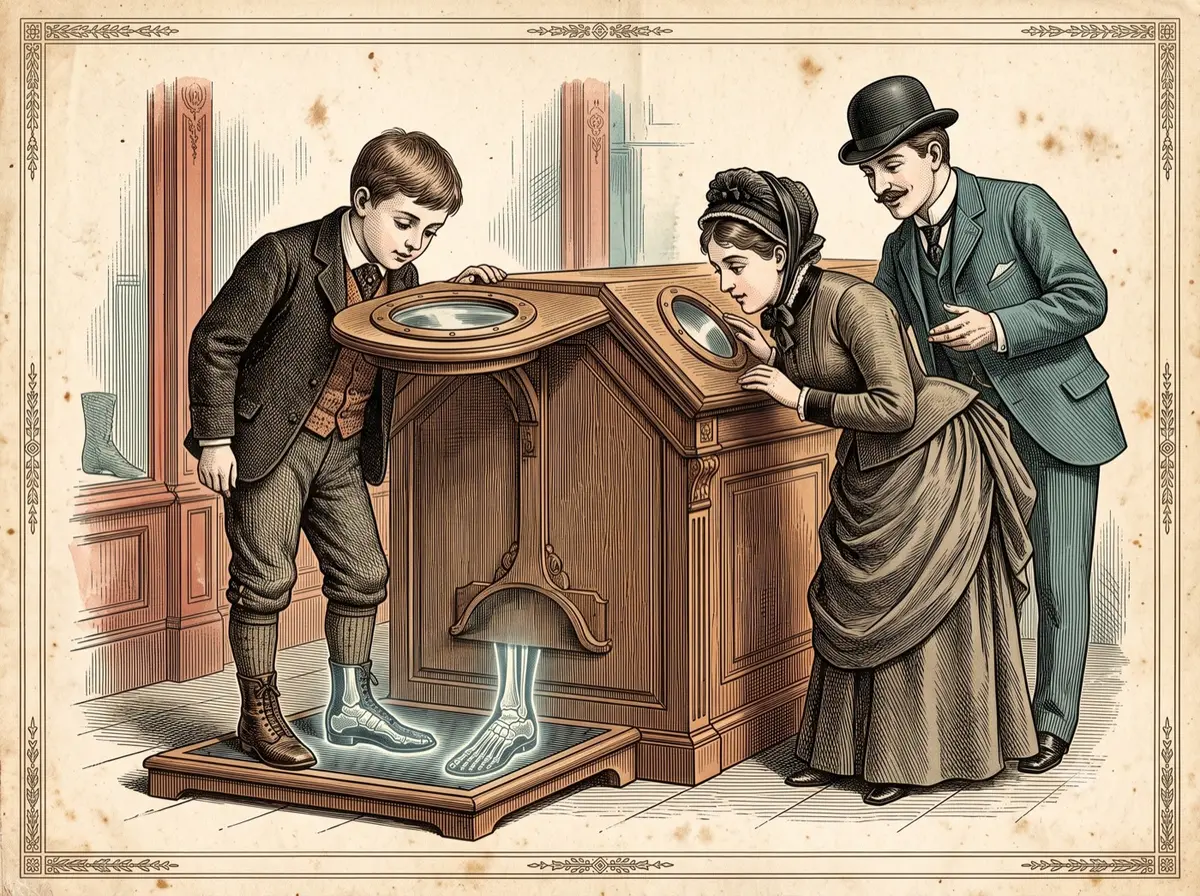
What happened: A Shoe-Store X-Ray Machine
The device was called, depending on who made it, the Foot-O-Scope, the X-Ray Shoe Fitter, or the Pedoscope — but almost everyone just called it the shoe-fitting fluoroscope, a machine that used X-rays to show a live, glowing image of the bones inside a customer’s foot and shoe. From the 1920s through the 1950s, it was a fixture in shoe stores across the United States, Canada, the United Kingdom, and parts of Europe.
Its origin is genuinely tangled. The strongest claim belongs to Dr. Jacob Lowe, a Boston physician who built a fluoroscope — a device that uses X-rays to produce a real-time image, rather than a still photograph — during World War I to examine soldiers’ feet without making them remove their boots. After the war, Lowe adapted the device for shoe stores and demonstrated it at a retailers’ convention in Boston in 1920. He filed a patent in 1919 and was finally granted it in 1927, assigning it to the Adrian Company of Milwaukee. Around the same time, a Milwaukee man named Clarence Karrer claimed he’d built his own version in 1924, only to have the idea taken and patented by one of his father’s employees — a story that survives mainly through a single 1978 letter and can’t be fully verified. A separate British device, the Pedoscope, appeared in the UK around the same period. Historians still don’t agree on exactly who deserves credit.
Whoever invented it, the machine spread fast. By the early 1950s, an estimated 10,000 units were operating in the United States, another 3,000 in the UK, 1,500 in Switzerland, and 1,000 in Canada. A typical model ran a low-power X-ray tube — about 50 kilovolts, 3 to 8 milliamps — positioned so that a standing customer’s feet were directly above it, separated from the beam by little more than a thin sheet of aluminum. Push a button, and a timer ran the exposure for anywhere from 5 to 45 seconds, with 20 seconds being typical. Some machines even let the operator choose a radiation intensity: high for men, medium for women, low for children — though children, being fitted for new shoes every few months as their feet grew, were often the machine’s most frequent users.
Why it was strange: A Shoe-Store X-Ray Machine
By the time these machines were showing up in shopping districts, the dangers of X-rays were not exactly a secret. Early radiologists and X-ray pioneers had already suffered severe burns, amputations, and cancers from the very technology now being aimed at children’s feet for fun. Yet the shoe-fitting fluoroscope was marketed as the picture of modern, scientific reliability — some models even carried a “Parent’s Magazine Seal of Commendation.” There was no medical training required to operate one, no dosage tracking, and for decades, no regulation at all. A device serious enough to require a trained radiologist in a hospital was, in a shoe store, treated like a novelty toy that happened to sell shoes.
Another odd chapter in medicine: The Roman Doctor Who Prescribed a Live Electric Fish for Your Headache.
What scientists learned: A Shoe-Store X-Ray Machine
When researchers finally measured the machines properly in the late 1940s, the numbers were alarming. A typical 20-second fitting delivered an average dose of about 13 roentgens to the feet — and some poorly maintained machines delivered as much as 116 roentgens in that same 20 seconds, roughly equivalent to a full-body dose of around 1 sievert, a level associated with acute radiation sickness if it were spread across the whole body. Because the feet and hands are relatively resistant to radiation damage compared with other tissues, and because customers used the machines only occasionally, there were no confirmed injuries to shoppers. Store employees were a different story: operators who leaned in or reached into the beam dozens of times a day accumulated real harm, including a documented radiation burn severe enough to require a leg amputation in 1950 and a case of ulcerated dermatitis in 1957.
The bigger scientific lesson was about how radiation damage works. Researchers studying these machines helped establish what’s now called the linear no-threshold model — the idea that there is no truly “safe” dose of ionizing radiation, and that risk simply scales with cumulative exposure over a lifetime. That principle, still central to radiation safety today, owes part of its evidentiary foundation to nervous physicists measuring shoe stores.
The same thread — Radiation — continues in The Watch Painters Who Glowed in the Dark.
How it reaches us today: A Shoe-Store X-Ray Machine
Every time you get a dental or medical X-ray today, you benefit from lessons learned partly from this device: lead aprons, shielding, trained technicians, dose limits, and the rule that any X-ray exposure needs a real medical justification rather than a marketing purpose. Pennsylvania became the first U.S. state to ban shoe-fitting fluoroscopes outright in 1957; by 1960, roughly three dozen states had followed, and the machines faded out internationally over the following decades — some lingered in parts of Europe into the 1970s and 80s. The episode is now a standard case study in radiation-safety courses, a cautionary tale for what happens when a genuinely useful medical technology gets repurposed as a sales gimmick with no oversight.
Another treatment that history kept the receipt for: The Box of Light Bulbs the Corn Flakes Doctor Said Cured a King.
Fun fact: A Shoe-Store X-Ray Machine
In 1999, Time magazine put shoe-store X-rays on its list of the 100 worst ideas of the 20th century. British Pedoscopes, as it turns out, were built differently and produced roughly one-tenth the radiation of their American counterparts — meaning that for once, choosing British shoes was probably the more scientifically sound choice.
A note: this article discusses historical radiation exposure and its long-term health effects. If you have concerns about a personal or family medical history involving radiation, that’s a conversation worth having with a doctor.
Sources: A Shoe-Store X-Ray Machine
- Frame, Paul. “Shoe-Fitting Fluoroscope (ca. 1930–1940).” Museum of Radiation and Radioactivity, Oak Ridge Associated Universities.
- Lewis, Leon, and Paul E. Caplan. “The Shoe-Fitting Fluoroscope as a Radiation Hazard.” California Medicine 72, no. 1 (1950): 26–30.
- Duffin, Jacalyn, and Charles R. R. Hayter. “Baring the Sole: The Rise and Fall of the Shoe-Fitting Fluoroscope.” Isis 91, no. 2 (2000): 260–282.
- “Shoe-fitting fluoroscope.” Wikipedia.
- August, Melissa, et al. “The 100 Worst Ideas of the Century.” Time, June 14, 1999.
Related stories: A Shoe-Store X-Ray Machine
- The Glow Across the Room That Let Us See Inside the Body — A glow across a darkened lab let us see inside the living body
- The Watch Painters Who Glowed in the Dark — The watch painters who licked radium brushes and glowed
- The Radioactive Tonic That Dissolved a Millionaire’s Jaw — A radium tonic that dissolved a millionaire’s jaw