Accidental Discoveries · Physics
The Glow Across the Room That Let Us See Inside the Body
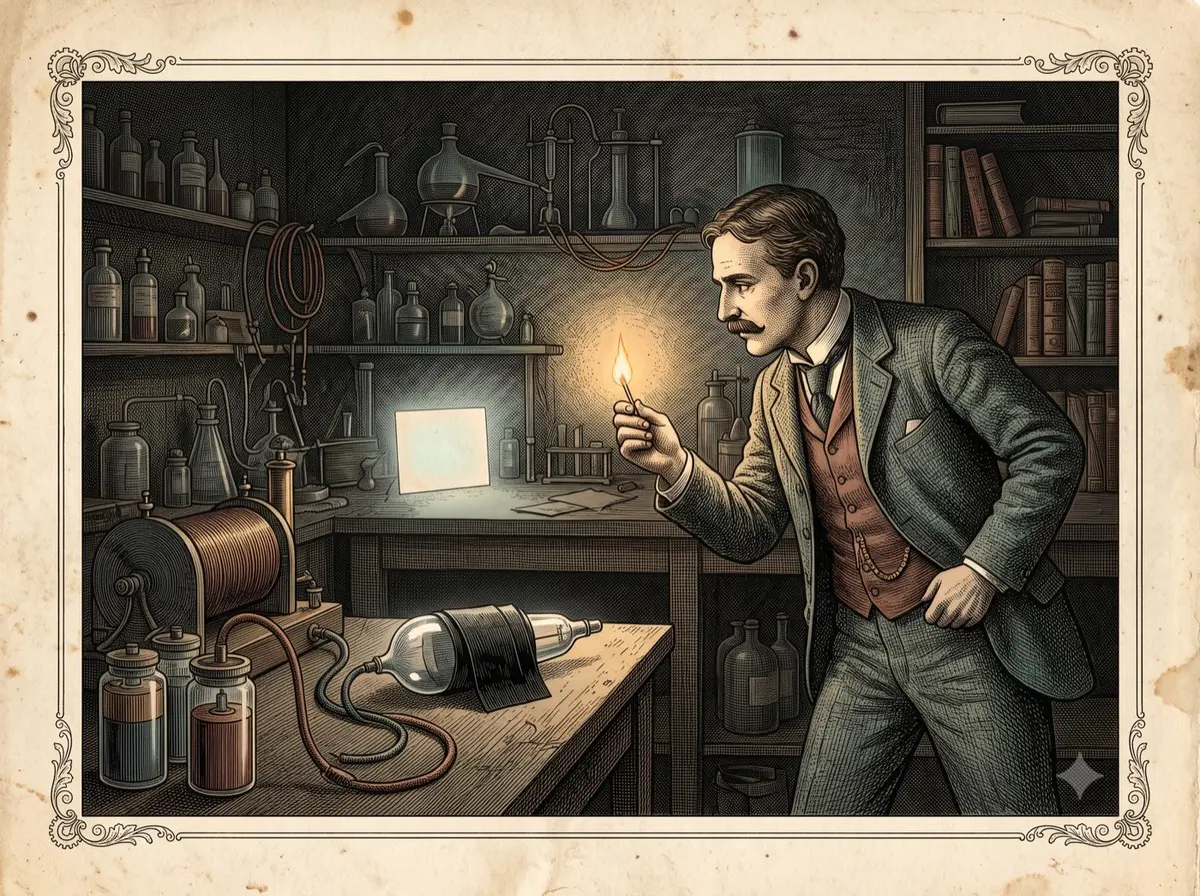
It was a Friday evening in November 1895, and the room was completely dark. Wilhelm Röntgen had wrapped a glowing vacuum tube in black cardboard specifically so no light could escape. Yet a few feet away, on a bench he wasn't even looking at, something was faintly shimmering. He struck a match and found the source: a small paper screen, glowing all on its own, with nothing visibly touching it.
By the Curiosities Desk · · 6 min read · Filed under Physics · Today’s round
What happened: X-Rays by Accident
Wilhelm Conrad Röntgen was a 50-year-old physicist at the University of Würzburg in Germany, working through a problem that was fashionable at the time: what exactly came pouring out of a cathode-ray tube when you ran electricity through it? These were sealed glass tubes with most of the air pumped out, and when charged by an induction coil they produced mysterious “cathode rays” (which we now know are streams of electrons). Physicists across Europe were poking at them with borrowed equipment from Crookes, Hittorf, Lenard, and others.
On the evening of 8 November 1895, Röntgen was preparing an experiment. He had covered a Crookes–Hittorf tube in black cardboard and darkened his laboratory to make sure the covering was completely light-tight before setting up his real measurement. When he switched on the tube, he noticed a faint glimmer coming from a workbench nearby. Sitting there was a small cardboard screen he had painted with barium platinocyanide, a chemical that fluoresces — glows — when the right kind of energy hits it. But the tube was covered. No visible light was reaching that screen.
He ran the discharge again. The screen glowed again. Whatever was leaving the tube was invisible, passed straight through opaque black cardboard, and traveled across the room. Röntgen was so gripped that, over the following weeks, he essentially moved into his lab — eating and sleeping there — while he tested everything he could think of. He held objects between the tube and the screen: wood, thin metal, a book. The rays passed through some materials and were blocked by others. At one point he slid a piece of lead into the beam and saw, on the screen, the flickering shadow of his own finger bones. He had just seen inside a living hand.
Not knowing what these rays were, he gave them the name mathematicians use for an unknown quantity: X. About six weeks after that first night — just before Christmas 1895 — he made a photographic image using the rays. The subject was his wife, Anna Bertha Ludwig’s, hand. The developed plate showed the bones of her fingers and the dark ring of her wedding band floating around one of them. According to the account that has followed the story ever since, she looked at the image of her own skeleton and said, “I have seen my death.”
Röntgen wrote up his findings in a paper titled Über eine neue Art von Strahlen — “On a New Kind of Rays” — dated 28 December 1895. Within days the news had leapt from a scientific society into the newspapers, and from there around the world.
Why it was strange: X-Rays by Accident
The discovery broke a basic expectation about how looking at things works. For all of human history, to see something you had to get its surface to bounce light at your eye. Skin was a wall. What was underneath — bone, bullet, swallowed coin — was simply hidden unless you cut it open. Röntgen’s rays ignored that wall entirely, sorting the body into shadows by density and printing the hard parts onto a screen while the soft parts faded to a ghost.
It was also strange because Röntgen wasn’t looking for it. He was doing careful housekeeping — checking that a piece of cardboard was opaque — when the universe volunteered a phenomenon nobody had catalogued. The rays had almost certainly been produced in other physicists’ labs before his; their equipment could make X-rays too. But others had shrugged off the fogged photographic plates and odd glows as nuisances. Röntgen’s gift was refusing to look away from an anomaly.
The same thread — Nobel Prize — continues in The Pigeon Mess That Turned Out to Be the Echo of the Big Bang.
What scientists learned: X-Rays by Accident
X-rays turned out to be electromagnetic radiation — the same fundamental phenomenon as visible light and radio waves, but with far shorter wavelengths and much higher energy. That high energy is why they slip through soft tissue while denser material like bone or metal absorbs them, creating the contrast that makes an image possible.
The discovery detonated a chain reaction in physics. Within months, Henri Becquerel, wondering whether glowing minerals might emit something similar, wrapped uranium salts with a photographic plate and discovered natural radioactivity in 1896. That thread led directly to Marie and Pierre Curie’s work on radioactive elements. Röntgen’s accidental glow was, in a real sense, the opening scene of modern atomic and nuclear physics — and in 1901 it earned him the very first Nobel Prize in Physics.
Another time the mistake was the invention: The Spotted X-Ray Film That Traced the First Atomic Bomb — Through a Cardboard Box.
How it reaches us today: X-Rays by Accident
Röntgen’s rays became one of the fastest-adopted discoveries in the history of science. Within a year of his paper, doctors were using X-ray images to find broken bones, locate bullets, and guide surgery — a leap that previously required guesswork or a scalpel. That first blurry picture of a hand is the direct ancestor of the chest X-ray, the dental X-ray, the mammogram, the airport security scanner, the CT scan that stacks X-ray slices into a 3-D view of the body, and the X-ray crystallography that later helped reveal the structure of DNA.
Röntgen could have made a fortune. Instead, he refused to patent the discovery, saying he wanted all of society to benefit from it. His name became so bound up with the phenomenon that in German and many other languages an X-ray is still called a Röntgen, a unit of radiation exposure was named the roentgen, and in 2004 chemists named element 111 roentgenium in his honor.
Another accident worth keeping: The Botanist Who Ground Up a Piece of the Sphinx to See If It Would Wiggle.
Fun fact: X-Rays by Accident
World Radiography Day is celebrated every year on 8 November — the exact anniversary of the night Röntgen noticed that stray glow across his darkened lab.
Sources: X-Rays by Accident
- Nobel Prize, “Wilhelm Conrad Röntgen – Biographical” and “The Nobel Prize in Physics 1901” — https://www.nobelprize.org/prizes/physics/1901/rontgen/biographical/
- U.S. National Library of Medicine, papers of Wilhelm Conrad Röntgen — https://www.nlm.nih.gov/
- American Physical Society, “This Month in Physics History: November 8, 1895: Röntgen’s Discovery of X-rays” — https://www.aps.org/publications/apsnews/200111/history.cfm
- Deutsches Röntgen-Museum, Remscheid-Lennep — https://www.roentgen-museum.de/
- Encyclopædia Britannica, “Wilhelm Conrad Röntgen” — https://www.britannica.com/biography/Wilhelm-Conrad-Rontgen
Related stories: X-Rays by Accident
- The Shoe-Store X-Ray Machine That Kids Begged to Use — Shoe stores that x-rayed children’s feet for fun
- The Rolled-Up Paper That Became the Stethoscope — A rolled-up sheet of paper became the stethoscope
- The Slice of Cork That Named the Cell — A slice of cork under a microscope gave the cell its name