The Rolled-Up Paper That Became the Stethoscope
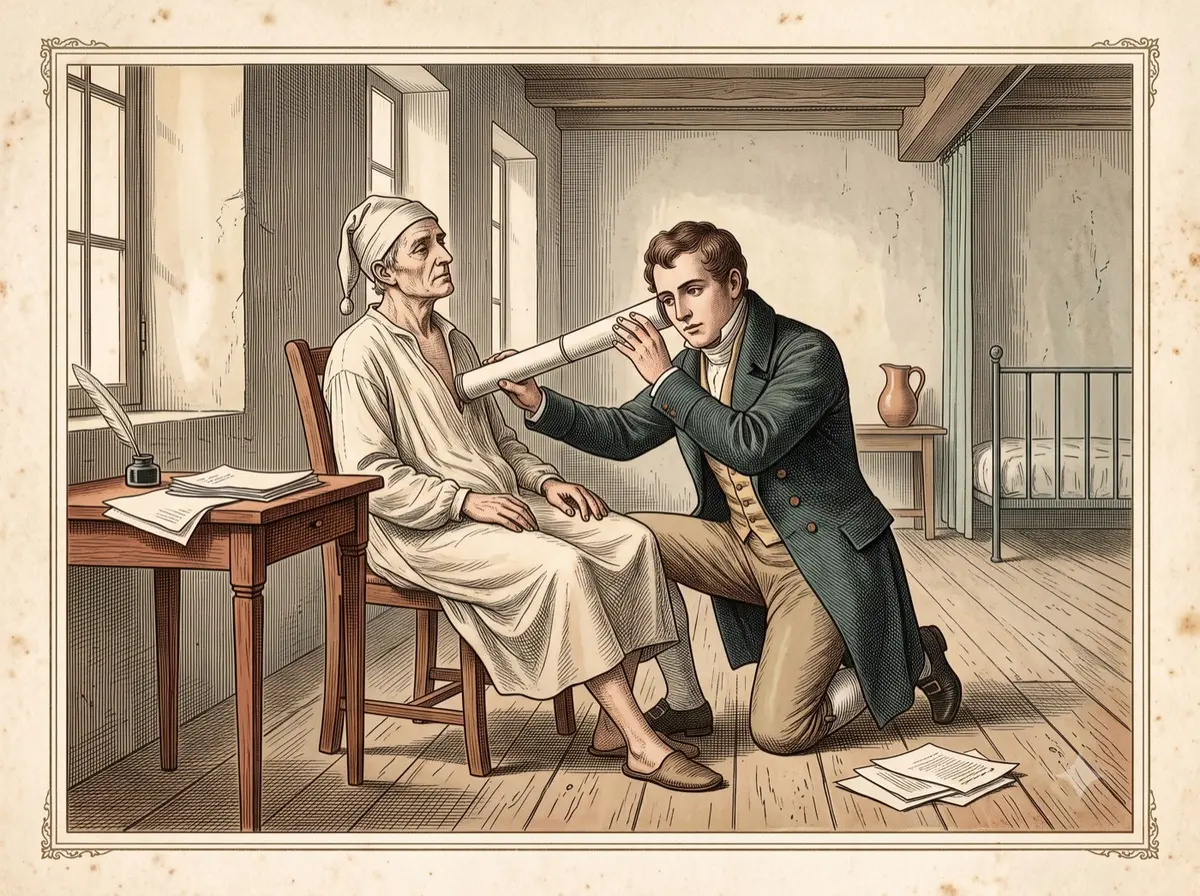
Paris, September 1816. A young, overweight woman comes to see Dr. René Laënnec at the Necker Hospital, complaining of heart trouble. The standard exam of the day is simple: the doctor presses his ear directly against the patient's chest. Laënnec can't bring himself to do it. Between her size, her age, and the plain awkwardness of the moment, he reaches instead for a sheet of paper on the table, rolls it into a tight tube, sets one end against her chest and the other against his ear — and hears her heart more clearly than he ever had by pressing his ear to a patient's skin.
By the Curiosities Desk · · 5 min read · Filed under Medicine · Today’s round
What happened: The Stethoscope
Laënnec was 35 years old and newly appointed as a physician at the Necker Hospital when this encounter took place. He’d spent his career studying under some of the leading French clinicians of the era, including Jean-Nicolas Corvisart, physician to Napoleon and a champion of percussion — tapping on a patient’s chest and listening to how the sound changed, the way you’d thump a barrel to check whether it’s full. That technique, borrowed from a Viennese doctor named Leopold Auenbrugger, had already shown Laënnec that sound could reveal what was happening inside a body without cutting it open.
Direct auscultation — pressing an ear to the chest to listen to heart and lung sounds — was the other tool available, and it was ancient; Hippocrates had described it centuries earlier. But it was a poor method in practice. Sounds were often faint and muffled, especially in heavier patients, and it put doctor and patient in an intimate, sometimes humiliating position. That was exactly the problem Laënnec faced with his patient in 1816.
In his own account of the moment, later translated into English by the physician John Forbes, Laënnec wrote that he recalled “a well known acoustic phenomenon” — that if you press your ear against one end of a wooden beam, you can clearly hear even a faint scratch made at the other end. Some biographers have added a vivid detail to this story: that Laënnec had recently watched children in the courtyard of the Louvre sending signals to each other by scratching a pin at one end of a long plank of wood and listening at the other. That anecdote appears in later biographical accounts rather than in Laënnec’s own writing, so it’s worth treating as a colorful — and plausible — embellishment rather than a confirmed fact. What’s well documented, in Laënnec’s own words, is the improvisation that followed: he rolled a sheet of paper into a cylinder, placed it against the woman’s chest, and listened.
“I was surprised and elated to be able to hear the beating of her heart with far greater clearness than I ever had with direct application of my ear,” he wrote. He immediately recognized that the method could be useful for more than just hearts — it might reveal anything in the chest cavity capable of producing sound.
Laënnec spent the next three years refining the idea, testing different tube materials before settling on a hollow wooden cylinder roughly the length of a forearm, which could be unscrewed into pieces for portability. He presented his findings to the Academy of Sciences in Paris in 1818, and in August 1819 published a two-volume treatise, De l’Auscultation Médiate ou Traité du Diagnostic des Maladies des Poumons et du Coeur (“On Mediate Auscultation, or a Treatise on the Diagnosis of the Diseases of the Lungs and Heart”). He named his invention the stethoscope, combining the Greek words stethos (“chest”) and skopein (“to examine”).
Why it was strange: The Stethoscope
The breakthrough wasn’t a new machine born of careful engineering — it was an act of social discomfort solved with whatever was on the table. And the truly odd part is that the workaround outperformed the “proper” method it was designed to avoid. Laënnec expected the paper tube to be, at best, a more polite substitute for pressing his ear to a patient’s chest. Instead, it turned out to transmit sound more clearly than direct contact ever had. A moment of embarrassment produced a better diagnostic tool than centuries of direct practice.
Another ordinary thing with a strange past: The Floor Cleaner That Taught America to Fear Its Own Breath.
What scientists learned: The Stethoscope
Laënnec called his technique “mediate auscultation” — listening to internal body sounds indirectly, through an instrument, rather than by direct ear-to-skin contact (“immediate auscultation”). Using his wooden stethoscope, he spent years cataloguing the sounds of the chest — distinguishing normal breathing from the crackles, wheezes, and murmurs of disease — and then correlating what he heard in living patients with what autopsies later revealed inside their bodies. That systematic matching of sound to underlying pathology helped lay the groundwork for modern clinical diagnosis: the idea that a disease has a signature you can detect at the bedside, before a patient dies or undergoes surgery.
Laënnec’s treatise contained some of the first clear descriptions of conditions like bronchiectasis (permanent damage and widening of the airways) and cirrhosis of the liver, and it classified chest diseases including pneumonia, pleurisy, emphysema, and tuberculosis by their distinct sounds. He also distinguished the two basic heart sounds still taught to every medical student today, though the physiological understanding of why the heart makes those sounds was still decades away.
Another object that did not start out as itself: The Strange History of the Ballpoint Pen.
How it reaches us today: The Stethoscope
Nearly every doctor’s visit still involves some version of Laënnec’s invention. His single-eared wooden tube was gradually redesigned by other physicians — a flexible earpiece here, a two-eared “binaural” version there, rubber tubing by the mid-1800s — into the shape doctors carry today. Modern stethoscopes now come in electronic and digital forms that can amplify faint sounds or even feed heart and lung audio into software for automated analysis, but the underlying principle Laënnec stumbled into in 1816 — that an instrument between doctor and patient can reveal more than direct contact — hasn’t changed. The stethoscope also became something more than a tool: draped around a doctor’s neck, it’s arguably the single most recognizable visual symbol of medicine in the world.
A close cousin: The Canned Food That Arrived 48 Years Before the Can Opener.
Fun fact: The Stethoscope
Laënnec died of tuberculosis in 1826, the same disease that had killed his mother, his uncle, and two of his own medical mentors. In his final months, he asked his nephew to listen to his own chest with the very instrument he’d invented — and heard, in his own lungs, the unmistakable sounds of the disease that was killing him. In his will, he left his nephew his scientific papers, his watch, his ring, and, as he put it, “above all, my stethoscope, which is the best part of my legacy.”
Sources: The Stethoscope
- Ariel Roguin, “Rene Theophile Hyacinthe Laënnec (1781–1826): The Man Behind the Stethoscope,” Clinical Medicine & Research, 2006 (includes translated primary-source passages from Laënnec’s 1819 treatise) — https://pmc.ncbi.nlm.nih.gov/articles/PMC1570491/
- René Laënnec, De l’Auscultation Médiate ou Traité du Diagnostic des Maladies des Poumons et du Cœur, Paris: Brosson & Chaudé, 1819 (the original treatise introducing the stethoscope)
- “René Laënnec,” Encyclopaedia Britannica — https://www.britannica.com/biography/Rene-Laennec
- “The Story of Rene Laennec and the First Stethoscope,” Past Medical History — https://www.pastmedicalhistory.co.uk/the-story-of-rene-laennec-and-the-first-stethoscope/
- Rene Laënnec biography, Lemelson-MIT Program — https://lemelson.mit.edu/resources/rene-laennec
This article touches on tuberculosis and death. If a respiratory illness in your own life is on your mind, it’s worth raising with a doctor — modern diagnosis and treatment look very different than they did in Laënnec’s era.
Related stories: The Stethoscope
- The Glow Across the Room That Let Us See Inside the Body — A glow across a darkened lab let us see inside the living body
- The Two Vacuum Cleaners That Learned to Breathe — Two vacuum cleaners became the first iron lung
- The Wrong Resistor That Grabbed a Heartbeat Out of Thin Air — A wrong resistor turned a recording device into the pacemaker