The Baby Swab Once Sold as 'Baby Gays' — Whose Box Now Begs You to Keep It Out of Your Ear
Pick up a box of Q-tips today and, somewhere on the package, you'll find a polite plea: "Do not insert swab into ear canal." It is a strange instruction for a product that generations of people bought for exactly that purpose. Stranger still, the little stick began its life in the 1920s as a baby-care product with a name nobody would put on a box now: "Baby Gays."
By the Curiosities Desk · · 5 min read · Filed under Medicine · Today’s round
What happened?
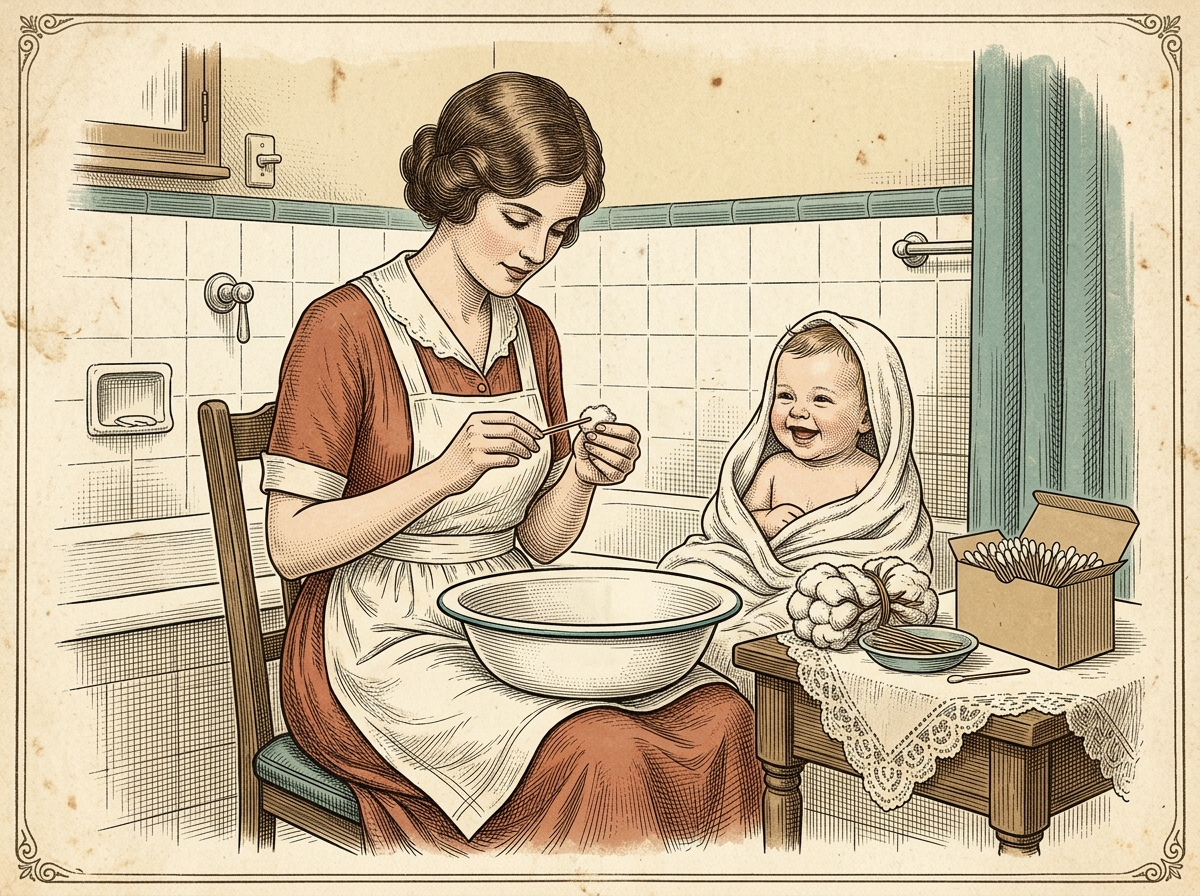
The usual origin story goes like this. In 1923, Leo Gerstenzang, a Polish-born businessman living in New York, watched his wife, Ziuta, wrap wisps of cotton around toothpicks to clean their baby daughter’s ears, nose, and eyes during bath time. He decided the world needed a ready-made version: cotton fixed firmly to a stick, sterile, and sold in a box. That kitchen scene comes from family lore and company storytelling rather than any document from the time, so it’s best enjoyed as legend.
The paper trail tells a slightly different story. A 1952 federal court decision, Q-Tips, Inc. v. Johnson & Johnson, describes a woman named Mrs. Forbis as “the first commercial producer of cotton tipped applicators.” She made them in her home and sold them as “Baby Nose-Gay.” In 1925, Gerstenzang’s company bought the rights to her patent, and that same year its packages carried the name “Baby-Gays.” In the 1920s, “gay” simply meant cheerful, and a nosegay was a small bouquet of flowers.
In 1926 the box was relabeled “Q-Tips Baby Gays.” By the mid-1930s the “Baby Gays” half had been dropped, and the company registered plain “Q-Tips” as a trademark in 1934. What the “Q” stands for depends on whom you ask. Unilever, which owns the brand today, says it stands for “quality.” The 1952 court opinion says the name was chosen so that, spoken aloud, it would sound like “cute tips.” A 2017 obituary for Gerstenzang’s daughter, Betty, offered a family version: the product was a play on “Cutie-Tips,” because she was such a cute baby.
What happened next is a story about how customers can quietly rewrite a product’s purpose. Old Q-tips boxes listed “adult ear care” among the main uses, and mid-century ads showed adults swabbing their own ears and even drying them after a swim. Later ads pitched the swabs for makeup, crafts, and household fix-ups. But the ear habit stuck.
Then, in the 1970s, under the ownership of Chesebrough-Pond’s, the boxes gained the warning against putting swabs in the ear canal. Exactly what prompted it is unclear. The company had no record of a publicized injury that triggered it; a 1990 Washington Post report guessed that something must have happened that the company didn’t want to be blamed for. By then Q-tips held roughly three-quarters of the U.S. cotton-swab market. Unilever bought the brand in 1987, and the warning stayed.
Why was it strange?
Most products come with instructions for how to use them. Q-tips come with instructions for how not to use them, aimed squarely at the use most people associate with them. As one former Unilever brand manager put it to CNN, “It was just accepted that that’s how people were using it.”
It’s also a rare case where a company’s legal team and its customers ended up in a long, polite standoff. The box says one thing; bathroom habits say another. A neurotologist, a surgeon who specializes in the ear and its nerves, told CNN that swabbing feels “almost addicting,” which helps explain why a printed warning has done so little. For another household product whose purpose drifted far from its starting point, see The Floor Cleaner That Taught America to Fear Its Own Breath.
What did scientists learn?
The surprising science is that ears mostly clean themselves. Earwax, which doctors call cerumen, is a mix of oily secretions from glands in the outer ear canal, shed skin cells, and trapped dust. It lubricates the canal’s skin and helps protect it. The skin lining the canal also grows slowly outward, a bit like a conveyor belt, carrying old wax toward the opening, where it dries and falls away on its own.
A cotton swab can work against that process. It may remove a little wax near the opening while pushing the rest deeper, packing it against the eardrum. Doctors call a hardened plug like this a cerumen impaction, and it can cause muffled hearing, fullness, or pain.
In 2017, the American Academy of Otolaryngology–Head and Neck Surgery Foundation updated its clinical guideline on earwax. It advises clinicians to tell patients that earwax is normal, that it usually doesn’t need removing, and that they should not clean their ears with cotton swabs or other small objects.
The same year, a study in The Journal of Pediatrics by researchers at Nationwide Children’s Hospital in Ohio estimated that about 263,000 children were treated in U.S. emergency departments for ear injuries involving cotton-tip applicators from 1990 through 2010 — roughly 34 a day. Ear cleaning accounted for 73 percent of the injuries, and about two-thirds of patients were under age 8. The good news: 99 percent were treated and sent home. For another everyday tool that began with a doctor improvising, see The Rolled-Up Paper That Became the Stethoscope.
How does it affect us today?
The cotton swab is now everywhere: in makeup bags, art studios, electronics repair kits, and, in a sterile form, in hospitals and labs for collecting samples. It’s one of those objects so ordinary that few people wonder where it came from.
The warning label has become a small cultural joke, but the medical advice behind it is real. Ear specialists suggest leaving the canal alone, wiping the outer ear with a washcloth, and seeing a clinician if wax causes symptoms. Single-use plastic swab sticks have also drawn environmental scrutiny, and several countries, including England, have restricted them, nudging manufacturers toward paper stems. For more on how we’ve tried to help ears over the centuries, see From a Lion-Headed Throne to the Cochlear Implant: A Short History of the Hearing Aid.
If you have ear pain, hearing changes, or a feeling of blockage, a doctor or audiologist can check your ears safely — no swab required.
Fun fact
When Johnson & Johnson started selling its own “Cotton Tips” in the 1940s, Q-Tips, Inc. sued — and a federal judge ruled in 1952 that J&J had to stop using the word “tips” as a trademark for its swabs.
Sources
- Q-Tips, Inc. v. Johnson & Johnson, 108 F. Supp. 845 (D.N.J. 1952) — https://law.justia.com/cases/federal/district-courts/FSupp/108/845/1417414
- Schwartz, S. R., et al., “Clinical Practice Guideline (Update): Earwax (Cerumen Impaction),” Otolaryngology–Head and Neck Surgery 156(1 suppl): S1–S29 (2017) — https://journals.sagepub.com/doi/10.1177/0194599816680327
- Nationwide Children’s Hospital, “Cotton Tip Applicators Are Sending 34 Kids to the Emergency Department Each Day” (2017), summarizing Ameen et al., The Journal of Pediatrics — https://www.nationwidechildrens.org/newsroom/news-releases/2017/05/cotton-tip-applicators-are-sending-34-kids-to-the-emergency-department-each-day
- “How we got addicted to using Q-tips the wrong way,” CNN Business (2022), via WTOP — https://wtop.com/health-fitness/2022/06/how-we-got-addicted-to-using-q-tips-the-wrong-way/
- Hauk, L., “Cerumen Impaction: An Updated Guideline from the AAO–HNSF,” American Family Physician 96(4): 263–264 (2017) — https://www.aafp.org/afp/2017/0815/p263
Related stories
- The Floor Cleaner That Taught America to Fear Its Own Breath — Another product whose purpose wandered
- The Rolled-Up Paper That Became the Stethoscope — An improvised tool that became medical standard
- From a Lion-Headed Throne to the Cochlear Implant: A Short History of the Hearing Aid — The long history of helping ears