The Bread Preacher Behind the Graham Cracker — and the Bakers Who Came to Mob Him
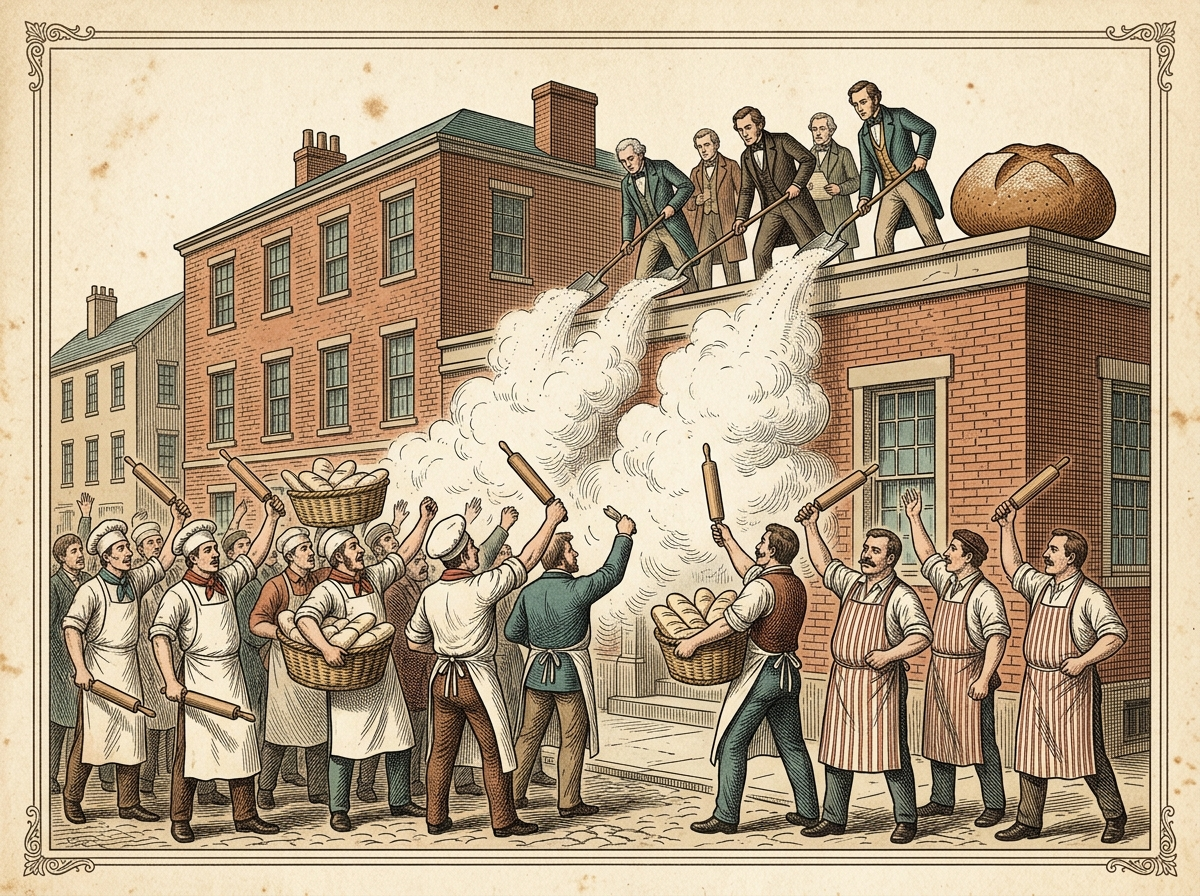
Boston, 1837. A lecturer on healthy eating is shut inside the building where he was supposed to speak. Outside, according to a story told for more than a century, an angry crowd of bakers and butchers wants a word with him. Up on the roof, his loyal followers fight back with the only ammunition they have: shovelfuls of lime, raining down on the mob. The man they're defending is Sylvester Graham, and someday his name will be printed on a box of crackers in your pantry.
By the Curiosities Desk · · 5 min read · Filed under Medicine · Today’s round
What happened?
Sylvester Graham was born on July 5, 1794, in Suffield, Connecticut. He spent his early years drifting between jobs and illnesses, studied briefly at Amherst, and was ordained as a Presbyterian minister in 1826. In 1830 he went to work for the Philadelphia Temperance Society, campaigning against alcohol. Within about six months he had left to preach something broader: that what you eat and how you live decides your health.
His timing was lucky. When cholera swept into New York in 1832, Graham lectured on how to avoid it, and reports spread that people who followed his plain regimen had fared better. Whether that was true or not, it made him famous. His followers, called “Grahamites,” opened boardinghouses in New York and Boston where residents slept on hard mattresses with the windows open, took cold baths, drank water, and ate no meat.
At the center of all of it was bread. Graham wanted it made at home, from coarsely ground whole wheat flour, bran and all. White flour, he argued, had been stripped of what made wheat nourishing. And commercial bread was worse. In his 1837 book A Treatise on Bread, and Bread-Making, he listed substances he said public bakers had used to whiten and bulk up their loaves, including alum, chalk, pipe clay, and plaster of Paris. He complained that people “eat the most miserable trash that can be imagined, in the form of bread.” The best bread, he wrote, came from a mother who watched over her bread trough with almost as much care as she would watch over the cradle of a sick child.
To be fair to Graham, he tried to soften the blow. “I have no doubt that public bakers, as a body, are as honest and worthy a class of men as any in society,” he wrote in the same book. But when your life’s work is telling people to stop buying bakers’ bread, and your vegetarian sermons tell them to stop buying butchers’ meat, you’re going to make some enemies.
That brings us back to Boston. In March 1837, Graham was scheduled to lecture at Amory Hall to an audience of women. The Boston Almanac for 1838 recorded “great excitement” at the hall, and said opponents made such a disturbance that the lecture was defeated. The more famous version of the story adds the details everyone remembers: a crowd of angry bakers and butchers, and Grahamites dispersing them by shoveling slaked lime (a caustic white powder made from limestone) down from the roof or out the windows. That version has been retold for well over a century, but the details shift between tellings. Some put it at a hotel, others at a hall; at least one reference dates it to 1847. The disturbance is documented. The rooftop lime is best treated as a colorful story that may or may not be accurate.
Why was it strange?
Food fights in history are usually about price or scarcity. This one was about a preacher’s opinions on bran. Graham was not a doctor, and his ideas about the body were a mix of real insight and guesswork. He believed that spicy, rich, or “stimulating” foods (meat, sugar, coffee, alcohol, and white bread among them) overexcited the body and stirred up lust, and that a bland diet would help keep people calm and chaste. That last idea is the reason graham crackers are often described today as a snack invented to suppress desire. There is no evidence they ever did.
Stranger still, the cracker may not be quite his. Britannica and the Connecticut Humanities’ history site credit Graham with developing graham bread and crackers around 1829. Food historian Stella Parks argues that the sweet cookie-like “grahams” were really a bakers’ product, made by the very trade he criticized. What everyone agrees on is that Graham’s own version would have been dense, unsweetened whole wheat, nothing like what goes into a s’more. For another health pioneer whose name ended up on a breakfast box, see The Box of Light Bulbs the Corn Flakes Doctor Said Cured a King.
What did scientists learn?
Graham was wrong about plenty, but he was onto something with flour. A whole wheat kernel has three parts: the bran (the fiber-rich outer layer), the germ (the oil- and vitamin-rich seed embryo), and the endosperm (the starchy core). Refined white flour keeps mostly the endosperm. Removing the bran and germ strips out much of the fiber and many of the B vitamins and minerals, which is why modern dietary guidelines recommend making at least half of your grains whole grains.
His complaints about adulterated bread also weren’t paranoid. Alum was a known additive used to whiten bread in the 1800s, and concerns like his helped build public pressure for food purity laws, eventually including the U.S. Pure Food and Drug Act of 1906. Another product whose marketing outran its medicine: The Tomato Pills That Cured Everything — and Contained No Tomato.
How does it affect us today?
“Graham flour” is still sold as a coarse whole wheat flour, and the name survives on graham crackers, which the National Biscuit Company (now Nabisco) began mass-producing in 1898. Ironically, the commercial cracker drifted toward the refined flour and sugar Graham opposed.
His broader movement left a longer trail. Grahamite ideas about vegetarianism, whole grains, and clean living fed into the American health-food tradition that later produced breakfast cereals and sanitariums. Graham himself died in Northampton, Massachusetts, on September 11, 1851, at age 57, despite having suggested his diet could help people live to a hundred. Another bathroom-cabinet product with a surprising backstory: The Floor Cleaner That Taught America to Fear Its Own Breath.
Fun fact
Not everyone took Graham seriously. Ralph Waldo Emerson called him “the poet of bran and pumpkins,” and one Northampton newspaper nicknamed him “Dr. Bran, the philosopher of sawdust pudding.”
If you’re thinking about a major change to your diet for health reasons, a doctor or registered dietitian is a far better guide than any 19th-century lecture, or any modern influencer.
Sources
- Sylvester Graham, A Treatise on Bread, and Bread-Making (1837), Project Gutenberg — Graham’s own words on whole wheat, commercial bakers, and adulterants.
- Connecticut Humanities, “Sylvester Graham: Progressive Advocate for Healthy Living” — biography, the 1829 date, the 1837 Boston disturbance, and the Emerson and “Dr. Bran” nicknames.
- Encyclopaedia Britannica, “Graham cracker” — origin and Nabisco’s mass production from 1898.
- Here & Now (WBUR), “Stella Parks on BraveTart” — the argument that bakers, not Graham, created the sweet “graham” cookie.
- “Amory Hall (Boston)” and “Sylvester Graham”, Wikipedia — used as guides to dates and the 1837 disturbance, following their citations to the Boston Almanac (1838) and Stephen Nissenbaum’s Sex, Diet, and Debility in Jacksonian America (1980).