The Floor Cleaner That Taught America to Fear Its Own Breath
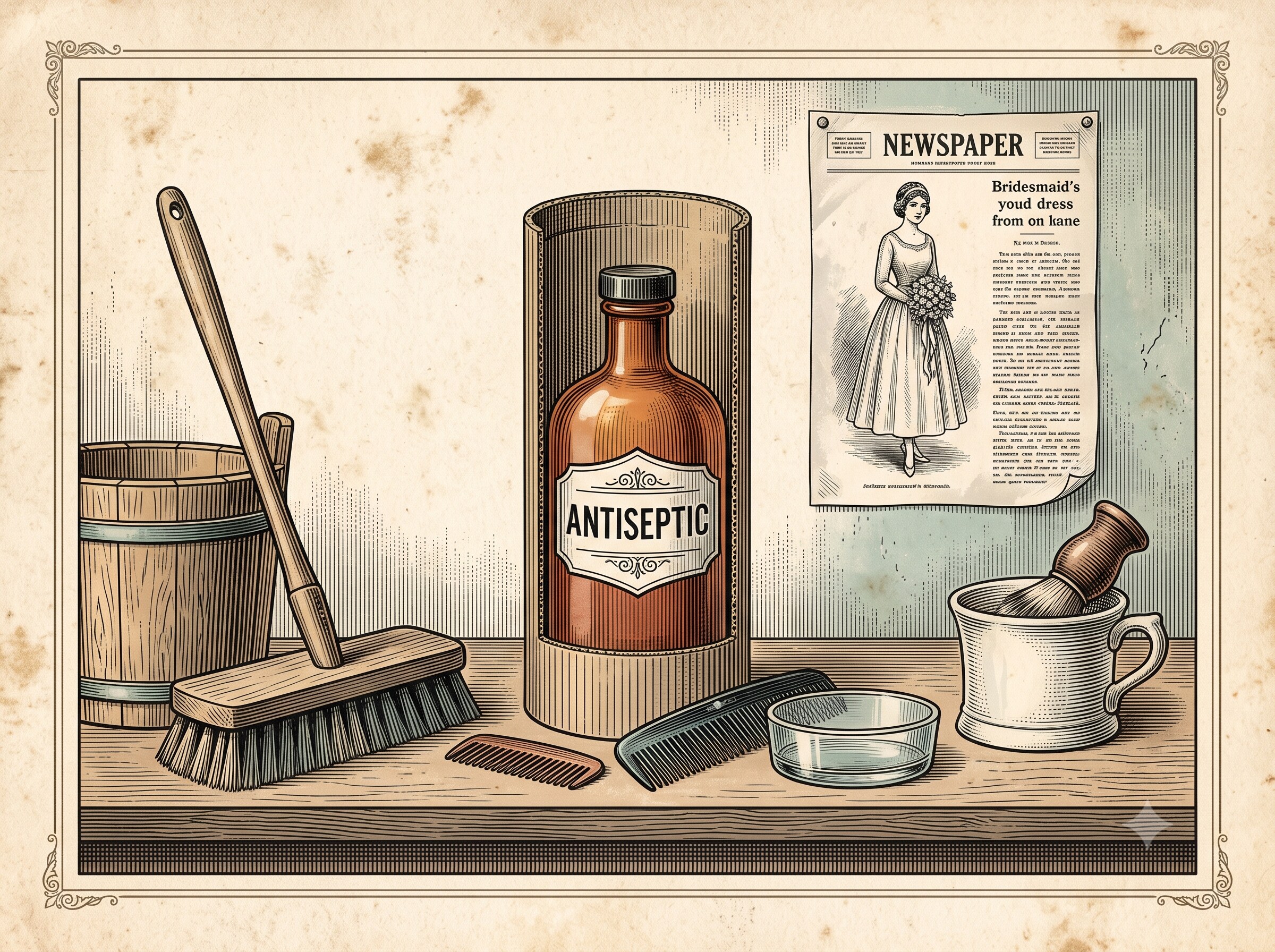
For forty years, the amber liquid in the corrugated cardboard tube was a product in search of a purpose. It had been sold as a surgical antiseptic, a floor scrub, a hair tonic, a dandruff cure, a deodorant, and a "beneficial remedy" for ailments from diphtheria to gonorrhea. Nothing quite stuck. Then, in the early 1920s, a young executive came across an obscure medical word in a clipping and asked what it meant. The word was *halitosis*. Within seven years the company's revenues had gone from roughly $115,000 to more than $8 million — and millions of Americans had started worrying about something they had barely thought about before.
By the Curiosities Desk · · 5 read · Filed under Medicine · Today’s round
What happened?
The story starts with a genuine breakthrough. In 1865, the English surgeon Joseph Lister — building on Louis Pasteur’s work on microbes — showed that treating surgical dressings with carbolic acid dramatically cut post-operative infections. Antisepsis, the practice of killing germs before they can infect a wound, was suddenly the most exciting idea in medicine.
In St. Louis in 1879, a chemist and physician named Joseph Lawrence formulated his own alcohol-based surgical antiseptic. Its active ingredients were four essential-oil compounds: thymol (from thyme), eucalyptol (eucalyptus), methyl salicylate (wintergreen), and menthol (mint). He named it Listerine, after Lister, and kept the recipe a trade secret. In 1881 he licensed it to a local pharmacist, Jordan Wheat Lambert, who founded the Lambert Pharmacal Company to sell it — under a contract that owed Lawrence and his heirs a royalty on every bottle, indefinitely.
Then Lambert’s company went looking for customers. The Smithsonian’s National Museum of American History, which holds an 1895–1906 Listerine bottle, lists the early uses plainly: surgical disinfectant, dandruff cure, floor cleaner, hair tonic, deodorant, and a remedy pitched at diseases from diphtheria and dysentery to smallpox and gonorrhea. In 1895 the company began promoting it to dentists as a way to kill germs in the mouth. In 1914 it became the first over-the-counter mouthwash sold in the United States. Sales were fine. They were not spectacular.
Jordan Lambert died in 1889, when his son Gerard Barnes Lambert was three. Gerard grew up, joined the family firm, and in 1923 became president of the merged Lambert-Warner company. In the early 1920s — the moment survives mostly through Gerard’s own later telling — he encountered the word halitosis in company material and learned it simply meant unpleasant breath.
Here is the part usually reported wrong: Lambert did not invent the word. A New York physician, Joseph William Howe, had used it back in 1874 in a book with the wonderfully blunt title The Breath, and the Diseases Which Give It a Fetid Odor. It came from the Latin halitus, breath, plus the medical suffix -osis, and had sat in dictionaries for half a century, unread.
What Lambert and his copywriter Milton Feasley did was take that dusty clinical term and put it in newspapers. The most famous of the ads featured a young woman — Edna — who kept being a bridesmaid and never a bride. A 1928 ad ran: “No matter how charming you may be or how fond of you your friends are, you can not expect them to put up with halitosis (unpleasant breath) forever. They may be nice to you — but it is an effort.”
The pitch worked with almost frightening efficiency. Under Gerard Lambert, by the Smithsonian’s account, Listerine’s profits rose roughly sixtyfold in five years.
Why was it strange?
Most products are invented to solve a problem. Listerine spent four decades as a solution rummaging through problems — floors, scalps, armpits, gonorrhea — and only became a household staple once its owners reached past the product entirely and reframed the customer.
The strangeness isn’t that bad breath is fake. It is entirely real, and people have chewed herbs and resins to mask it for thousands of years. The strangeness is the move: taking an ordinary, universal fact of having a human body, dressing it in a Latin name so it sounded like something a doctor would write on a chart, and letting the reader conclude she might be suffering from it without knowing. You cannot smell your own breath. That uncertainty was the product.
Marketing historians gave the technique its own name — the “halitosis appeal” — shorthand for selling something by first making the buyer afraid.
Another ordinary thing with a strange past: The Rolled-Up Paper That Became the Stethoscope.
What did scientists learn?
Ironically, the science eventually caught up with the sales pitch, at least partly.
Bad breath, researchers now know, is overwhelmingly a local problem — it usually starts a few centimeters inside your mouth, not in your stomach. The main culprits are anaerobic bacteria (microbes that thrive without oxygen) living in the crevices on the back of the tongue. They break down proteins from food debris and dead cells and release volatile sulfur compounds, chiefly hydrogen sulfide and methyl mercaptan — the same family of molecules behind rotten eggs and rotting cabbage. Those two account for the great majority of oral sulfur odor.
And Listerine’s four essential oils do have measurable antibacterial effects. A six-month trial published in the Journal of Clinical Periodontology in 1985 found the essential-oil rinse reduced dental plaque by roughly a fifth and gingivitis (inflammation of the gums) by a bit more than a quarter compared with a control rinse. A real, useful effect — modest, additive to brushing, and nothing like a cure-all.
Which matters, because the company kept claiming a cure-all. From 1921 into the 1970s, Listerine was advertised as preventing and relieving colds and sore throats. In 1976 the Federal Trade Commission ruled it did no such thing.
The same thread — Advertising — continues in When Doctors Recommended Cigarettes.
How does it affect us today?
That FTC ruling produced something remarkable. The Commission ordered Warner-Lambert to spend the next $10.2 million of Listerine advertising including the line: “Listerine will not help prevent colds or sore throats or lessen their severity.” The company sued, arguing the FTC had no power to make it un-say things. In Warner-Lambert Co. v. FTC (1977), the D.C. Circuit disagreed, holding the agency could order corrective advertising to dissipate the lingering effects of decades of false claims. It remains a foundational American case on truth in advertising — a doctrine that exists, in part, because of a mouthwash.
The 1881 royalty clause outlived nearly everyone involved, too. Lawrence’s heirs and later buyers of their shares have collected on Listerine bottles for well over a century; the Archdiocese of New York, the Salvation Army, the American Bible Society, and Wellesley College have all held stakes at some point, and pieces of the royalty stream were still changing hands in 2020.
And the template — name the flaw, medicalize it, sell the fix — never went away. Every ad that has ever suggested you might have a problem you hadn’t noticed is working from Edna’s playbook.
Another object that did not start out as itself: The Germ-Fighting Paper Cup Named After the Doll Company Next Door.
Fun fact
In 1927, at the height of its campaign teaching America to worry about what came out of its mouth, the Lambert Pharmacal Company briefly launched a companion product: Listerine Cigarettes.
Sources
- Listerine bottle, 1895–1906 — National Museum of American History, Smithsonian Institution (object record listing the product’s early marketed uses)
- Joseph W. Howe, The Breath, and the Diseases Which Give It a Fetid Odor (1874) — full text, Internet Archive (the book that coined “halitosis,” five decades before the ad campaign)
- Warner-Lambert Co. v. Federal Trade Commission, 562 F.2d 749 (D.C. Cir. 1977) — Justia
- Gordon, Lamster & Seiger, “Efficacy of Listerine antiseptic in inhibiting the development of plaque and gingivitis,” Journal of Clinical Periodontology 12(8): 697–704 (1985)
- Laura Clark, “How Halitosis Became a Medical Condition With a ‘Cure’,” Smithsonian Magazine (2015)
A note: persistent bad breath is usually harmless and fixable with brushing, flossing, and cleaning the tongue — but it can occasionally signal gum disease or another dental problem. If it doesn’t go away, it’s worth mentioning to a dentist rather than rinsing over it.