The Germ-Fighting Paper Cup Named After the Doll Company Next Door
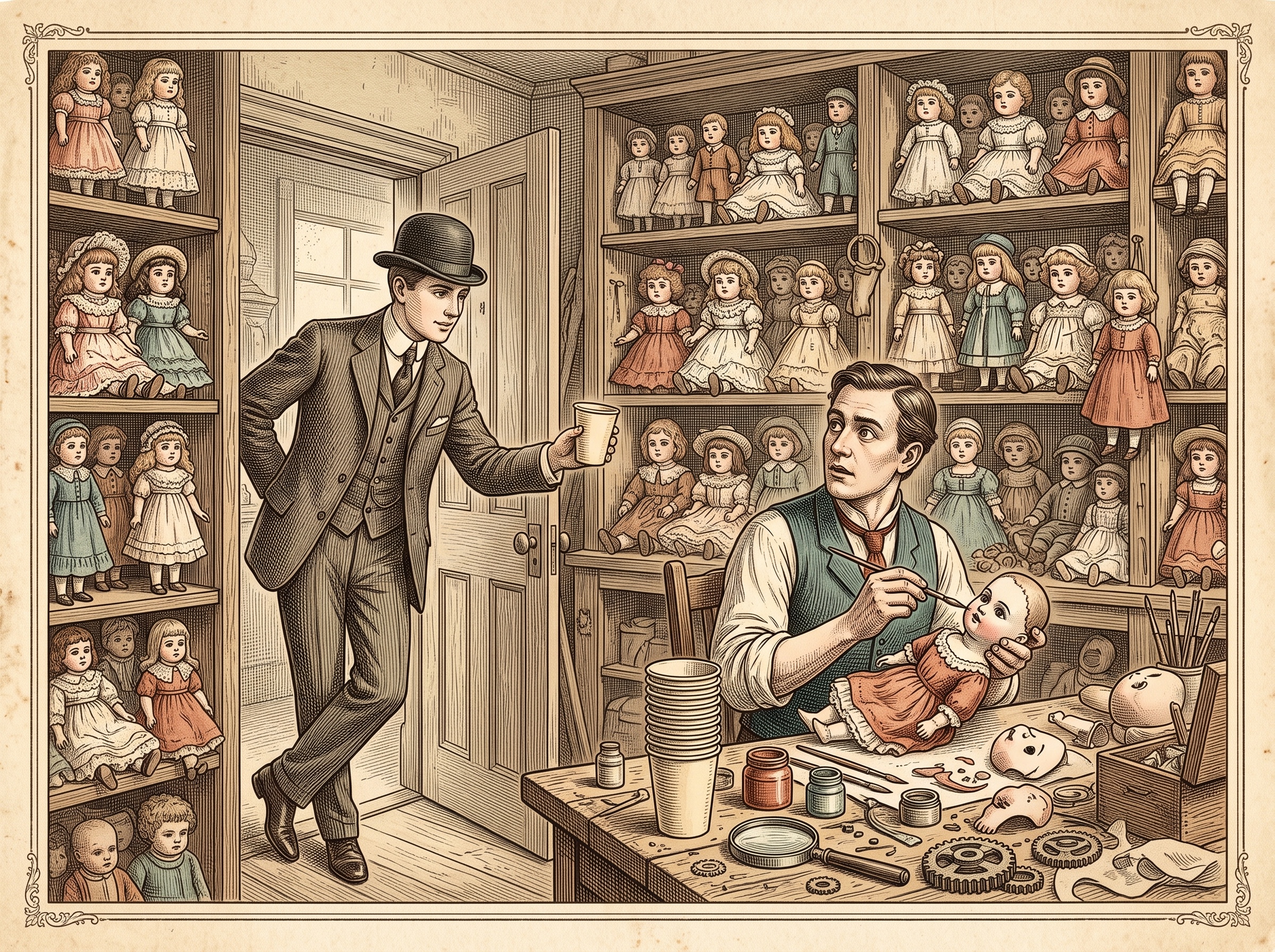
In 1919, the makers of America's most earnest public-health product had a branding problem. Their paper cup was called the "Health Kup," and a crowd of competitors was selling nearly identical cups. So Hugh Moore looked next door to his Manhattan factory, where a toymaker named Schindler ran the Dixie Doll Company, and asked if he could borrow the name. Schindler said yes. And that's how a cup built to stop tuberculosis ended up named after a line of dolls.
By the Curiosities Desk · · 5 min read · Filed under Biology · Today’s round
What happened?
The story starts in Boston in 1907, with a lawyer named Lawrence Luellen. According to the Lafayette College archive that holds the company’s papers, Luellen shared a State Street office suite with another lawyer, Austin Pinkham, whose investors wanted to sell flat-folded paper cups from a vending machine attached to a water cooler. Luellen thought the cups should come out already open, ready to drink from. By 1908 he had designed a two-piece paper cup (a rolled cone of paper with a separate bottom) and a tall white porcelain “Cup & Water Vendor”: a glass jug of water sitting on ice, a slot for used water, and a bin for tossed cups. One penny got you a cold drink in a cup no stranger had ever touched.
Luellen’s brother-in-law, Hugh Moore, a Kansas-born Harvard dropout, joined him. On April 4, 1908, Luellen and a group of investors incorporated the American Water Supply Company of New England. Then the science caught up with them.
That same year, Lafayette College biology professor Alvin Davison published an article with a title that needed no marketing department: “Death in School Drinking Cups.” Davison had studied the shared cups in the public schools of Easton, Pennsylvania, and reported them loaded with germs he tied to illnesses ranging from colds to diphtheria. The Massachusetts State Board of Health reprinted his work in 1909.
Out west, Dr. Samuel Crumbine of the Kansas State Board of Health was fighting the same enemy. As Crumbine later told the story, he was riding a train when he watched a man in the late stages of tuberculosis drink from the coach’s common cup, then saw a mother give her child a drink from the same cup without rinsing it. In 1909, Kansas became the first state to ban the common drinking cup in public places, including the tin “dipper” by the water bucket and the shared glass on trains. Other states followed.
Suddenly railroads needed a lot of disposable cups. Moore gave speeches, including one at the Pure Food Show in Madison Square Garden in 1910, and published a pamphlet called The Cup Campaigner. When he pitched New York bankers, one of them later recalled that Moore put on quite a show about the “vision of instant death on the rim of the common drinking cup.” The bankers put in $200,000, and in December 1910 the Individual Drinking Cup Company was born. By 1916, more than 100 railroads had signed contracts.
Then came the 1918 flu pandemic, and demand for single-use cups exploded — for Moore and for every competitor who had spotted the same opportunity. Moore needed his product to stand out. Next door to the company’s factory at 220 West 19th Street was the Dixie Doll Company, and the name struck him as far livelier than “Kup.” In 1919, the Health Kup became the Dixie Cup.
Sources disagree on some details. Lafayette’s archive calls the toymaker Alfred Schindler; a historian at the National Canal Museum calls him Albert. And a popular backstory says the name “Dixie” traces back to old ten-dollar notes from New Orleans marked “dix,” French for ten. That tale is widely repeated, but it’s a story about the word, not something the company records confirm as Moore’s reason.
Why was it strange?
For most of the 1800s, a shared tin cup by a water bucket was simply what drinking water in public looked like. You didn’t think about who used it before you, because there was nothing to see.
That was the real obstacle. By the 1890s, doctors had embraced germ theory, the idea that many diseases are caused by microorganisms too small to see. But plenty of ordinary people still found it hard to believe something invisible, odorless, and tasteless could make them sick. A cup that looked clean was clean.
The paper cup’s pitch flipped that logic around: the cup itself was proof of hygiene. Moore’s company later adopted the motto “We sell health.” It’s an odd thing to find at the root of the throwaway culture that followed: the single-use cup began as a medical device.
Another ordinary thing with a strange past: The Pudding Recipe That Gave Microbiology Its Favorite Jelly.
What did scientists learn?
The campaign against the common cup was part of a bigger shift in how public health worked. Instead of treating diseases after they spread, officials like Crumbine tried to break the chains of transmission, meaning the routes a germ takes from one person to the next.
Saliva is one of those routes. A shared rim collects traces of it from every drinker, and many germs travel that way, including the bacteria behind strep throat and diphtheria and viruses like those that cause colds and cold sores. It’s worth being precise about tuberculosis, though. TB spreads mainly through the air, when an infected person coughs, speaks, or sings, so the shared cup was probably a smaller risk for TB than a crowded, stuffy railcar was. Crumbine’s broader campaign reflected that, taking aim at public spitting and shared roller towels too.
Davison’s study, like much bacteriology of its day, didn’t have modern tools to prove which cup caused which illness. But the core idea it popularized has held up: when many people share one object that touches their mouths, it becomes a bridge for germs.
Another object that did not start out as itself: The Slice of Cork That Named the Cell.
How does it affect us today?
Look at any dentist’s office, water cooler, or hospital bedside and you’ll see the Dixie’s descendants. The idea that a public drinking vessel should belong to one person at a time is now so normal it’s invisible.
The company went on to sell Ice Cream Dixies (single servings with a wooden spoon, starting in 1923) and eventually merged into larger firms. Dixie is now a brand of Georgia-Pacific.
There’s a less tidy legacy too. The Dixie cup helped launch an era of single-use products, from paper towels to plastic bottles, and that success comes with the modern waste problems we’re still sorting out. The same logic that made a disposable cup a health breakthrough in 1910 now has to be weighed against landfills.
A close cousin: The Floor Cleaner That Taught America to Fear Its Own Breath.
Fun fact
When the company moved to Easton, Pennsylvania, in 1921 — the same town where Davison had tested those school cups — its factory had a water tower on the roof shaped like a giant Dixie cup.
Sources
- Company History — Hugh Moore Dixie Cup Company Collection, Lafayette College Special Collections
- How the Dixie Cup Got Its Name — National Canal Museum (Martha Capwell Fox)
- How the Deadly 1918 Flu Pandemic Brought Dixie Cups to Easton — National Canal Museum
- Samuel J. Crumbine — Kansapedia, Kansas Historical Society
- The Unnatural History of the Dixie Cup — Smithsonian Magazine