The Pudding Recipe That Gave Microbiology Its Favorite Jelly
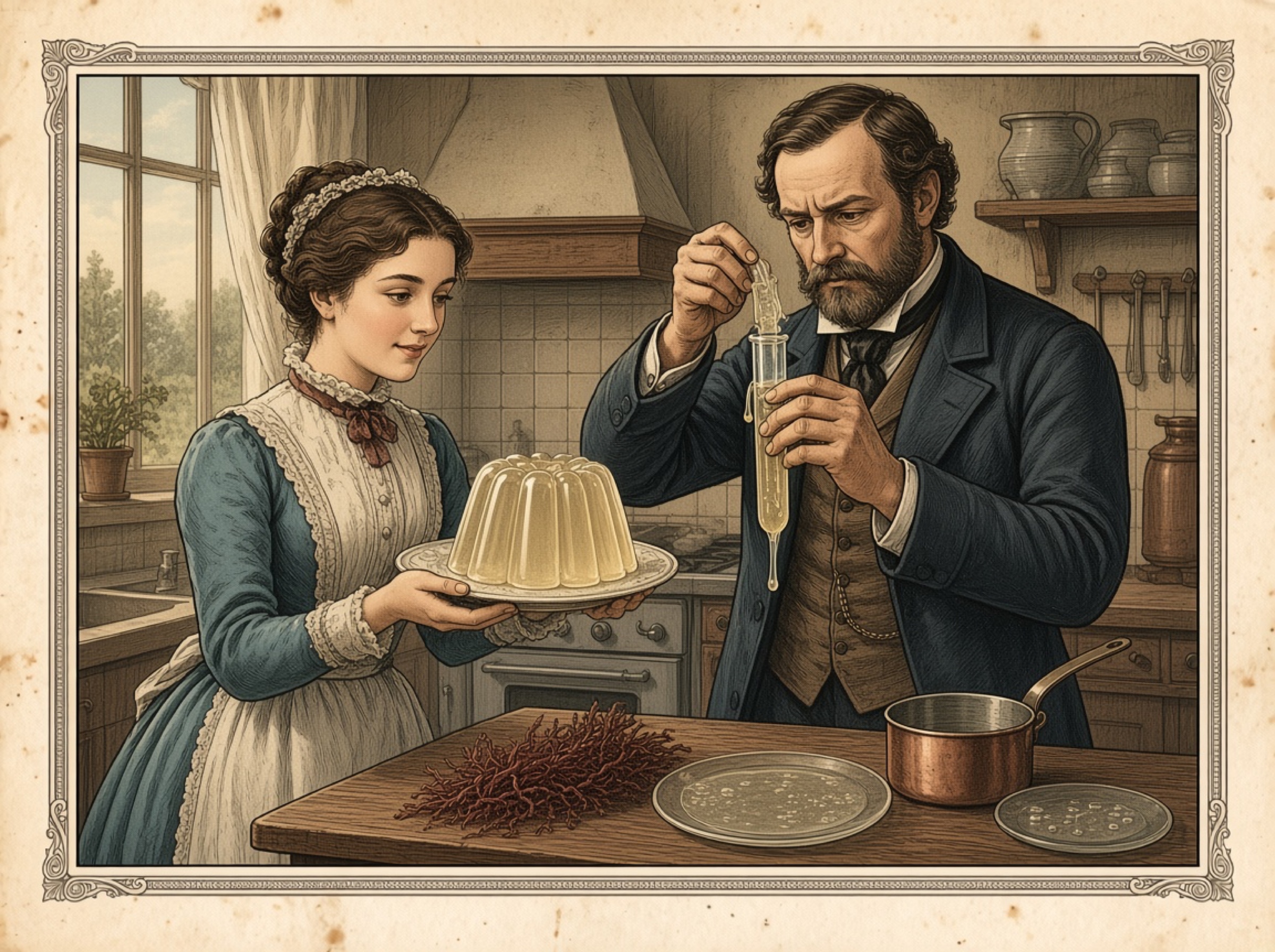
In the hot summer of 1881, near Dresden, Germany, a doctor named Walther Hesse kept losing his experiments to the weather. The gelatin he grew bacteria on turned soft and runny in the heat, and his carefully separated colonies slid together into a soupy mess. His wife, Fanny Angelina Hesse, had a better idea, and it came from her dessert recipes. She set her summer puddings with a seaweed jelly called agar, and it never melted on a warm day. Why not try it on the germs?
By the Curiosities Desk · · 5 min read · Filed under Biology · Today’s round
What happened?
Fanny Angelina Eilshemius was born in New York City in 1850 and grew up on a family estate in Kearny, New Jersey. She was not trained as a scientist. At 15 she was sent to a finishing school in Switzerland to study home economics and French, the usual education for a wealthy young woman of her day. But she learned to cook at home from her mother and the household staff. According to the Science History Institute, the family picked up a useful trick from Dutch neighbors who had come from Java (then a Dutch colony, now part of Indonesia): agar-agar, a jellying agent made from red seaweed. In Southeast Asia, it was used to set desserts that would hold up in warm weather.
In her early twenties, she married Walther Hesse, a German physician she met while he was working as a ship’s doctor. The couple settled in Saxony, near Dresden, where Walther served as a district doctor for more than 80 towns. Public health work pulled him toward the new science of bacteriology, the study of bacteria. In the winter of 1880–81, the Hesses moved to Berlin so Walther could train in the laboratory of Robert Koch, who was then hunting for the cause of tuberculosis.
Koch’s lab had a problem. To study one kind of microbe, you need a pure culture, a population grown from a single cell with no other species mixed in. The best way to get one is a solid surface, where each microbe stays put and multiplies into its own visible dot, called a colony. Koch had been using gelatin for that surface. But gelatin melts at around body temperature, which is exactly where many disease-causing bacteria grow best. Worse, many microbes digest gelatin, turning the surface into goo.
Back home in the summer of 1881, Walther was studying microbes floating in the air, and the heat made the gelatin even less reliable. This is when Fanny Angelina suggested agar. It worked. Agar stays solid far above body temperature, and almost no common bacteria can eat it. Walther wrote to Koch about the switch.
Koch’s landmark 1882 report on the tuberculosis bacterium is the first known printed mention of agar as a culture medium. He did not name the Hesses or explain where the idea came from. The Hesses never published on it either. Much of what we know comes from family papers, a 1939 history in the Journal of Bacteriology, and a 1992 account in ASM News by their grandson, Wolfgang Hesse. Many family records were likely destroyed in the bombing of Dresden in World War II, so some details of that kitchen-table moment can’t be checked today.
Fanny Angelina kept contributing in quieter ways. She painted detailed watercolors of bacterial colonies, which appeared in scientific articles published under her husband’s name. Her grandson later said she worked like a “present-day medical technologist,” a job title that didn’t exist yet.
Why was it strange?
Bacteriology in the 1880s was a race between serious men with microscopes, sterilizing ovens, and grand theories of disease. One of its most lasting tools came from a dessert.
Scientists had already tried growing microbes on almost everything edible: broths, bread, slices of potato, egg whites, blood serum, gelatin. Each failed in some way. The answer turned out to be sitting in a cookbook. Henriette Davidis’s popular 1874 German cookbook gave agar an entire chapter. The knowledge wasn’t hidden. It just lived in the kitchen, and the kitchen wasn’t where anyone expected science to happen.
There’s another oddity. Koch didn’t seem to grasp right away how important the switch was. On his 1883–84 cholera expedition to Egypt and India, he still struggled with gelatin melting in the Cairo heat.
Another ordinary thing with a strange past: The Germ-Fighting Paper Cup Named After the Doll Company Next Door.
What did scientists learn?
Agar is mostly made of two long sugar chains, agarose and agaropectin, built largely from a sugar called galactose. These chains tangle into a firm, clear gel at very low concentrations, often just 1 to 2 percent by weight.
Its secret weapon is a quirk of melting. Once set, agar gel stays solid until about 85°C (185°F). So microbiologists can melt it, mix in nutrients, pour it, and let it set into a surface that won’t sag inside a warm incubator at 37°C. It’s also clear, so you can see colonies growing, and it can be boiled to sterilize it.
That reliable solid surface made pure cultures routine. In 1887, Koch’s assistant Julius Richard Petri described a shallow glass dish with an overhanging lid. He specifically recommended it for agar plates and noted that counting colonies was easy. Agar plus Petri’s dish became the standard way to grow and identify bacteria. Looking back in 1909, Koch said the new culture methods were like keys to studying microorganisms: “Discoveries fell into our laps like ripe fruits.”
Another object that did not start out as itself: The Slice of Cork That Named the Cell.
How does it affect us today?
Nearly 150 years later, agar plates are still everywhere: hospital labs identifying the bacteria behind an infection, antibiotic sensitivity tests, food safety checks, and school science fairs. Agarose, purified from agar, is the gel scientists use to sort DNA fragments by size. Agar plating also played a role in the research that revealed CRISPR, the bacterial defense system that became a gene-editing tool.
Agar became so important that during World War II, the U.S. War Production Board restricted civilian use so the military would have enough for medical work. In Britain, Scouts, lighthouse keepers, and schoolchildren combed the coastline for agar-bearing seaweed.
Fanny Angelina Hesse, meanwhile, is finally getting credit. In 2024, a newly described bacterium was named Streptomyces hesseae in her honor. The same year, the Dutch microbiology society began giving out a Fanny Hesse Award.
A close cousin: The Grocer Who Hired Fake Shoppers to Push His Invention Around the Store.
Fun fact
The Japanese name for agar, kanten, is often translated as “cold weather” or “frozen sky,” because it was traditionally made by leaving seaweed jelly outside to freeze and thaw for weeks.
Sources
- Corrado Nai, “Fanny Angelina Hesse,” Science History Institute, Scientific Biographies (2025).
- Arthur Parker Hitchens and Morris C. Leikind, “The Introduction of Agar-agar into Bacteriology,” Journal of Bacteriology 37(5): 485–493 (1939).
- Wolfgang Hesse, “Walther and Angelina Hesse — Early Contributors to Bacteriology,” ASM News 58(8): 425–428 (1992), translated by Dieter H. M. Groeschel.
- Corrado Nai, “The Origins of Agar,” Asimov Press (2026).
- Corrado Nai, “Meet the Forgotten Woman Who Revolutionized Microbiology With a Simple Kitchen Staple,” Smithsonian Magazine (2024).