Everyday Objects · Engineering
The Grocer Who Hired Fake Shoppers to Push His Invention Around the Store
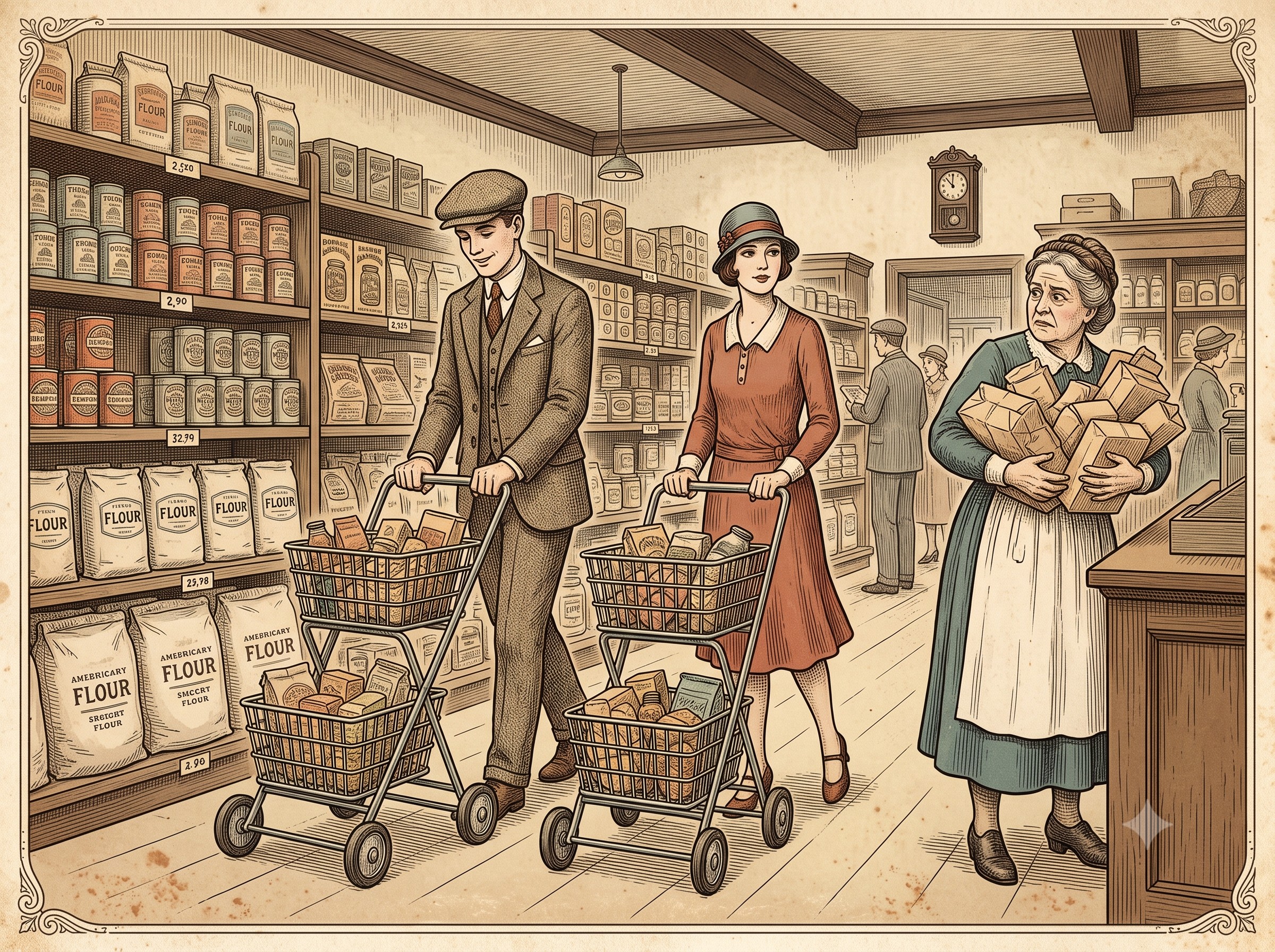
In the summer of 1937, an Oklahoma City grocer stood in his own store and watched shoppers walk straight past the wheeled baskets he had built for them, arms full, ignoring the empty carts entirely. So he hired actors. Attractive young men and women were paid to stroll the aisles pushing carts and looking perfectly comfortable about it, while real customers watched — and slowly, one by one, decided it was allowed.
By the Curiosities Desk · · 5 read · Filed under Engineering · Today’s round
What happened?
Sylvan N. Goldman owned two grocery chains in Oklahoma City, Standard Food Markets and Humpty Dumpty, and he had a problem he could measure. His stores were self-service — no clerk fetching things from behind a counter — and customers carried their purchases in handheld wire baskets. “Women had a tendency to stop shopping when the baskets became too full or too heavy,” he later said. When the basket got heavy, the sale ended. He wanted to give a shopper more capacity without taking away a free hand.
Others had tried. In the 1910s the Texas grocer Joseph Weingarten offered wheeled carriers that customers could set their baskets into; almost nobody used them. In the 1920s, the Houston store Henke & Pillot installed a raised track — about fifteen inches wide, thirty inches off the floor — along which small wheeled baskets could glide. It solved the carrying, but shoppers were now stuck in a single-file queue behind whoever was slowest.
Goldman’s version, worked out in 1936 with a handy employee named Fred W. Young, was cruder and better: a folding chair frame on casters, with a wire basket sitting where you’d sit and a rack underneath for a second one. Casters on each leg let it pivot around aisle corners. It was not elegant. Early versions had a habit of folding themselves up when they hit an obstacle, and of tipping when taken around a turn too fast. Goldman filed a patent for the “Combination Basket and Carriage” on 4 May 1937.
On 4 June 1937 he ran an advertisement in the Oklahoma City Times: “Can you imagine wending your way through a spacious food market without having to carry a cumbersome shopping basket on your arm?” That day the carts went out on the floor. (Accounts differ on which store got them first — the ad named Standard, while the Science Museum Oklahoma, which holds the original cart, ties the debut to Humpty Dumpty. Goldman owned both.)
Then almost nothing happened. Men treated pushing a cart as unmanly — trundling a wheeled basket was women’s work, or an admission you couldn’t carry your own groceries. Women, per multiple retellings, saw a baby carriage, and a great many of them had recently finished pushing one of those for real. The carts sat at the front of the store, unloved.
Goldman’s response was two-part and shameless. First, the following week he ran a second ad announcing that the “No Basket Carrying plan” had “met with instant approval last week-end,” which was flatly untrue. Second, he put people on the payroll to push carts. As the scholar Andrew Warnes puts it, Goldman “employ[ed] some actors, including, it seems, ‘manly bachelors,’ to use them around his store. This is where his real innovative contribution lay.” Shoppers who had needed permission got it, from strangers who looked like them.
It worked within weeks. By September 1937 Goldman was showing the cart at the first Super Market Convention with a promotional film aimed at store managers. He filed an improved patent on 14 March 1938 and received it on 9 April 1940 — U.S. Patent 2,196,914, “Folding Basket Carriage for Self-Service Stores.” By 1940 grocers reportedly faced a years-long waiting list, and in August of that year a double-decker cart turned up on the cover of the Saturday Evening Post. Goldman collected royalties and became very rich, not from a hard piece of engineering, but from persuading people it was fine to use it.
Why was it strange?
The cart is about as close as an invention gets to self-evident. It’s a basket. On wheels. Nothing about it needed to be explained, and its benefit was visible in a single glance. Yet it failed on first contact with the public, and it failed for reasons no engineer could have designed around: what a cart said about the person pushing it.
That’s the inversion at the heart of the story. Goldman didn’t fix his product. He fixed the audience’s read of it — and the fix was a piece of theater.
Another ordinary thing with a strange past: The Burrs Stuck to a Dog That Became Velcro.
What did scientists learn?
Later research gave a name to what Goldman had stumbled into. Social psychologists call it social proof: when we’re unsure how to behave, we look at what similar people around us are doing and copy it. The cue is strongest exactly where Goldman was standing — a public setting, an ambiguous new object, and a mild risk of looking foolish.
The pattern also fits what sociologists studying the spread of new technologies call observability and trialability — how visibly a new thing is being used by others, and how easily you can test it without committing. A cart parked by the door scores badly on both. A cart already rolling down aisle three, pushed by someone unremarkable, scores well on both at once. Goldman manufactured observability.
Researchers have kept treating the cart as a behavioral instrument ever since. In one line of work, simply drawing a partition inside a cart and labeling part of it for produce nudged shoppers to buy more fruit and vegetables.
Another object that did not start out as itself: The Wallpaper That Failed and Became Bubble Wrap.
How does it affect us today?
The cart won so completely that stores were redesigned around it. Aisles widened. Package sizes grew, because manufacturers now knew customers could haul a bulk box to the car. The weekly big shop — a car, a trunk, a fridge at home — assumes a vessel that can carry more than two arms.
The cart’s final form wasn’t Goldman’s, though. In 1946 a Kansas City inventor named Orla E. Watson designed a telescoping cart with a swinging rear gate, so carts could nest inside one another and take up a fraction of the floor space. Goldman filed a competing patent and undercut him on price; they settled out of court in June 1949, with Goldman taking an exclusive manufacturing license and Watson taking royalties. Watson’s patent, number 2,479,530, was granted that August. Nested carts by the entrance are his idea, not Goldman’s.
A close cousin: The Chemist Who Asked to Be Buried in the Pringles Can He Invented.
Fun fact
At any given moment, somewhere between 20 and 25 million shopping carts are in circulation across American retail stores — roughly one cart for every thirteen people in the country.
Sources
- Sylvan N. Goldman, “Folding Basket Carriage for Self-Service Stores,” U.S. Patent 2,196,914 (filed 14 March 1938; granted 9 April 1940) — the primary document.
- Orla E. Watson, “Telescoping Shopping Cart,” U.S. Patent 2,479,530 (granted 16 August 1949)
- National Museum of American History, “Goldman’s Folding Basket Carriage” (object record CL.302377.01) — an original ca. 1937 cart in the Smithsonian collection.
- Tricia Edwards, “Reinventing the Shopping Cart,” Lemelson Center for the Study of Invention and Innovation, Smithsonian Institution
- Ratha Tep, “How the Shopping Cart Went From Failure to Fixture,” HISTORY (2025) — includes Andrew Warnes on the hired actors and the 1937 advertisements.
- Heide Brandes, “An Industrious Grocer in the 1930s Wanted to Make It Easier for His Customers to Buy More,” Smithsonian magazine (December 2025)
Related stories
- The Canned Food That Arrived 48 Years Before the Can Opener — A solved problem waiting decades for its accessory
- The Strange History of the Ballpoint Pen — Another invention that took a patent war to settle
- The Frisbee Salesmen Who Charged a Dollar for an Invisible Wire — Selling a product by selling the story around it