Everyday Objects · Engineering
The Strange History of the Ballpoint Pen
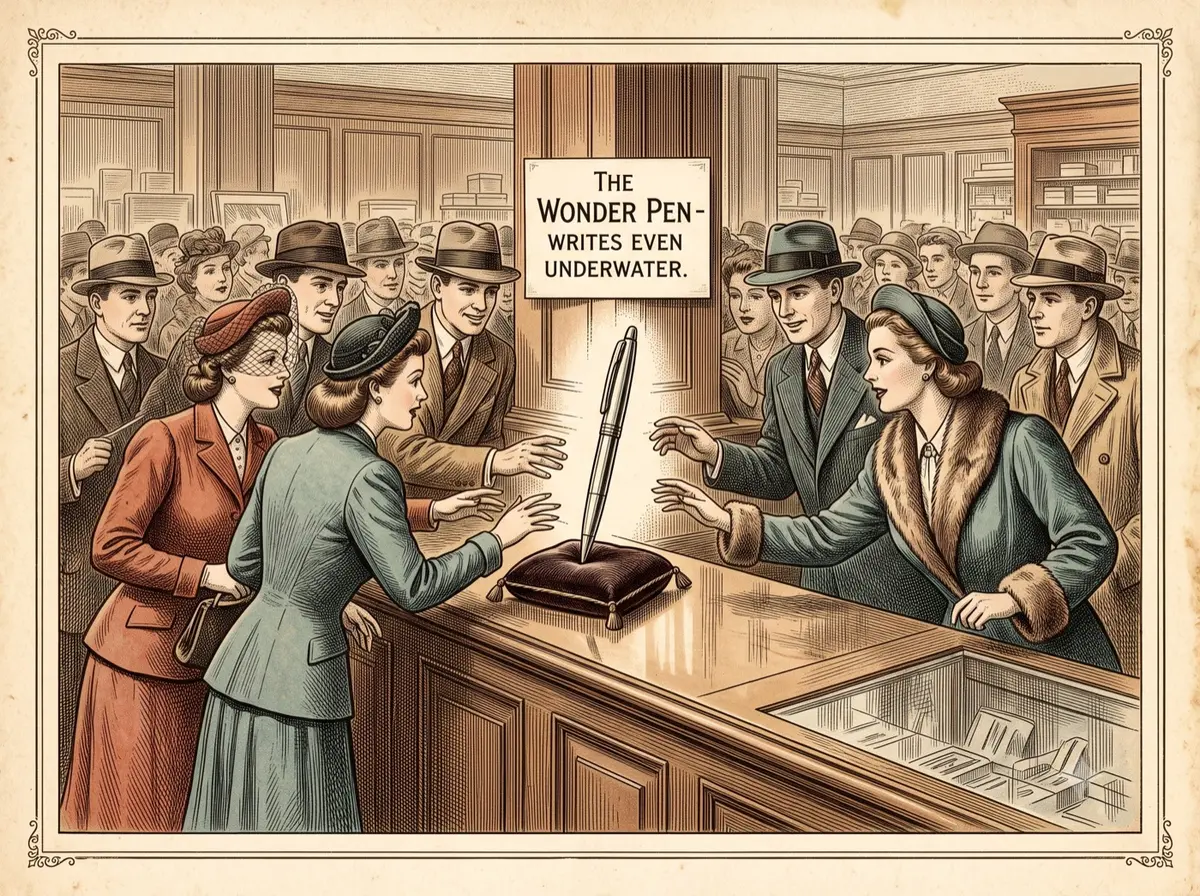
The pen in your drawer that you'd never think twice about losing was once a luxury item that drew mobbed crowds to a New York department store, sold for the equivalent of more than $200, and was marketed as a miracle that could "write underwater." Getting a tiny ball to roll ink onto paper turned out to be one of the more frustrating engineering puzzles of the 20th century.
By the Curiosities Desk · · 4 min read · Filed under Engineering · Today’s round
What happened: The Ballpoint Pen
The basic idea is old. The first ballpoint patent was issued back on October 30, 1888, to an American named John J. Loud, who wanted something that could write on rough surfaces like leather and wood — things fountain pens couldn’t handle. His pen worked for marking hides, but it was far too coarse for writing letters, had no commercial future, and the patent lapsed.
The breakthrough came from a frustrated Hungarian newspaper editor, László Bíró. Tired of constantly refilling fountain pens and blotting smudged pages, he noticed that the ink used in newspaper printing dried almost instantly and left the page clean. Why not put that kind of ink in a pen? The problem was that thick, fast-drying ink wouldn’t flow through a normal nib. Working with his brother György, who had a background in chemistry, Bíró paired a viscous ink with a tiny rolling ball in a socket — the ball picked up ink from the reservoir and rolled it onto the paper, while keeping the ink from drying out inside. He filed a British patent in 1938.
Then history intervened. In 1941 the Bíró brothers fled Europe for Argentina, where they filed a new patent in 1943 and sold a pen called the “Birome.” An American businessman, Milton Reynolds, saw it on a trip to Buenos Aires, copied the concept with enough changes to dodge the patent, and beat everyone to the U.S. market. His “Reynolds Rocket” debuted at Gimbels department store in New York on October 29, 1945, at $12.50 each — over $200 in today’s money. Gimbels sold thousands in a single week.
Why it was strange: The Ballpoint Pen
The whole challenge came down to a sphere smaller than a peppercorn. Make the ball socket too tight, or the ink too thick, and nothing reaches the paper. Make the socket too loose, or the ink too thin, and the pen leaks and smears. Early ballpoints did both — they blotched, clogged, and skipped. The very first ballpoint boom actually collapsed: sales peaked in 1946, consumers got fed up with unreliable pens, prices crashed, and Reynolds’s company folded by the early 1950s. The pen we take for granted nearly failed as a product.
Another ordinary thing with a strange past: The Grocer Who Hired Fake Shoppers to Push His Invention Around the Store.
What scientists learned: The Ballpoint Pen
Solving the ballpoint was really a problem of materials science and precision manufacturing: formulating an ink with exactly the right viscosity and drying speed, and machining a ball (often of steel or tungsten carbide) and socket to tolerances tight enough to meter ink one rotation at a time. The lesson is that a “simple” everyday object can hide decades of chemistry and engineering — the genius is in making the hard part invisible.
Another object that did not start out as itself: The Burrs Stuck to a Dog That Became Velcro.
How it reaches us today: The Ballpoint Pen
The pen was rescued by relentless refinement. In the 1950s, Frenchman Marcel Bich licensed the Bíró design, shortened his name to “Bic,” and engineered a cheap, reliable, disposable version: the Bic Cristal. It’s now reportedly the most widely sold pen in the world, with millions made every day. The ballpoint became so cheap and dependable that we forgot it was ever hard — the ultimate sign of a solved problem.
A close cousin: The Chemist Who Asked to Be Buried in the Pringles Can He Invented.
Fun fact: The Ballpoint Pen
In Britain, the ballpoint is still called a “biro” after its inventor. And one of the Reynolds Rocket’s original selling points was that it could write underwater — a gimmick, but a memorable one that helped kick off the buying frenzy.
Sources: The Ballpoint Pen
- “Ballpoint pen,” Wikipedia — https://en.wikipedia.org/wiki/Ballpoint_pen
- “László Bíró,” Wikipedia — https://en.wikipedia.org/wiki/László_Bíró
- “Bic Cristal,” Wikipedia — https://en.wikipedia.org/wiki/Bic_Cristal
Related stories: The Ballpoint Pen
- The Canned Food That Arrived 48 Years Before the Can Opener — Tinned food shipped 48 years before anyone invented the opener
- The Wallpaper That Failed and Became Bubble Wrap — Textured wallpaper flopped and became bubble wrap
- The Weak Glue That Took Six Years to Find a Job — and Became the Post-it Note — A glue that would not stick properly took six years to find a job