Everyday Objects · Engineering
The Canned Food That Arrived 48 Years Before the Can Opener
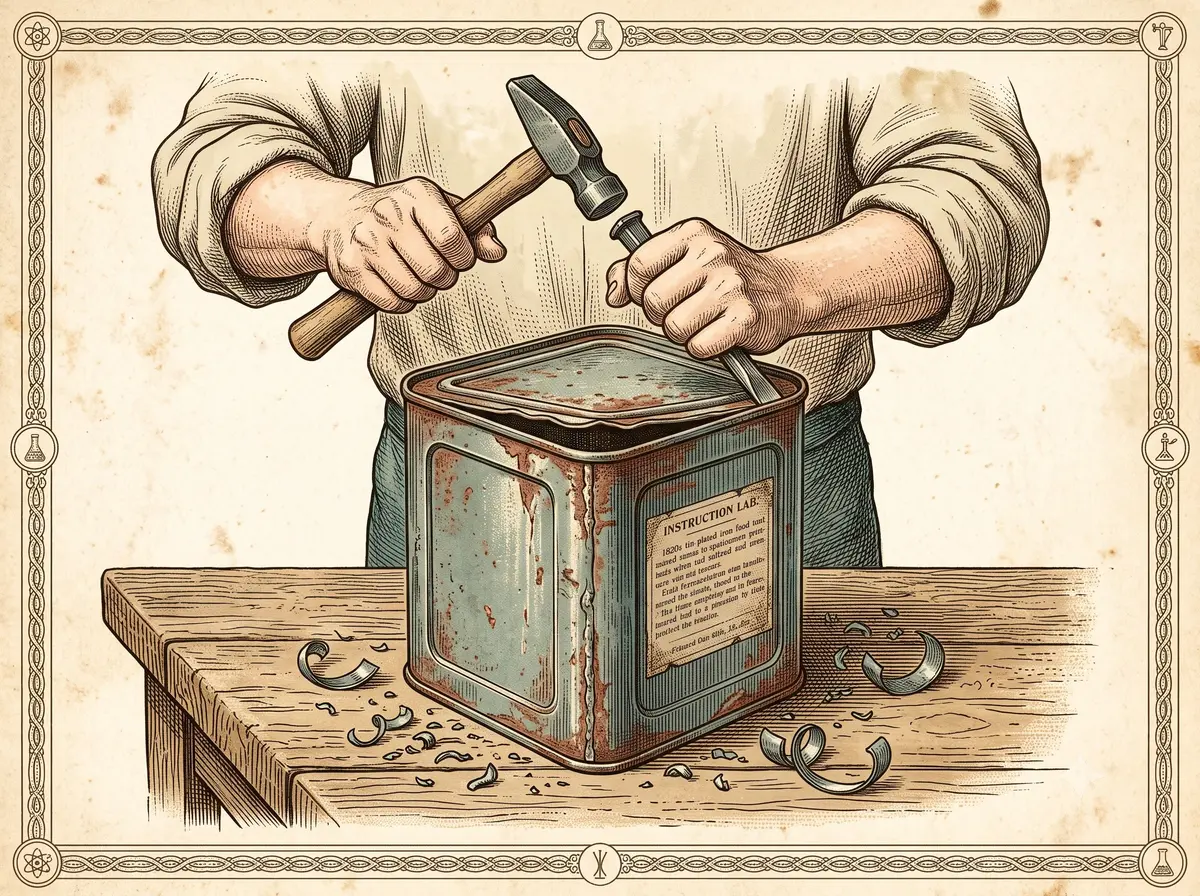
Printed on the side of the world's first commercial tin cans, where a modern label might say *peel here*, were these instructions: "Cut round the top near the outer edge with a chisel and hammer." The cans went on sale in the 1810s. A practical tool for opening them would not be patented for another four and a half decades. For nearly two generations, dinner was a carpentry project.
By the Curiosities Desk · · 5 read · Filed under Engineering · Today’s round
What happened: The Canned Food That Arrived 48 Years Before the Can Opener
The problem the can was invented to solve was armies and navies starving. In the 1790s the French government offered a prize — eventually paid out as 12,000 francs — for a reliable way to preserve food for troops on campaign. A Paris confectioner named Nicolas Appert won it in 1810 by sealing food in glass jars and heating them, then published his method as a condition of the award. He had no idea why it worked; Louis Pasteur’s germ theory was still half a century away. It simply did.
Glass, though, is a poor thing to hand a soldier. That same year, a British merchant named Peter Durand received a patent from George III for preserving food in vessels of “tin or other metals.” In 1812 the patent was bought for £1,000 by the engineer Bryan Donkin and his partner John Hall, and by 1813 they had opened the world’s first cannery, in Bermondsey, London. Their workers cut, folded, and hand-soldered sheets of tinned iron into cans at roughly six per hour.
These were not the cans in your pantry. The walls could be as thick as 3/16 of an inch, roughly five millimetres of tin-plated wrought iron, and a filled can often weighed more than the food inside it. They were built to survive a sea voyage to the Arctic, a cart ride across a battlefield, and years in a damp hold. They succeeded completely. They were also, essentially, small iron safes with soup in them.
So the instructions told you to attack. Cut round the top with a chisel and hammer. Sailors and soldiers improvised with bayonets and knives. (The often-repeated claim that troops shot cans open with their rifles is a good story, but it traces to retellings rather than to any contemporary record, so treat it as folklore.) Canned food spread anyway: by 1820 it was an established product in Britain and France, and by 1822 in the United States. Grocers often opened cans for customers at the counter, which meant that for decades a great many people ate canned food without ever owning the means to open it.
The first purpose-built opener came in 1855, when Robert Yeates — a London cutler and surgical instrument maker — devised a claw-shaped lever that hacked its way around a lid. Three years later, on 5 January 1858, Ezra Warner of Waterbury, Connecticut, patented the first American can opener: a bayonet-like point with a guard to stop it plunging into the food, plus a curved sickle blade you sawed around the rim. It left a jagged edge and it was frankly dangerous, so it never caught on in kitchens — but the U.S. Army adopted it during the Civil War, and grocery stores kept them behind the counter.
The tool you’d recognize took longer still. William Lyman of Meriden, Connecticut, patented the rotating cutting wheel in July 1870, though his version required you to first punch a hole in the center of the lid and then adjust a lever to the can’s diameter. The design that finally worked came in 1925, when the Star Can Opener Company of San Francisco added a second, serrated “feed wheel” to grip the rim and hold the lid against the cutter. That’s the opener in your drawer. It arrived 115 years after the can.
Why it was strange: The Canned Food That Arrived 48 Years Before the Can Opener
We assume invention runs downhill: solve the hard problem, and the small conveniences follow quickly. Here the hard part — sterilizing food and sealing it in metal so it stays edible for years — was solved first, and the easy part took five decades.
Nobody was being slow-witted about it. That’s the interesting bit. A hammer and chisel were already in every household and every ship’s stores, and they worked. There was no market for a specialized tool as long as the free tool did the job well enough. What eventually created the demand wasn’t a flash of insight but a change in the cans themselves: as manufacturing improved through the mid-1800s, walls got thinner and cheaper, cans reached ordinary kitchens rather than just quartermasters, and suddenly a device that cut clean rims was worth paying for. The invention waited for its market, not for its idea.
The same thread — Food History — continues in The 22-Pound Lump of 2,000-Year-Old Butter Turf Cutters Dug Out of a Bog.
What scientists learned: The Canned Food That Arrived 48 Years Before the Can Opener
Two things, on very different timescales.
The near-term lesson was metallurgical and industrial: how to make a container thin enough to open and strong enough to hold a vacuum seal. Thinner steel, machine-formed seams, and eventually the double seam — a folded, interlocked joint between lid and body — replaced hand-soldering, which mattered for reasons beyond speed. Early cans were sealed with lead solder, and lead leaching from the seams is one of the suspected contributing factors in the health collapse of the 1845 Franklin Arctic expedition, though that remains debated and other causes, including tuberculosis and zinc deficiency, have been argued from the remains.
The longer-term lesson was biological. Appert had a working process with no explanation, and for fifty years canning was a craft rather than a science. When Pasteur established in the 1860s that microorganisms cause spoilage, the guesswork became engineering: you could now calculate the temperature and time required to kill specific organisms in a specific food. That calculation is why modern canning is safe, and it’s the reason home-canning guidance is so fussy about low-acid foods, where Clostridium botulinum can survive gentler heating.
Another object that did not start out as itself: The Burrs Stuck to a Dog That Became Velcro.
How it reaches us today: The Canned Food That Arrived 48 Years Before the Can Opener
The 1925 double-wheel mechanism is still the standard — the opener in most kitchen drawers is a direct descendant of it, a century on. But the more useful inheritance is the pattern. Engineers now talk explicitly about “complementary goods” — the razor and the blade, the printer and the cartridge, the electric car and the charger. A product can be technically finished and commercially stranded because the thing that makes it usable doesn’t exist yet or isn’t cheap enough. The can spent forty-eight years as a solved problem waiting for an unglamorous accessory.
Another ordinary thing with a strange past: The Chemist Who Asked to Be Buried in the Pringles Can He Invented.
Fun fact: The Canned Food That Arrived 48 Years Before the Can Opener
A seven-pound tin of roast veal, canned by Donkin, Hall & Gamble for Sir Edward Parry’s 1824 Arctic expedition, went unopened for over a century. It was finally opened and chemically analyzed in 1937, with the results presented to the Society of Chemical Industry’s Food Group the following year; the meat was reported to be in remarkably good condition. It’s now in the Science Museum in London — a can that outlived everyone who packed it.
Sources: The Canned Food That Arrived 48 Years Before the Can Opener
- Ezra J. Warner, “Improvement in Can-Openers,” U.S. Patent 19,063 (5 January 1858) — the primary document for the first American can opener.
- William W. Lyman, “Improvement in Can-Openers,” U.S. Patent 105,346 (12 July 1870)
- Connecticut Humanities, “The First US Can Opener – Today in History: January 5”
- Esther Inglis-Arkell, “Don’t lose a finger: The 200-year evolution of the can opener,” Ars Technica (2017)
- Packaging New Zealand, “History of Canmaking” (PDF)
Related stories: The Canned Food That Arrived 48 Years Before the Can Opener
- The Strange History of the Ballpoint Pen — The pen that took decades and a patent war to work properly
- The Wallpaper That Failed and Became Bubble Wrap — Textured wallpaper flopped and became bubble wrap
- From the Everlasting Staircase to the Home Gym: A Short History of the Treadmill — A prison punishment device that became gym equipment