Science Through Time · Engineering
From the Everlasting Staircase to the Home Gym: A Short History of the Treadmill
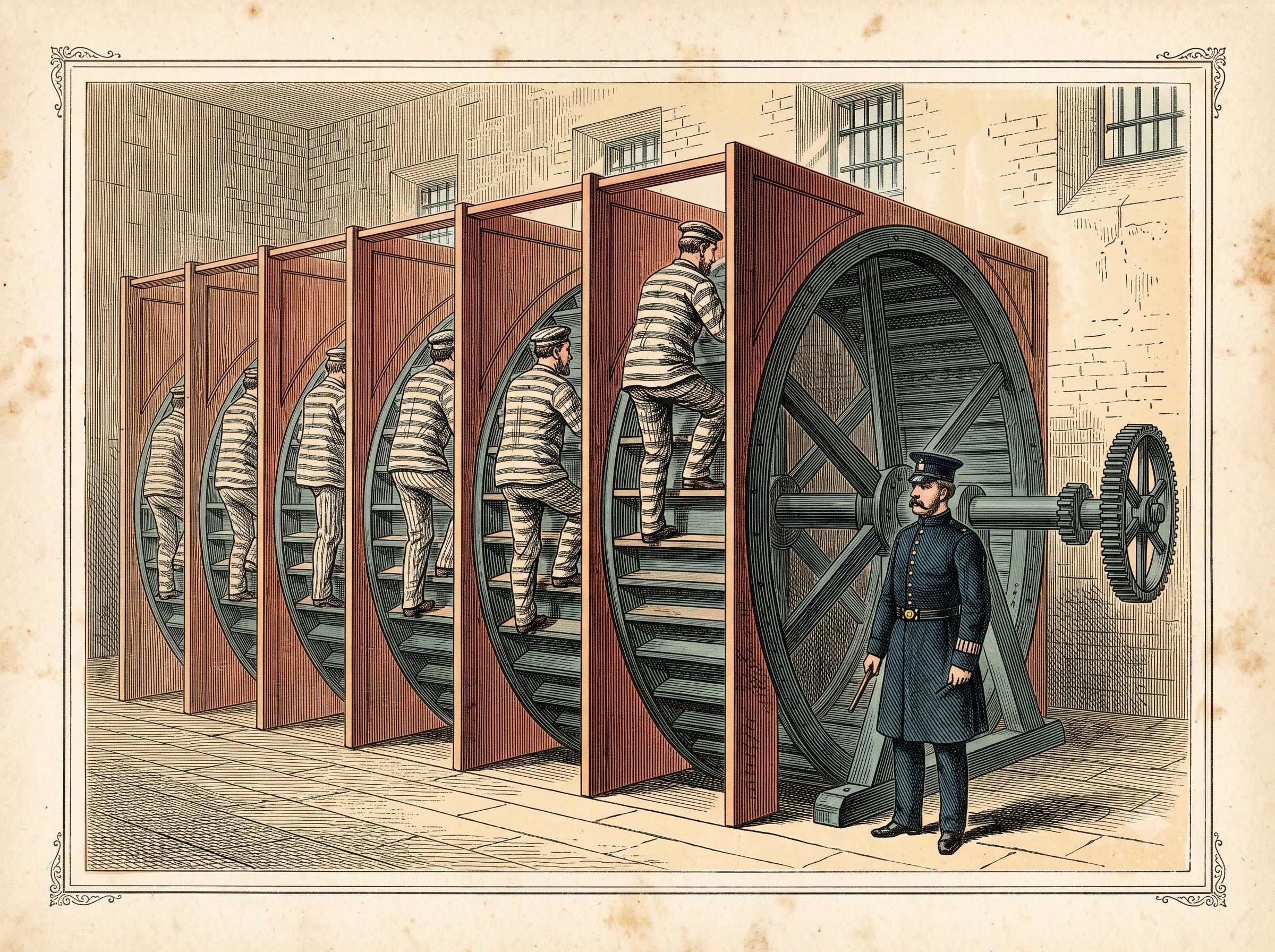
In a London house of correction around 1821, two dozen men stand shoulder to shoulder in wooden stalls, each facing a blank wall, each climbing a step that immediately sinks away beneath him. The great wheel they are climbing turns all day. At many prisons it was connected to nothing at all. There was a phrase for that: *grinding the wind*.
· 5 min read · Filed under Engineering
What happened?
Around 1817, a Suffolk magistrate asked his friend William Cubitt — an engineer at the Ransomes works in Ipswich, and the son of a miller — for help with an awkward problem. The prisoners at Bury St Edmunds Gaol had nothing to do. Sentences were short, training was expensive, and idleness offended the era’s reformers, who believed that work itself was the medicine.
Cubitt’s answer was not a new machine so much as an old one turned inside out. Treadwheels had powered cranes and mills for centuries; in a medieval version, two or three men walked inside a great wheel, like a hamster, and their weight rolled it forward. Cubitt stretched the wheel out sideways so more men could work at once, and then flipped the arrangement: he bolted wooden steps to the outside of the cylinder, so the prisoners climbed the wheel from above rather than walking it from within.
That inversion did three things at once. It let a guard see every prisoner. It turned a walk into an endless climb, which is far harder. And it made punishment measurable — every man on the wheel took exactly the same number of steps.
The machine spread with startling speed. Prototypes were running at Bury St Edmunds and at Brixton House of Correction by 1819. Britain’s leading penal reform group, the Society for the Improvement of Prison Discipline, endorsed it in the early 1820s, and by 1824 treadwheels stood in at least 54 British prisons, with more appearing in Ireland, Australia, and North America. New York City installed one in 1822.
A typical wheel was about six feet across, with steps roughly seven and a half inches apart and eighteen to twenty-five stalls partitioned so that no prisoner could see or speak to his neighbour. Men worked in shifts of roughly fifteen minutes on and five minutes off, for around six hours a day. One estimate from an American prison put the pace at about 2,500 feet of climbing per hour — a Mount Everest of stairs every few days, going nowhere.
Early reports were oddly cheerful. A Home Office inquiry concluded the wheel was good for prisoners’ health. Officials at Ipswich claimed men queued up for a turn. Women at Northallerton reportedly said the wheel beat the prison laundry.
The cheerfulness did not last. Prisoners developed hernias, lung trouble, and rheumatism; nursing mothers lost their milk supply. Badly built wheels collapsed. A missed step in a moving staircase could mangle a leg, and sometimes killed. By the 1830s most treadwheels had stopped grinding grain anyway — industrial mills did it better and cheaper — so what remained was the climbing, and only the climbing. The Prison Act of 1865 made the treadmill or the crank machine compulsory for men sentenced to hard labour. Britain finally retired the last of them in 1902, under the Prison Act of 1898.
Why was it strange?
The strangeness isn’t that a punishment device became exercise equipment. It’s that the machine was invented by a man trying to be kind.
Cubitt genuinely believed he was solving a humane problem — that idle prisoners were being wasted, and that “habits of industry” would reform them. He designed a device to produce something. Within a decade the productive part had quietly fallen away and only the suffering remained, endorsed by the same reformers who had championed it.
There’s a smaller irony stacked on top. Cubitt went on to build canals, docks, and railways, and served as chief engineer for the Crystal Palace at the Great Exhibition of 1851. Queen Victoria knighted him for that. Two centuries later, the thing his name is attached to is the machine in your gym.
What did scientists learn?
The treadwheel’s real legacy is not cruelty but measurement.
Before it, human effort was hard to compare. Cubitt’s wheel produced a standardised unit of exertion: this many steps, at this height, for this long. That is the logic of an ergometer — a device that applies a known, repeatable physical workload so that a person’s response to it can be recorded. The idea outlived the punishment.
In 1952, cardiologist Robert A. Bruce and engineer Wayne Quinton at the University of Washington built a motorised treadmill for medicine. Instead of the patient setting the pace, the belt did — speeding up and steepening on a fixed schedule while an electrocardiograph watched the heart respond. That schedule, the Bruce protocol, is still the standard cardiac stress test in hospitals today. The Victorian innovation — everyone climbs exactly the same staircase — turned out to be exactly what diagnostic medicine needed.
How does it affect us today?
The home treadmill arrived through a book. In 1968, Air Force physician Kenneth Cooper published Aerobics, arguing that ordinary people, not just athletes, should train their hearts. One reader was William Staub, a mechanical engineer in New Jersey, who went looking for a treadmill he could afford, found nothing, and built one — the PaceMaster 600, with an on-off switch designed by his son Gerald. Staub mailed the prototype to Cooper, who helped him find his first buyers. Staub died in 2012, aged 96, still using a treadmill.
So the object in the corner of the spare room has an unusually tangled family tree: a medieval crane wheel, a prison, a cardiology lab, and a paperback about jogging.
Fun fact
The Victorians nicknamed the prison treadwheel “the everlasting staircase.” In 1824, a New York prison guard named James Hardie explained why inmates dreaded it, and it wasn’t the pain: it was, he wrote, the machine’s “monotonous steadiness, and not its severity, which constitutes its terror.” Anyone who has watched the last four minutes tick down on a treadmill display knows the feeling — though not, thankfully, the rest of it.
Sources
- Rosalind Crone, “The legacy of the Victorian prison treadmill,” The Open University / OpenLearn
- Prison History Project (Open University), “Origins and legacy of the penal treadmill”
- Kat Eschner, “In the 19th Century, You Wouldn’t Want to Be Put on the Treadmill,” Smithsonian Magazine, 2017
- “Treadwheel,” Encyclopædia Britannica
- Robert A. Bruce and the origins of exercise cardiology, British Columbia Medical Journal
Related stories
- From a Sponge on a Stick to the Flush Toilet: A Short History of the Toilet — Two thousand years of sanitation, from shared sponges to the S-bend
- The Canned Food That Arrived 48 Years Before the Can Opener — Tinned food shipped 48 years before anyone invented the opener
- The Strange History of the Ballpoint Pen — The pen that took decades and a patent war to work properly