Science Through Time · Engineering
The City That Piped the Time Through Its Sewers — Until a Flood Stopped Every Clock at Once
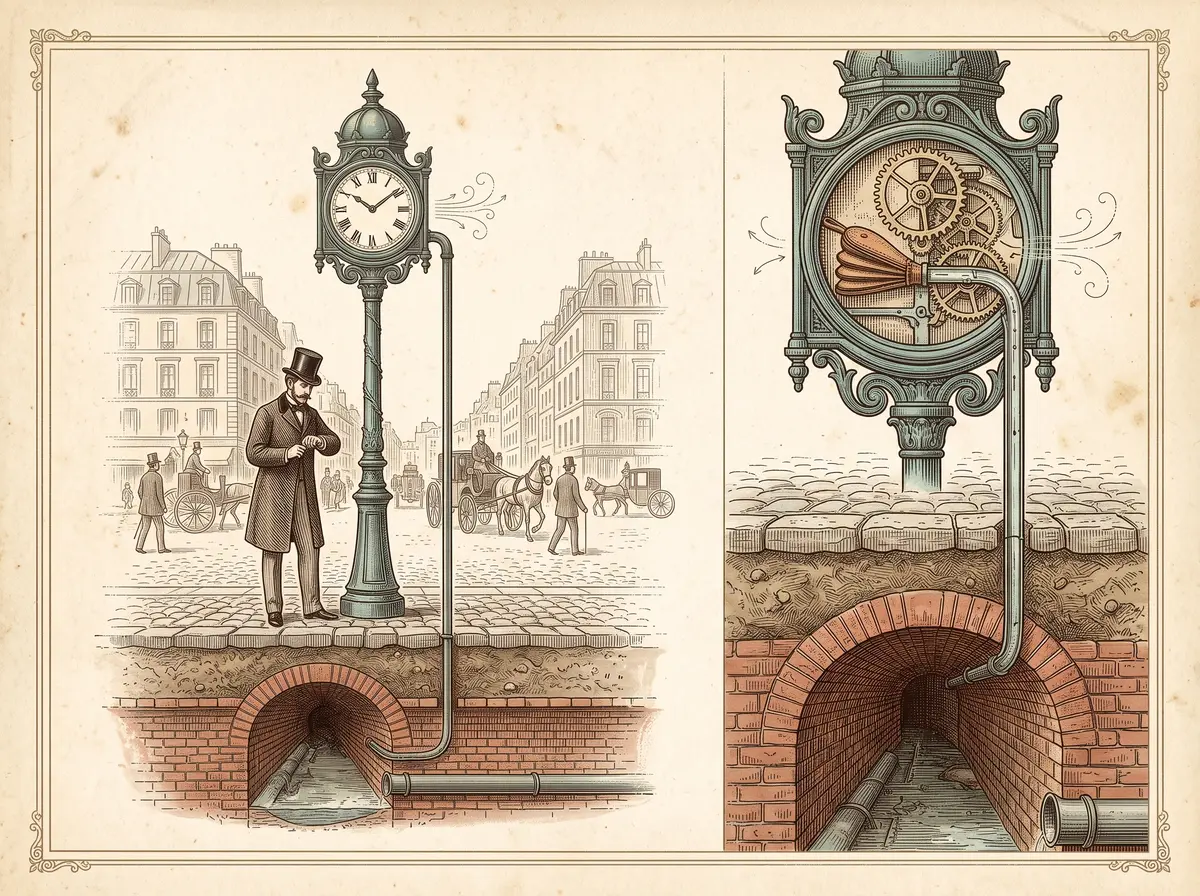
In 1880s Paris, you didn't wind your clock. You rented it, and once a minute the city breathed on it. A puff of compressed air rushed up a lead pipe from the sewers, a tiny bellows inside the clock filled like a lung, and the minute hand jumped forward one notch. All over town, on lampposts, in banks and in hotel corridors, thousands of clocks took the same breath at the same moment.
By the Curiosities Desk · · 5 min read · Filed under Engineering · Today’s round
What happened: The City That Piped the Time Through Its Sewers — Until a Flood Stopped
In the 1870s, Paris had a small but maddening problem: its public clocks disagreed with each other. A clock on one boulevard might be a few minutes off from the one on the next.
The fix came from Vienna. There, an inventor named Carl Albert Mayrhofer had worked out a way to drive many clocks from a single master clock using air pressure instead of springs or electricity. An Austrian engineer named Victor Popp and his partner Ernest Resch took up the idea, ran a public service in Vienna starting in February 1877, and won a silver medal for the system at the 1878 Paris Exhibition. Popp moved the business to Paris, where the city gave him permission to try it out.
The plan was audacious. Popp built a central plant at 7 rue Sainte-Anne, in the heart of the city, where steam engines drove compressors that squeezed air into large tanks. From there, iron pipes ran out into the city’s sewers, which already formed a ready-made tunnel network under nearly every street. Smaller lead pipes climbed into buildings to individual clocks.
At the plant, a carefully regulated master clock opened a valve once a minute and sent a pulse of air down the line. Period accounts disagree on exactly how long each puff lasted; the engineering journal Engineering gave about 20 seconds, while Popular Science Monthly said 10 to 15. Either way, the pulse traveled out through the pipes and reached each clock, where it inflated a small leather bellows. The bellows pushed a lever, the lever nudged a 60-tooth wheel forward by one tooth, and the minute hand advanced. Then the air was released, and the system waited for the next minute.
Public service began on March 15, 1880, with clocks mounted on lampposts along the grand boulevards. Nature reported that summer that the problem of giving a big city accurate, uniform time had been “all but completely solved.” Private customers could rent a dial for five centimes a day, which Nature translated for British readers as a halfpenny.
Parisians signed up fast. By the end of 1881, according to period figures gathered by historians, the network served around 750 buildings and roughly 4,000 clocks. The Hôtel Meurice alone installed 148. A visitor named Jules Albert Berly, who later described the system to an audience in London, was charmed that the clocks in Paris hotels were, as he put it, “keeping accurate time” — something he noted was “unusual with hotel clocks.” That year the city granted Popp’s company a 50-year concession to extend the service across Paris.
Then, on January 21, 1910, the Seine rose in one of the worst floods in the city’s history. Water reached the compressed-air works, the pressure failed, and the clocks stopped together. Accounts put the moment a little before 11 a.m. (sources give 10:50 to 10:53). A 1910 photograph shows one of the street clocks on the rue de Rivoli, stopped. The system was repaired and ran again, but by 1927 the clock service was shut down.
Why it was strange: The City That Piped the Time Through Its Sewers — Until a Flood Stopped
We usually think of time as something you look up, not something delivered to you. Popp’s network treated it like water or gas: a utility, piped under the street, metered and billed by the day. The clocks on your wall didn’t keep time themselves. They were just receivers, and if the air stopped coming, so did the hours.
It was also strange that air, of all things, was the messenger. Electricity was the glamorous new technology of the day, but early electric clocks could be finicky. Berly called them more “a delicate scientific instrument” than a practical everyday device. Compressed air, by contrast, was simple and sturdy, and the sewers gave it a free path to almost every door. For another case of someone selling the exact time to a city, see The Woman Who Sold London the Time From a Watch Named Arnold.
What scientists learned: The City That Piped the Time Through Its Sewers — Until a Flood Stopped
The pneumatic clocks were an early lesson in what engineers now call time distribution: keeping many devices in step by sending them a shared signal rather than trusting each one to run on its own. The trade-off is that every receiver depends on the signal. One failure at the center, like a flood at the plant, takes everything down at once.
The system also ran into a basic limit of physics. An air pulse moves through a pipe at roughly the speed of sound, a little over 300 meters per second, and it spreads and weakens as it goes. Clocks far from the plant got their nudge a moment later than clocks nearby. Writers at the time put the lag at up to about 10 seconds, small enough that for a minute hand it rarely mattered. If you like the long, strange road to knowing what time it is, try From Plato’s Night Clock to Pea Shooters at the Window: A Short History of the Alarm Clock.
How it reaches us today: The City That Piped the Time Through Its Sewers — Until a Flood Stopped
The pipes outlived the clocks. Popp’s company found that the same compressed air could do real work, and the network grew into a citywide power supply that ran machines, lifts and workshops. It was renamed several times, later operating as the Société Urbaine d’Air Comprimé, or SUDAC, and it kept supplying customers until the City of Paris ended the concession in the mid-1990s.
The deeper idea is everywhere now. Your phone sets its clock from a network signal, GPS satellites broadcast precise time to receivers around the world, and power grids and stock exchanges depend on everything ticking together. Paris in 1880 was doing the same thing with a steam engine and a lot of plumbing. For another moment when the official time suddenly changed for everyone at once, see The September That Jumped From the 2nd to the 14th.
Fun fact: The City That Piped the Time Through Its Sewers — Until a Flood Stopped
Because each clock only moved when the air arrived, a pneumatic clock’s minute hand never glided. It sat perfectly still for a minute, then hopped forward all at once, in unison with thousands of others across the city.
Sources: The City That Piped the Time Through Its Sewers — Until a Flood Stopped
- “Pneumatic Clocks,” Nature, vol. 22, pp. 226–228 (July 8, 1880): https://www.nature.com/articles/022226a0
- Norman Ball, “A question of time,” Parisian Fields (2018), drawing on Berly (1882), Scientific American (1880) and 1910 flood photographs: https://parisianfields.com/2018/03/25/a-question-of-time/
- Ville de Paris / Archives de Paris, “Victor Popp et l’horlogerie pneumatique à Paris” (lecture by historian Paul Smith, 2026): https://www.paris.fr/evenements/victor-popp-et-l-horlogerie-pneumatique-a-paris-98573
- Tristan de la Broise and Florence Meffre, Histoire de la Sudac (1877–1996), SUDAC Air Service (1996): https://www.sudac.fr/sites/g/files/dvc4171/files/document/2021/03/Livre - Histoire de la Sudac (1877 - 1996).pdf
- Douglas Self, “The Paris Pneumatic Clock Network,” Museum of RetroTechnology (summarizing Popular Science Monthly, Jan. 1882, and Engineering, June 24, 1881): https://www.douglas-self.com/MUSEUM/COMMS/airclock/airclock.htm