The Woman Who Sold London the Time From a Watch Named Arnold
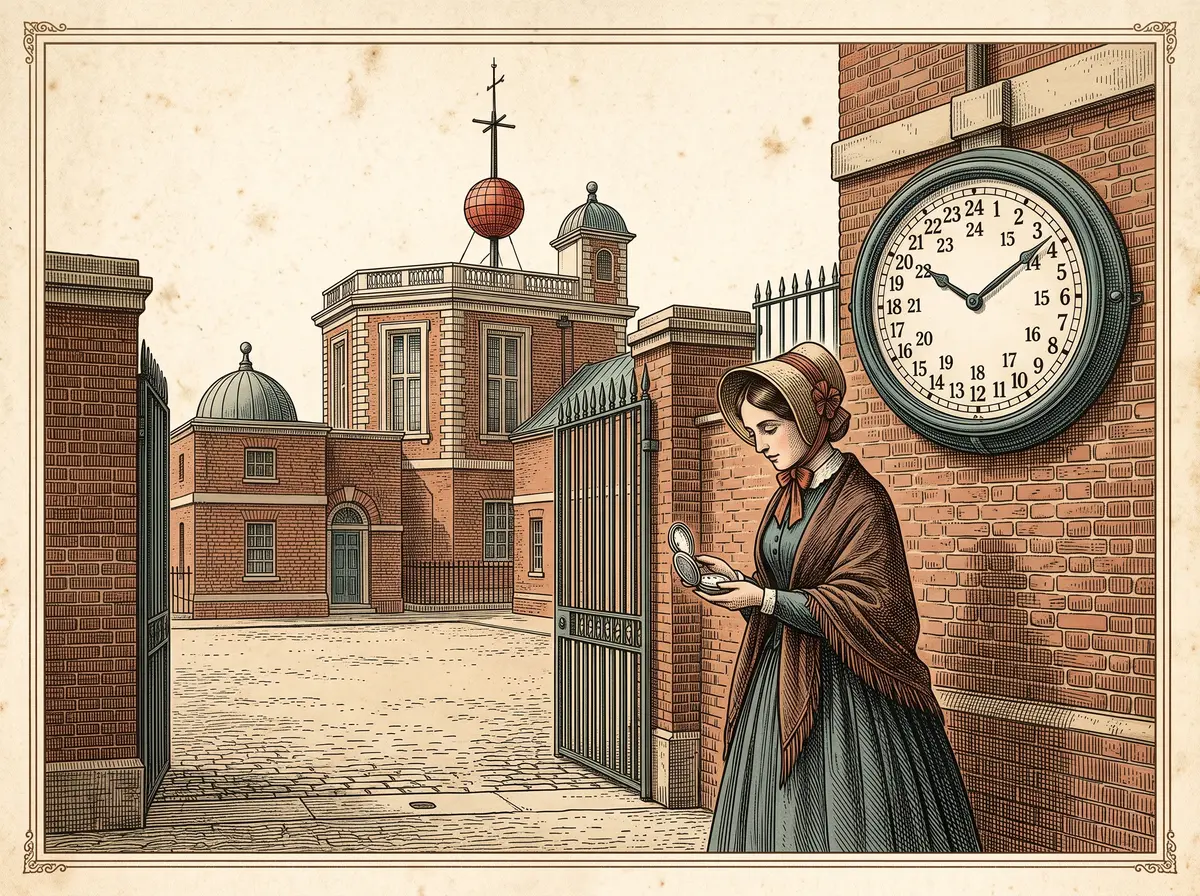
Once a week, a woman rode out to the Royal Observatory in Greenwich, had a cup of tea with the porter, and handed over an 18th-century pocket watch so it could be checked against the Observatory's standard clock. Then she carried that watch back into London and let paying customers look at it. That was the whole product. For 48 years, Ruth Belville's job was selling people the time.
By the Curiosities Desk · · 5 min read · Filed under Space · Today’s round
What happened: The Woman Who Sold London the Time From a Watch Named Arnold
The business began in 1836 with Ruth’s father, John Henry Belville, who worked at the Royal Observatory for decades under two Astronomers Royal, John Pond and George Airy. In the 1830s, getting the exact time was surprisingly hard. There were no radio signals, no telephones, and no electric time signals in central London. The Observatory had just begun dropping a large ball from a mast on its roof at 1 p.m. each day, which helped ships on the Thames, but it did little for a watchmaker in Clerkenwell who couldn’t see it.
So John Belville brought the time to them. He set his pocket chronometer by the Observatory’s clock and then made the rounds of subscribers who paid an annual fee for a regular visit. His early client list reportedly ran to about 200 customers, including clockmakers, shipping firms, and wealthy households.
The watch did the real work. It was a pocket chronometer made by the London maker John Arnold — No. 485/786, built in 1794. The family called it “Arnold.” According to the story the family passed down, it was first made with a gold case for the Duke of Sussex, who turned it down; John Belville later had it recased in silver, reasoning that a plain watch was less likely to tempt thieves.
When John died in 1856, his widow Maria asked for permission to carry on the work, and the Astronomer Royal agreed. Maria carried Arnold around London for another 36 years, until she retired in her eighties in 1892. Then their daughter Ruth, who was 38 and had been two years old when her father died, took it over.
Ruth’s routine barely changed for half a century. Once a week she traveled to Greenwich, had Arnold checked against the Observatory’s standard clock, and collected a certificate stating how far it was off. Then she walked her round of clients — in the docks, Clerkenwell, the West End, and beyond — letting each of them set their clocks by the watch in her hand. By her later years the list was down to a few dozen subscribers.
Then, in 1908, she became briefly famous for the wrong reason. St John Wynne, a director of the Standard Time Company, which sold time signals over telegraph wires, gave a speech in the City of London criticizing her service. According to accounts of the speech, he called her methods “amusingly out of date” and hinted that she was trading on her femininity to win business. The Times printed the speech without mentioning that Wynne’s company was her competitor. Reporters soon showed up at Ruth’s door. Her response, as later accounts put it, was that Wynne had given her free advertising — and her subscriber list grew.
Why it was strange: The Woman Who Sold London the Time From a Watch Named Arnold
By 1908, the technology to beat Ruth already existed. Since 1852, the Observatory’s master clock had been sending electrical signals to clocks around the country, including the Shepherd Gate Clock on the Observatory’s wall. Telegraph time services were faster and covered far more people.
But Ruth’s customers kept paying for a woman with a watch. Part of the reason was trust. Subscribers often complained that Post Office time signals were disrupted by problems on the line, while Arnold arrived in person, with a written certificate from Greenwich. In an age of new wires, a well-kept 18th-century machine and a reliable person turned out to be a competitive product.
It is a reminder that “obsolete” is not the same as “useless” — a theme across From the First Spark to the Thing You Still Use.
What scientists learned: The Woman Who Sold London the Time From a Watch Named Arnold
The time Ruth sold did not come from a clock. It came from the sky. Astronomers at Greenwich found the exact time by watching stars cross an imaginary north–south line overhead, called the meridian, through a fixed telescope called a transit instrument. Because Earth spins at a steady rate, the moment a known star crosses that line tells you the time to a fraction of a second. The Observatory then used those observations to correct its master clock.
Arnold was the bridge between that clock and London. A chronometer is a watch built to keep time steadily despite changes in temperature and motion. No chronometer is perfect, but a good one gains or loses at a predictable “rate.” That is why the weekly certificate mattered: once you knew how far Arnold had drifted and how fast, you could correct for it. The Science Museum describes the watch as state of the art for its day, accurate to about a tenth of a second.
The same problem — carrying exact time from one place to another — had already driven a famous earlier breakthrough: The Self-Taught Carpenter Who Solved the Deadliest Problem in Ocean Navigation.
How it reaches us today: The Woman Who Sold London the Time From a Watch Named Arnold
Ruth’s competitors arrived one after another. In 1924 the BBC began broadcasting the six “pips” and Big Ben. In 1936 Britain launched the speaking clock, which callers reached by dialing TIM. Ruth kept working until 1940, when, in her mid-eighties, wartime London made her rounds too dangerous. She died in December 1943 with Arnold by her bedside.
The idea she sold is still everywhere. Your phone and computer set themselves by checking in with time servers that trace back to atomic clocks, which replaced star-watching as the world’s timekeeping standard in the 20th century. Instead of a weekly visit, the check happens automatically, many times a day. Arnold itself is on display in the Clockmakers’ Museum at the Science Museum in London.
For another story about time refusing to behave, see The September That Jumped From the 2nd to the 14th.
Fun fact: The Woman Who Sold London the Time From a Watch Named Arnold
When the speaking clock launched in 1936, its voice belonged to a telephone operator named Ethel Cain — who, according to the Science Museum, lived near Ruth Belville in Croydon. The human time service and her automated replacement were practically neighbors.
Sources: The Woman Who Sold London the Time From a Watch Named Arnold
- Rooney, David. “Ruth Belville: The Greenwich Time Lady”. Science Museum Blog, October 23, 2015. (Written by the curator and author of the National Maritime Museum’s book on Belville.)
- “Ruth Belville: The Greenwich Time Lady”. Royal Museums Greenwich, 2023.
- “How did Arnold get to the Clockmakers’ Museum?”. Antiquarian Horological Society.
- Lienhard, John H. “No. 2070: Time & Ruth Belville”. The Engines of Our Ingenuity, University of Houston.
- “Ruth Belville”. Scientist of the Day, Linda Hall Library.