Science Through Time · Engineering
The Self-Taught Carpenter Who Solved the Deadliest Problem in Ocean Navigation
On a stormy October night in 1707, the flagship of a 21-ship Royal Navy fleet slammed into rock off the Isles of Scilly, certain it was still 100 miles away in open water. Within minutes it was gone, along with three more ships and, by most estimates, well over a thousand men. The fleet's admiral had asked his officers where they thought they were. They guessed wrong — because in 1707, there was no reliable way to know.
By the Curiosities Desk · · 6 min read · Filed under Engineering · Today’s round
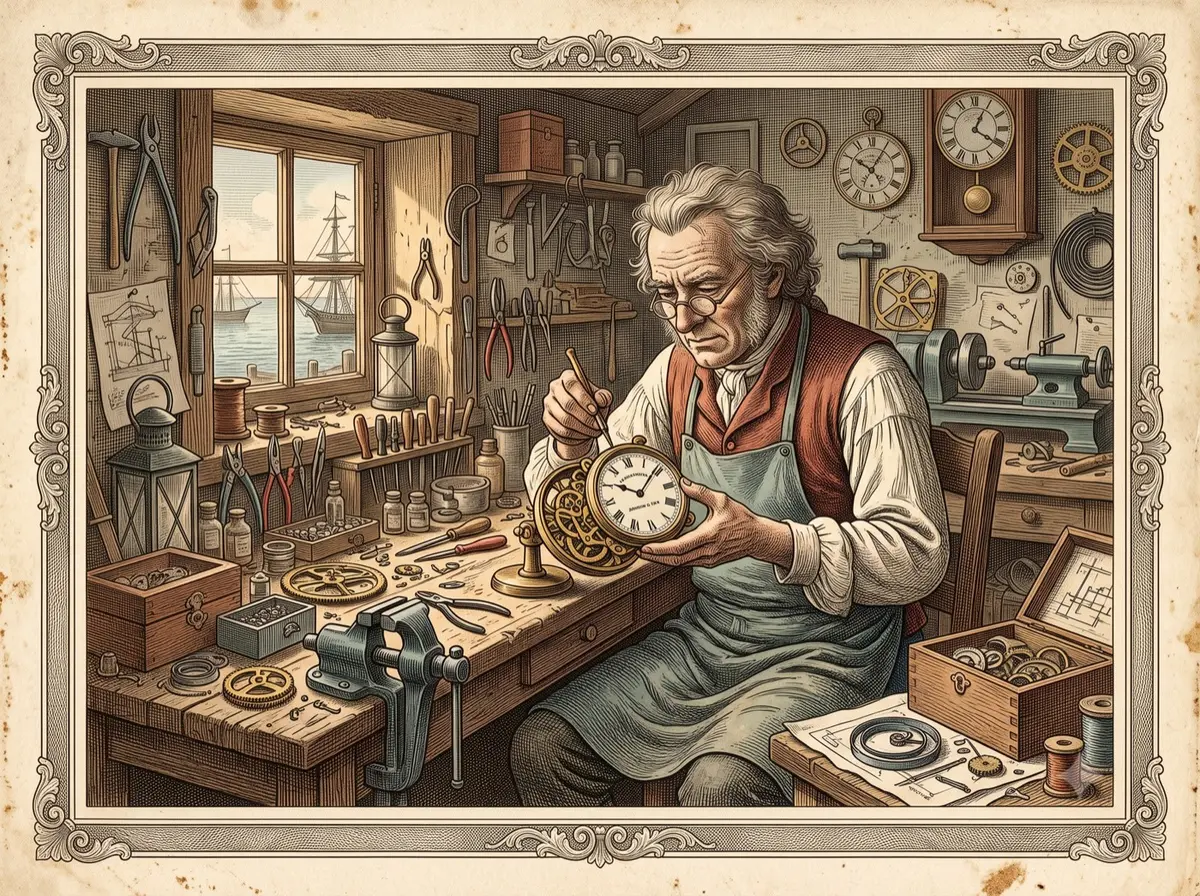
What happened: The Self-Taught Carpenter Who Solved the Deadliest Problem in Ocean Navigation
By the early 1700s, sailors could measure latitude — their position north or south of the equator — fairly easily, by tracking the height of the sun or the North Star. Longitude, the east-west measurement, was another matter. Ships estimated it through “dead reckoning”: tracking speed, heading, and elapsed time from a known starting point, then guessing. Every gust of wind, current, or measurement error compounded the mistake, sometimes by hundreds of miles.
On 22 October 1707, that guesswork caught up with a fleet returning from the Mediterranean under Admiral Sir Cloudesley Shovell. Believing they were safely west of the French island of Ushant, the ships instead sailed straight into the Isles of Scilly. Shovell’s flagship HMS Association struck the Outer Gilstone Rock and sank in minutes; HMS Eagle, HMS Romney, and HMS Firebrand went down with her. Between roughly 1,400 and 2,000 sailors died, by the Royal Navy’s own later reckoning — one of the worst peacetime losses in its history, and only a handful of men survived.
The disaster jolted Parliament into action. The 1714 Longitude Act offered a reward of up to £20,000 (several million pounds today) to anyone who could find a practical way to determine longitude at sea. Most of the era’s leading scientific minds — including Isaac Newton — believed the answer lay in astronomy: comparing the moon’s position against the stars, a method called “lunar distance,” which required precise tables and a skilled navigator with a sextant.
John Harrison thought otherwise. Longitude is really a time problem: since Earth rotates 360 degrees in 24 hours, a ship that knows the exact time at a fixed reference point (say, London) and compares it to local time — determined by observing the sun — can calculate exactly how far east or west it has traveled. Every four minutes of difference equals one degree of longitude. The trouble was building a clock precise enough to keep London time accurately through months at sea, in swinging temperatures and heaving decks, without the ship’s motion throwing off its rate.
Harrison was an unlikely candidate to solve it. Born in Yorkshire in 1693, the son of a carpenter, he had no formal training in mathematics or horology — he taught himself both, building his first wooden clocks as a young man before turning to the longitude problem in the 1720s. Over the next four decades he built a series of increasingly refined marine timekeepers — H1 through H4 — each solving new mechanical problems: compensating for temperature swings with paired metal strips that expanded and contracted differently, reducing friction with self-lubricating parts, and eventually shrinking a room-sized sea clock down to a five-inch watch.
That watch, H4, was tested on a 1761 voyage to Jamaica and lost only about five seconds over 81 days at sea — accurate enough to place the ship’s longitude within roughly a nautical mile. A second trial to Barbados in 1764 was watched by Nevil Maskelyne, an astronomer promoting the rival lunar-distance method; H4 again proved remarkably accurate. But the Board of Longitude, and Maskelyne in particular once he became Astronomer Royal, resisted crediting a clock over the establishment’s preferred astronomical approach, and stalled for years, questioning whether Harrison’s results were luck. Only after Harrison appealed directly to King George III, who tested the watch himself and pressured Parliament, did Harrison receive £8,750 in 1773 — at age 80, three years before his death. Neither he nor anyone else ever collected the Board’s full £20,000; the prize, as framed, was never formally awarded to anyone.
Why it was strange: The Self-Taught Carpenter Who Solved the Deadliest Problem in Ocean Navigation
The scientific establishment of the day — backed by Newton’s authority — was confident that timekeeping at sea was essentially impossible, and that a problem of astronomical scale had to be solved by astronomy. Instead, the answer came from a self-taught tradesman with no university education, working largely alone in a workshop, against the near-unanimous judgment of the experts evaluating him. Harrison didn’t just have to build a better clock; he had to out-argue an establishment with a professional and financial stake in a different answer, since Maskelyne’s own astronomical tables were the product he was competing against.
Another idea followed the long way: From Starving Horses to ‘Bicycle Face’: A Short History of the Bicycle.
What scientists learned: The Self-Taught Carpenter Who Solved the Deadliest Problem in Ocean Navigation
Harrison’s machines proved that mechanical precision could rival — and beat — the finest astronomical calculations available. Solving the problem meant mastering new physics of materials: how metals expand under heat, how to make gear trains that keep near-perfect time regardless of a ship’s pitching, and how to eliminate the friction and lubrication problems that had defeated earlier clockmakers. His bimetallic strip, designed to cancel out thermal expansion, remains a basic component of thermostats and circuit breakers today.
Another thread pulled across centuries: From the Everlasting Staircase to the Home Gym: A Short History of the Treadmill.
How it reaches us today: The Self-Taught Carpenter Who Solved the Deadliest Problem in Ocean Navigation
Every GPS satellite carries an atomic clock, and GPS positioning works on exactly the principle Harrison proved: if you know the precise time, you can calculate precise position. The marine chronometers that descended from Harrison’s designs became standard equipment on ships within decades, making ocean navigation dramatically safer and helping set Greenwich as the world’s reference meridian for measuring time and longitude. The basic insight — that position is, at its core, a timekeeping problem — still underlies how the modern world locates itself.
A close cousin: From a Cargo of Melting Ice to the Kitchen Fridge: A Short History of Refrigeration.
Fun fact: The Self-Taught Carpenter Who Solved the Deadliest Problem in Ocean Navigation
Local legend holds that Admiral Shovell washed ashore alive after the wreck, only to be murdered on the beach by a woman who wanted his emerald ring — a story supposedly confessed on her deathbed thirty years later. Historians are skeptical: there’s no contemporary evidence, and it contradicts accounts that his body was recovered with valuables intact. A vivid tale, but by this site’s own standard, one to file under legend, not fact.
Sources: The Self-Taught Carpenter Who Solved the Deadliest Problem in Ocean Navigation
- John Harrison, Wikipedia
- Scilly Naval Disaster of 1707, Wikipedia
- How Did the Sinking of a Ship in 1707 Lead to the Invention of the Marine Chronometer?, Historic England
- Cloudesley Shovell, Wikipedia
A note: this story opens with the real loss of well over a thousand sailors in a single night. That disaster is what pushed Britain to fund a solution — and Harrison’s clock helped make ocean travel far safer for everyone who came after.
Related stories: The Self-Taught Carpenter Who Solved the Deadliest Problem in Ocean Navigation
- The Cylinder in a Paris Vault That Defined the Kilogram — Until It Started Losing Weight — The cylinder that defined the kilogram, until it mysteriously slimmed
- The September That Jumped From the 2nd to the 14th — The year Britain skipped eleven days overnight
- The Astronomer Who Spent Eleven Years at Sea to Watch Venus Cross the Sun — and Missed It Anyway — Eleven years at sea to watch Venus cross the Sun, and then clouds