The Astronomer Who Spent Eleven Years at Sea to Watch Venus Cross the Sun — and Missed It Anyway
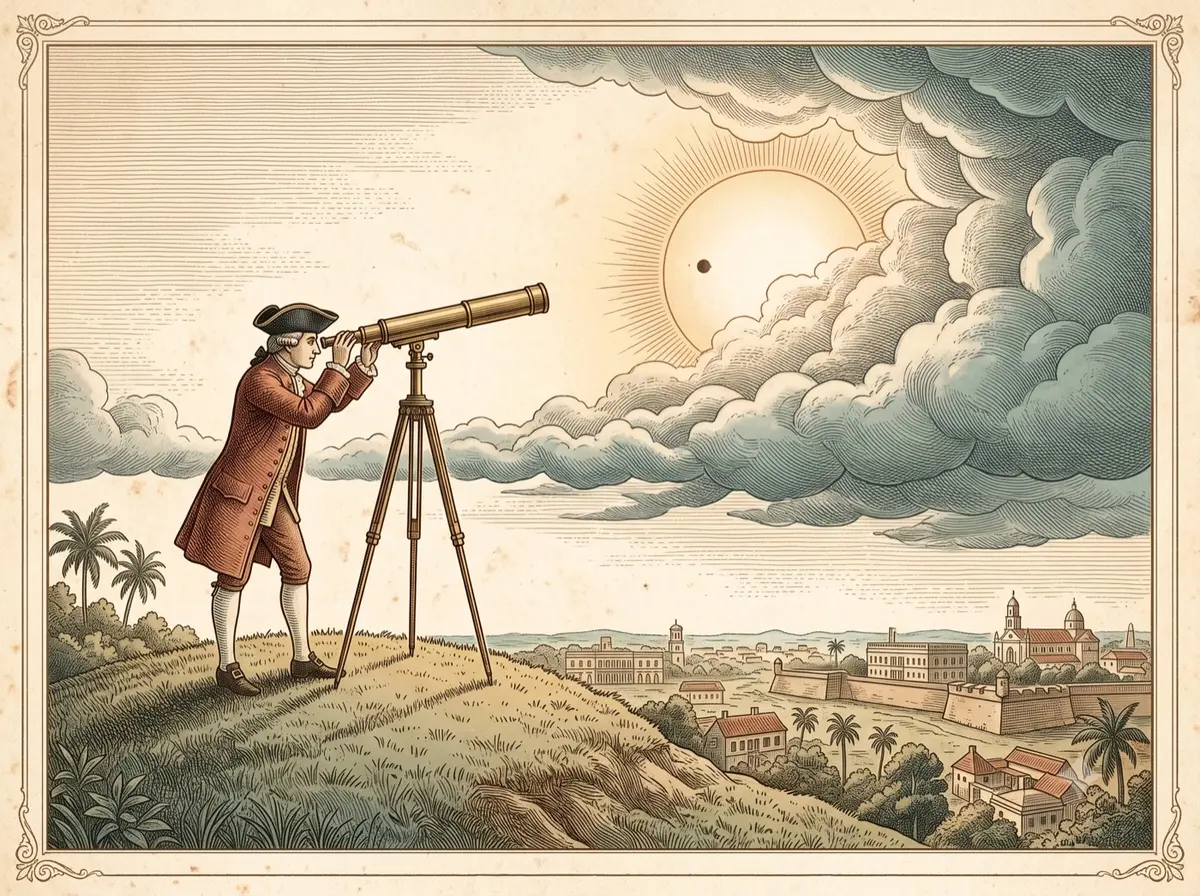
On the morning of June 4, 1769, French astronomer Guillaume Le Gentil climbed a hill outside Pondicherry, India, and pointed his telescope at the sun. He had left Paris eight years earlier for exactly this morning: the second of a once-in-a-lifetime pair of transits, when the planet Venus would cross the sun's face as a small black dot. He had already missed the first one, in 1761, stuck on a rolling ship at sea. This time the sky had been clear for weeks. Then, on the one morning it mattered, clouds rolled in and sat over the sun for the entire transit. Le Gentil didn't just lose a measurement. He was about to lose almost everything else, too.
By the Curiosities Desk · · 5 min read · Filed under Space · Today’s round
What happened: The Transit of Venus
Transits of Venus are rare because Venus’s orbit is tilted a few degrees relative to Earth’s, so the two planets and the sun line up perfectly only in pairs eight years apart, separated by gaps of more than a century. The first person known to have predicted and observed one was Jeremiah Horrocks, a self-taught English astronomer who, in 1639, corrected an error in Johannes Kepler’s planetary tables and realized a transit was coming that Kepler himself hadn’t foreseen. Horrocks, only about 20, watched it by projecting the sun’s image through a telescope onto a screen, sharing the moment with one friend, William Crabtree, in another town. As far as anyone knows, they were the only two people on Earth who saw it.
Nearly eighty years later, the astronomer Edmond Halley — already famous for the comet — realized the transits could do more than confirm Venus was there. If observers stationed far apart on Earth timed the transit precisely, the tiny difference in Venus’s path across the sun, seen from each location, could be used to calculate the distance from Earth to the sun: the astronomical unit, the basic yardstick for the entire solar system. In 1716, Halley published detailed instructions for astronomers who hadn’t been born yet, knowing he would be long dead before the transits of 1761 and 1769 arrived to test his method.
Those two transits triggered what’s often considered the first coordinated international scientific effort. More than 100 observers were sent to over 60 locations — Siberia, South Africa, Newfoundland, Tahiti — even as the Seven Years’ War made some of the voyages genuinely dangerous. Charles Mason and Jeremiah Dixon (yes, the pair who later surveyed the Mason-Dixon line) were attacked by a French warship on their way to observe the 1761 transit from Sumatra and ended up watching from the Cape of Good Hope instead.
Le Gentil’s own trip became a small epic of bad luck. Sailing for Pondicherry in 1761, he was still at sea when the transit occurred, and rolling waves made a precise observation impossible anyway. Rather than sail home, he decided to wait eight years for the next one, eventually settling in Pondicherry. The sky stayed clear for the weeks leading up to June 4, 1769 — and clouded over for the roughly two hours and forty-six minutes it took Venus to cross the sun. Le Gentil finally returned to Paris in 1771, eleven years after he’d left, to discover he had been declared legally dead, his relatives had divided his estate, and his seat at the Royal Academy of Sciences had been given to someone else. It took a lawsuit and the king’s intervention to get his life back.
Not everyone struck out. On Tahiti, James Cook’s expedition aboard HM Bark Endeavour — carrying astronomer Charles Green and naturalists Joseph Banks and Daniel Solander — built a small fortified observatory at a spot they named Point Venus and observed the 1769 transit under a cloudless sky. But even successful observers ran into a strange optical problem: as Venus’s silhouette touched the inner edge of the sun, it appeared to smear into a dark teardrop still connecting it to the sun’s rim, making it hard to pin down the exact instant of contact. Astronomers later named this the “black drop effect,” now understood to result from a mix of atmospheric blurring and the way telescopes handle sharp contrast in light.
Why it was strange: The Transit of Venus
For something as fundamental as the actual size of the solar system, the best available method was to wait for a rare planetary alignment, send wooden ships loaded with delicate brass telescopes to the far corners of the globe, and hope for clear skies on one specific afternoon. A cloud, a war, or an ocean swell could erase years of preparation. Stranger still, this fragile, weather-dependent project became one of the first times nations that were often at war with each other coordinated their scientists toward a shared goal — decades before international science collaboration was a recognized idea at all.
Another idea followed the long way: From a Pilot Cut Out of His Own Suit to Moonwalks Sewn by a Bra Company: A Short History of the Spacesuit.
What scientists learned: The Transit of Venus
Observers in different locations saw Venus trace a slightly different line across the sun’s disk, because they were viewing it from a different angle — the same effect that makes a nearby object seem to shift against a distant background when you look with one eye and then the other. By timing the transit’s start and end from widely separated latitudes and comparing the tiny angular differences, astronomers could use trigonometry to calculate real distances. In 1771, using data gathered from dozens of expeditions around the world, French astronomer Jérôme Lalande calculated the astronomical unit at roughly 153 million kilometers — within about two percent of the true value of 149.6 million kilometers. For the first time, humanity had a working ruler for the solar system, and from it, the actual distances to every other known planet.
Another thread pulled across centuries: From a Wet Spacesuit to a $23 Million Toilet: A Short History of the Space Toilet.
How it reaches us today: The Transit of Venus
The astronomical unit is still the base measurement astronomers use for distances within the solar system, now refined to the meter using radar and spacecraft tracking. But the more surprising legacy is Halley’s method itself: the same basic idea — watching a small object cross in front of a larger, brighter one and timing the dip in light — is exactly how NASA’s Kepler and TESS space telescopes have found thousands of planets orbiting other stars. A dip in a star’s brightness, timed precisely, still tells us something is passing in front of it. (Cook’s voyage also carried separate, secret orders to search for a hypothesized southern continent, and the same expedition went on to chart New Zealand and Australia’s eastern coast — a reminder that the transit expeditions became entangled with the colonial ambitions of the era in ways well beyond astronomy.)
A close cousin: The Element Discovered on the Sun 27 Years Before Anyone Found It on Earth.
Fun fact: The Transit of Venus
Le Gentil eventually recovered his Academy seat, remarried, and lived out his life in France — but the transit that ruined his decade wasn’t observed again by anyone until 1874. The next transits of Venus won’t occur until 2117 and 2125.
Sources: The Transit of Venus
Related stories: The Transit of Venus
- The Astronomer With a Metal Nose and a Beer-Drinking Elk — A gold nose, a private island, and a beer-drinking elk
- The September That Jumped From the 2nd to the 14th — The year Britain skipped eleven days overnight
- The Element Discovered on the Sun 27 Years Before Anyone Found It on Earth — Helium was found in sunlight 27 years before anyone found it here