From a Wet Spacesuit to a $23 Million Toilet: A Short History of the Space Toilet
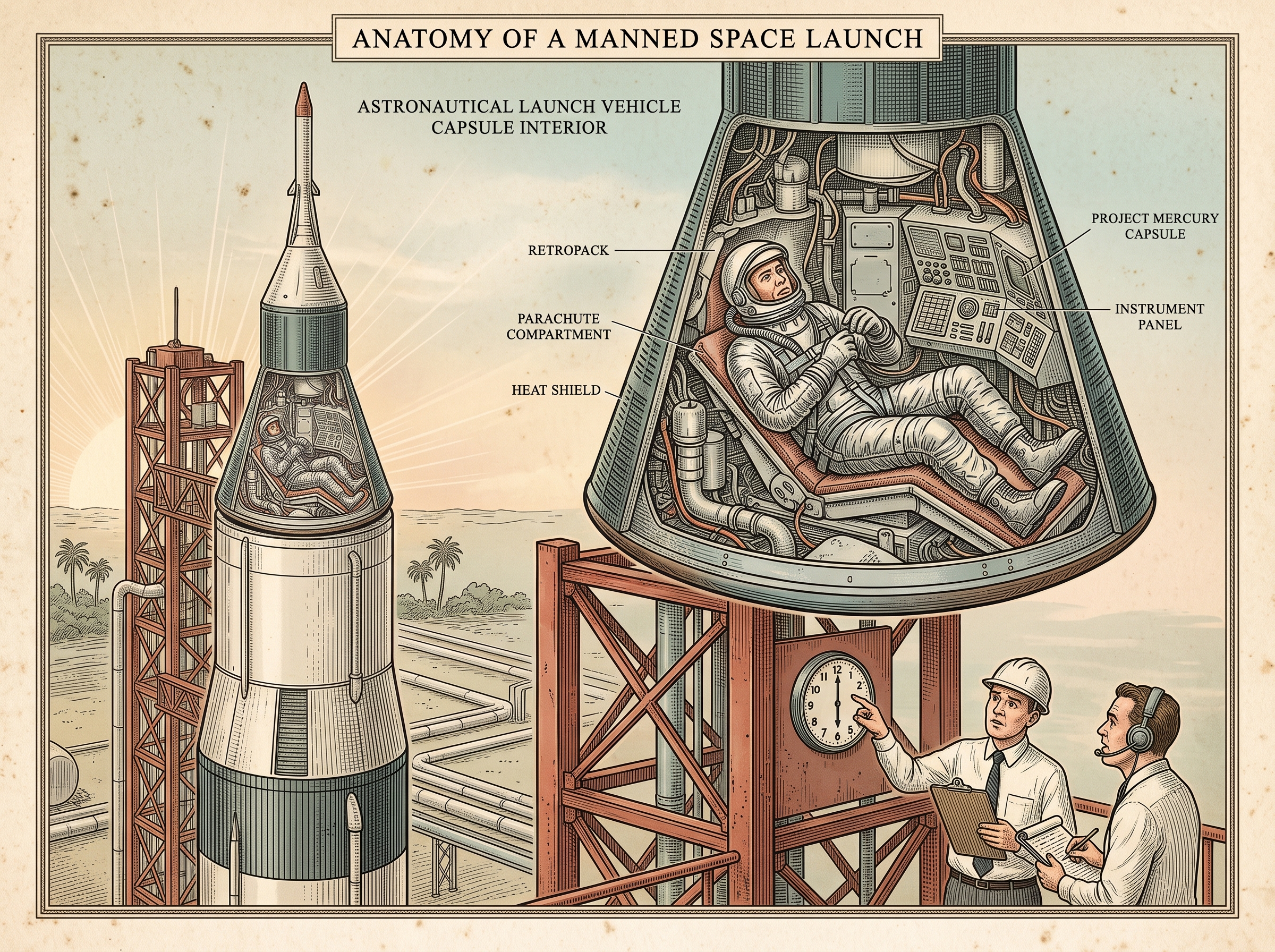
On the morning of May 5, 1961, Alan Shepard lay on his back inside a capsule the size of a phone booth, strapped to the top of a Redstone rocket, waiting to become the first American in space. The flight was supposed to last about fifteen minutes, so nobody had planned for a bathroom. Then the countdown stalled. And stalled. After hours of holds, the country's most important test pilot radioed down a problem no engineer had a checklist for: he really needed to pee.
By the Curiosities Desk · · 5 min read · Filed under Space · Today’s round
What happened?
Shepard had climbed into Freedom 7 about two hours before the planned 7:20 a.m. launch. Technical delays kept pushing it back. According to later accounts, including Shepard’s own, he asked to be let out to relieve himself and was told no — getting him out of the capsule and back in would take too long. Engineers worried that liquid would short out the medical sensors taped to his body. The eventual solution was simple and a little undignified: switch off the sensor power and let him go in the suit. The cotton undergarment soaked it up, the suit’s oxygen flow helped dry it, and at 9:34 a.m. the rocket finally lifted off. The flight lasted 15 minutes and 22 seconds. Shepard came home a national hero with, as far as the public knew, perfectly dry trousers.
It was the first lesson of a sixty-year engineering problem: in weightlessness, nothing falls. On Earth, gravity does most of a toilet’s work. In orbit, liquid forms wobbling blobs, solid waste drifts, and anything that escapes will eventually float past someone’s face — or into the electronics.
The longer Gemini and Apollo flights handled this with plastic. For urine, Apollo astronauts wore a rubber sleeve, a lot like a condom, connected to a hose; the urine was collected and eventually vented overboard, where it froze into a glittering cloud of crystals. For everything else there was the fecal collection bag: a plastic pouch with an adhesive rim that the astronaut stuck to his backside, used, then sealed after kneading in a packet of germicide. It was slow and messy, with two crewmates sitting a few feet away.
It did not always go to plan. In May 1969, as Apollo 10 circled the Moon in the final dress rehearsal before the landing, the onboard recorder caught commander Tom Stafford spotting something drifting through the cabin. “Get me a napkin quick,” he said. “There’s a turd floating through the air.” What followed, preserved in NASA’s own transcript, is three highly trained test pilots politely denying ownership. Nobody confessed.
Skylab, America’s first space station, brought the first device that looked vaguely like a toilet in 1973: a seat on the wall with airflow to pull waste into bags. Because doctors wanted to know how long stays in orbit affected the body, crews had to dry their feces in a special unit and bring them home for analysis.
The Space Shuttle, first launched in 1981, finally gave astronauts a proper commode, the Waste Collection System. It had foot restraints, thigh bars to hold you down, a hose with a personal funnel for urine, and a seat opening only about four inches wide. That small target led to one of NASA’s odder training devices, the Positional Trainer: a mock toilet with a camera mounted inside the bowl and a monitor in front, so astronauts could learn exactly where to sit. Crews nicknamed it NASA’s “deepest, darkest secret.”
Why was it strange?
Because the hardest problem in human spaceflight isn’t always the rocket. Getting a person to orbit took the combined effort of a superpower, but the plumbing lagged decades behind. For most of the space age, the most advanced vehicles ever built had bathrooms worse than a camping trip.
Space toilets also exposed a quiet design bias. For decades they were built mostly around male bodies, and the funnels and seats worked less well for women. Fixing that became an explicit goal only in the 2010s.
The same thread — Alan Shepard — continues in The Moon Golf Shot That Went ‘Miles and Miles and Miles’ — and Actually Went 40 Yards.
What did scientists learn?
That in microgravity, airflow has to replace gravity. Every working space toilet since Skylab relies on the same basic trick: a fan pulls air, and whatever comes with it, away from the body and into a container. Get the seal wrong or let the fan fail, and the waste goes where the air takes it.
Engineers also learned that urine is surprisingly hard on hardware. Minerals and other solids in it build up over time and clog lines, so modern systems add a strong acidic pretreatment. That acid is so corrosive that parts of NASA’s newest toilet had to be 3D-printed from titanium and other resistant alloys.
And they learned that waste isn’t only waste. On the International Space Station, urine is purified and recycled back into drinking water — which is a fair trade for a crew with no grocery store nearby.
Elsewhere in the space stories: The Rocket That Exploded on Live TV and Got Called ‘Kaputnik’.
How does it affect us today?
In October 2020, NASA delivered a new toilet to the space station, the Universal Waste Management System. It took six years and $23 million to develop, a sum that covered two units. It is about 65 percent smaller and 40 percent lighter than the older station toilets, turns on automatically when you lift the lid or remove the funnel, and was redesigned with input from female astronauts so it works for everyone.
The second unit went somewhere no toilet had gone before. When Artemis II launched on April 1, 2026, carrying four astronauts around the Moon, its Orion capsule became the first spacecraft to take a real toilet beyond Earth orbit. It lived up to tradition: within hours a fan in the urine system jammed, and at least one crew member had to use a backup bag until the crew fixed it about six hours into the flight. Later, the line that vented stored urine into space kept clogging. Controllers even turned the spacecraft toward the Sun to thaw suspected ice, but the cause was still unclear when the crew splashed down on April 10. The toilet itself worked; emptying the tank was the problem.
Sixty-five years after Shepard’s soggy launch, the space toilet is still unfinished work. For missions to Mars, the plumbing will matter as much as the rocket.
A close cousin: The Space Tomato That Vanished for Nearly a Year — and the Astronaut Accused of Eating It.
Fun fact
The floating mystery from Apollo 10 was never solved. The official NASA transcript shows each of the three astronauts denying it was his, and none of them ever publicly owned up.
Sources
- Michael Neufeld, “First American In Space: The Flight of Alan B. Shepard,” Smithsonian National Air and Space Museum, May 5, 2021
- Apollo 10 Onboard Voice Transcription (Command Module), NASA
- Amy Thompson, “NASA Just Sent a New $23 Million Space Toilet to the International Space Station,” Smithsonian Magazine, October 9, 2020
- Irene Jagla, “Secrets of the Space Shuttle Toilet,” The Museum of Flight, June 28, 2018
- Mike Wall, “The Artemis 2 space toilet is actually working fine. But there is another problem,” Space.com, April 7, 2026
#Alan Shepard #Space Shuttle #International Space Station #NASA history