From a Pilot Cut Out of His Own Suit to Moonwalks Sewn by a Bra Company: A Short History of the Spacesuit
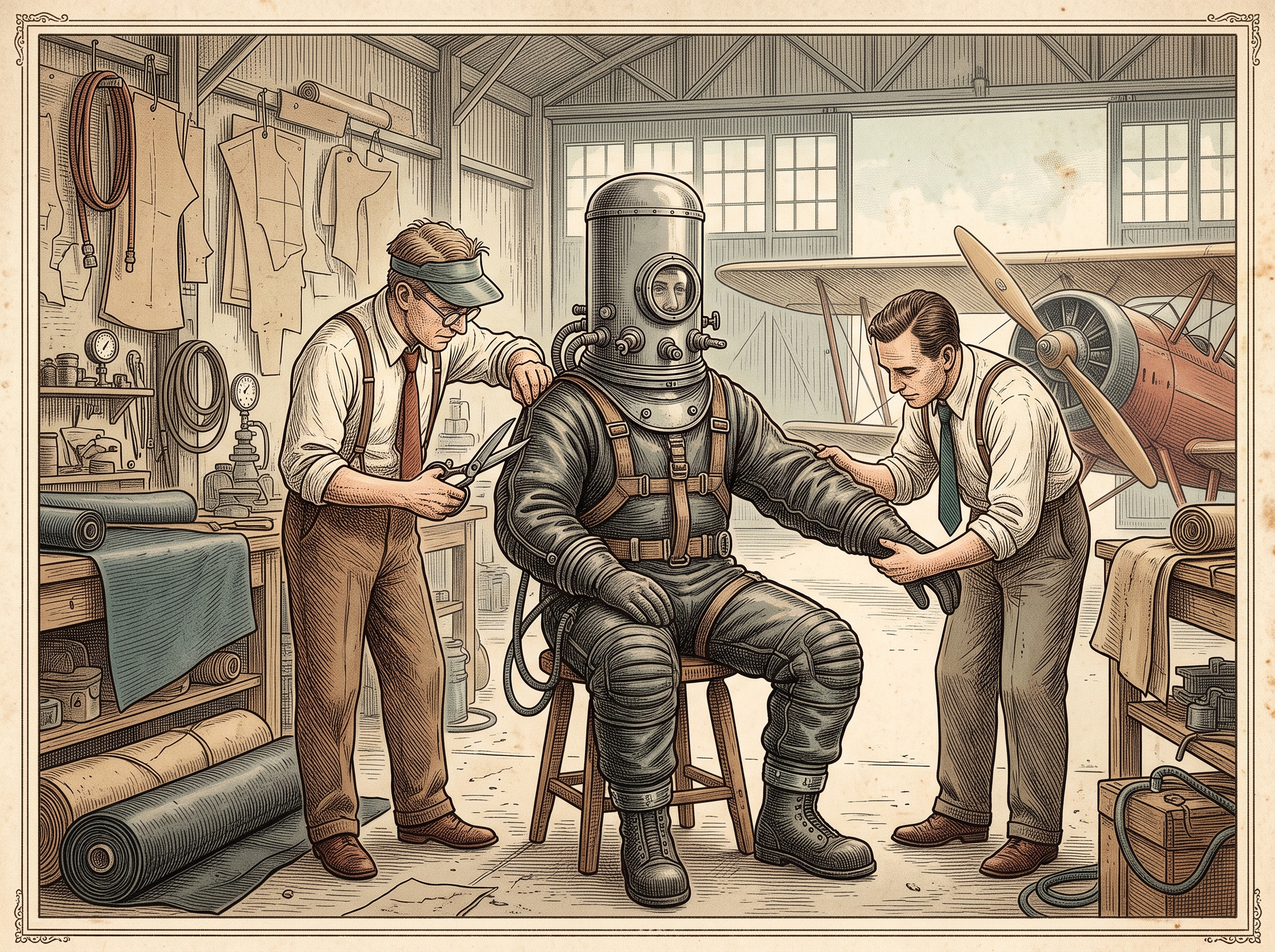
In 1934, the record-chasing pilot Wiley Post climbed into an experimental rubber pressure suit, gained a little weight, and discovered he could not get back out. The engineers had to cut him free. Thirty-five years later, the suit that carried Neil Armstrong across the Moon was hand-stitched by seamstresses who had learned their craft making Playtex bras and girdles.
By the Curiosities Desk · · 5 read · Filed under Space · Today’s round
What happened?
Post had a problem that no airplane of his day could solve. He wanted to fly higher than anyone, where the air is thin and fast, but above roughly 30,000 feet there isn’t enough air pressure to keep a human conscious. Pressurized cabins were still experimental. So in 1934 he went to the B.F. Goodrich rubber company and asked for a cabin he could wear.
According to Invention & Technology magazine, the first prototype, made from double-layer parachute silk, cost $75, was so stiff that Post had to be lowered into the cockpit, and leaked at the seams. Goodrich engineer Russell Colley redesigned it with metal hoops at the elbows and knees. That version is the one Post got stuck in. The third try worked: essentially a human-shaped tire with an airtight inner tube, topped with a tall metal helmet and a small round window. On September 5, 1934, Post wore it to about 40,000 feet over Chicago, and on later flights he climbed to around 50,000 feet, where he ran into the fast high-altitude winds we now call the jet stream.
The space age raised the stakes. On March 18, 1965, Soviet cosmonaut Alexei Leonov floated out of his Voskhod 2 capsule for the first spacewalk in history. About eight minutes in, he later wrote, he “clearly felt the volume of my spacesuit changed.” In the vacuum, his suit had puffed up like a balloon and stiffened so much that he could not reach the camera switch on his thigh or fold himself back into the inflatable airlock. Without telling mission control, he let air out of his suit, dropping its pressure below the safety limit, until he could bend enough to squeeze inside. The whole walk lasted 12 minutes and 9 seconds. Doctors later reported his body temperature had climbed sharply; he said he was up to his knees in sweat.
Meanwhile in the United States, NASA was shopping for a Moon suit. In 1962 it picked a proposal from the International Latex Corporation of Dover, Delaware, the company behind Playtex underwear, but placed it under the aerospace firm Hamilton Standard, which had its own suit ideas. The pairing went badly, and in 1965 Hamilton dropped ILC. NASA set up a contest between Hamilton and the David Clark Company, and ILC’s leaders flew to Houston and talked their way back in with a prototype built at their own expense. Each team had six weeks.
The trials went sideways for everyone. ILC’s zipper failed and the suit had to be flown home for repairs. David Clark’s helmet popped off during a test exit from a mock lunar module. Hamilton’s suit had shoulders too wide to fit through the module’s hatch, which author Nicholas de Monchaux described as “stranding the imaginary astronaut on the surface of the moon forever.” ILC won the contract.
Why was it strange?
We picture spacesuits as products of rocket engineers. The suit that actually reached the Moon came from people who understood how rubber and fabric move with a human body, because they had spent years making girdles that had to stretch, hold and still let the wearer sit down.
ILC’s key trick was the convolute, a bellows-like joint made of rubber reinforced with nylon. It let an astronaut bend an elbow or knee without fighting the air pressure inside, which was exactly the problem that had trapped Leonov. Many of the women who sewed the suits came straight from the Playtex lines, and the finished garments were built on ordinary Singer sewing machines. Until 1966, according to Racked, the latex for the spacesuit dipping room flowed from the same tanks that supplied the bra and girdle lines.
The same thread — Apollo — continues in The Great Wall ‘Visible From the Moon’ — Promised 215 Years Before Anyone Could Check.
What did scientists learn?
The central lesson of every spacesuit is the same: pressure makes a suit want to become a rigid balloon. Inflate any flexible bag and it pushes toward one fixed shape, so bending it means squeezing the gas inside, and that takes effort. Post’s metal hoops, Leonov’s emergency deflation and ILC’s convolutes are three answers to one question.
Engineers also learned to split the job into layers. The Apollo A7L suit, according to the Smithsonian, wrapped Armstrong in 21 layers of synthetic fabrics, neoprene rubber and metal-coated plastic films. An inner pressure bladder held about 3.75 pounds per square inch of pure oxygen, and steel cables kept it from ballooning. Outer layers shielded him from lunar temperatures ranging from roughly +240°F in sunlight to −280°F in shadow, and from micrometeoroids (tiny, fast-moving grains of space dust). After the 1967 Apollo 1 fire killed three astronauts during a ground test, NASA required fireproof materials, and ILC added Beta cloth, a Teflon-coated glass-fiber fabric, as the outer shell.
Precision mattered as much as materials. ASME records seam tolerances as tight as 1/32 of an inch, and de Monchaux reports some under 1/64. A crooked seam could ruin a suit. As Smithsonian curator Cathleen Lewis put it, “There’s no seconds outlet for spacesuits like there is for bra manufacturers.”
Another thread pulled across centuries: From a Wet Spacesuit to a $23 Million Toilet: A Short History of the Space Toilet.
How does it affect us today?
The pattern held. ILC Dover went on to make suit components for the space shuttle and the International Space Station, and the same thinking about flexible joints and layered protection runs through modern suits. Today NASA has hired the company Axiom Space to build suits for its Artemis Moon landings, and Axiom has partnered with the Italian fashion house Prada on the materials and design. Once again, people who know how fabric drapes on a body are helping dress astronauts for the Moon.
Post’s legacy lives on, too. Full pressure suits, the distant descendants of his rubber “tire,” are still worn by pilots of very high-altitude aircraft, and the jet stream he stumbled into now shapes airline routes and weather forecasts every day.
Another idea followed the long way: The Astronomer Who Spent Eleven Years at Sea to Watch Venus Cross the Sun — and Missed It Anyway.
Fun fact
Stray pins were such a danger to a pressurized suit that ILC kept an X-ray machine on the factory floor to scan finished suits for any that had been left behind.
Sources
- Smithsonian Magazine, Andrew Chaikin, “Neil Armstrong’s Spacesuit Was Made by a Bra Manufacturer”
- ASME, “Apollo Space Suit: A Historic Mechanical Engineering Landmark” (2013)
- Racked, Jasmin Malik Chua, “The Girdle-Inspired History of the Very First Spacesuits” (2018), drawing on Nicholas de Monchaux, Spacesuit: Fashioning Apollo (MIT Press, 2011)
- collectSPACE, “Spacewalk at 50: Alexei Leonov” (2015)
- Invention & Technology, “Wiley Post Flies High”