The September That Jumped From the 2nd to the 14th
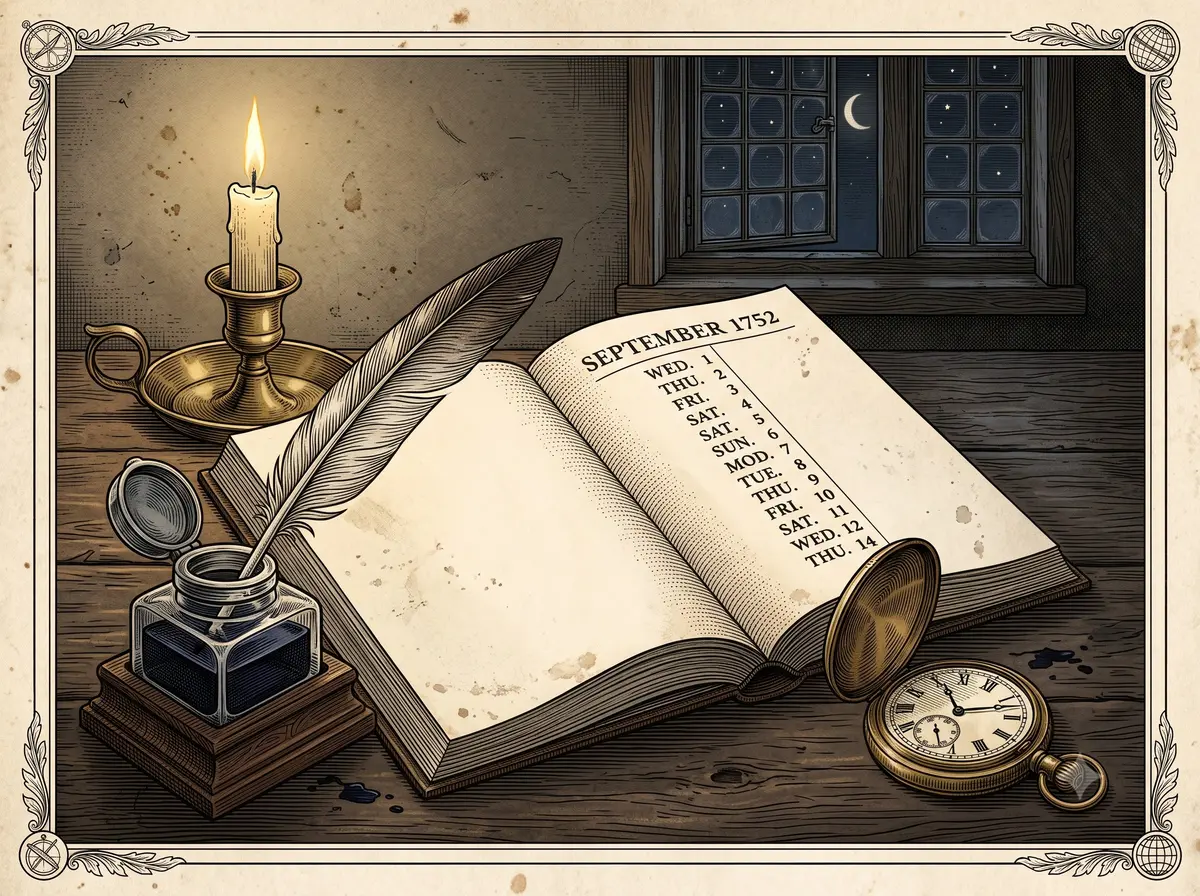
On the evening of Wednesday, 2 September 1752, people across Britain and its colonies went to bed as usual. When they woke up, it was Thursday the 14th. Eleven days had been deleted by Act of Parliament — no eclipse, no catastrophe, just a line of statute quietly removing a week and a half from everyone's life at once.
By the Curiosities Desk · · 5 min read · Filed under Space · Today’s round
What happened: The September That Jumped From the 2nd to the 14th
The trouble started with a rounding error roughly 1,800 years old.
Julius Caesar’s calendar reform of 46 BC set the year at 365.25 days — three years of 365, then one of 366. It was a good approximation. It was not a correct one. The tropical year, the time it actually takes Earth to return to the same point in its seasonal cycle, is closer to 365.2422 days. The Julian year was about eleven minutes too long.
Eleven minutes a year is nothing. Eleven minutes a year for fifteen centuries is a day every 128 years, and days pile up. By the 1500s the calendar had drifted about ten days out of step with the sky.
That mattered because of Easter. The Council of Nicaea in AD 325 had fixed Easter as the first Sunday after the first full moon following the spring equinox, and the equinox had been taken to fall on 21 March. By the 1570s the real equinox was arriving around 11 March, and the most important date in the Christian year was sliding steadily toward summer.
The fix came from Aloysius Lilius, a physician and astronomer from Calabria who worked out the arithmetic and died in 1576 before seeing it adopted. His brother Antonio carried the proposal to Rome, where the Jesuit mathematician Christopher Clavius refined it and spent years defending it in print. Pope Gregory XIII issued the reform as the bull Inter gravissimas on 24 February 1582.
It did two things. First, it deleted the accumulated ten days in one stroke: in the countries that adopted it immediately, Thursday 4 October 1582 was followed by Friday 15 October. October was chosen partly because it is thin on major feast days. Second — the part that actually fixed the problem — it changed the leap year rule. Century years would no longer be leap years unless divisible by 400. So 1600 and 2000 kept their extra day; 1700, 1800, and 1900 did not. That drops the average year to 365.2425 days, close enough to lose only about a day every three thousand years.
Spain, Portugal, Poland, and the Italian states switched at once. Much of the rest of Europe did not, because the correction had arrived with a papal seal on it. Protestant and Orthodox states treated it as Rome’s calendar rather than the sky’s, and held out — in Britain’s case for a further 170 years.
Britain finally gave in with the Calendar (New Style) Act 1750, which moved the legal start of the year from 25 March to 1 January and instructed that the day after 2 September 1752 be counted as the 14th, “omitting 11 days.” Parliament, plainly anticipating trouble, added Section 6: rents, annuities, leases, and the age at which a person turned 21 were all to be reckoned by real elapsed time, not the new dates. Nobody would owe rent early. Nobody would come of age eleven days sooner.
Why it was strange: The September That Jumped From the 2nd to the 14th
The famous part of this story is the riot. “Give us our eleven days!” — mobs in the streets, convinced the government had stolen a fortnight of their lives.
There is no good evidence it happened. The historian Robert Poole went looking for it in newspapers, diaries, and local records from 1752 and found no calendar riots. What he found instead was the slogan turning up in the 1754 election, where the calendar was one of several sticks the Tories used to beat the Whigs with. The image everyone remembers is William Hogarth’s 1755 print An Election Entertainment, in which a placard reading “Give us our Eleven Days” lies on the floor of a chaotic tavern dinner. It is satire of a political campaign. Later writers read it as reportage, and a painting became a memory of something that never took place.
The real strangeness is quieter and better: a correction that was mathematically settled in 1582 sat unadopted across half of Europe for centuries, not because anyone disputed the astronomy, but because of whose name was on the letterhead. Greece did not switch until 1923. Turkey completed the change in 1926.
The same thread — Timekeeping — continues in From Plato’s Night Clock to Pea Shooters at the Window: A Short History of the Alarm Clock.
What scientists learned: The September That Jumped From the 2nd to the 14th
A calendar is a machine for approximating an inconvenient number. The year is not a whole number of days and never will be, so every calendar is a scheme for hiding the remainder somewhere. Caesar hid it in a leap day every four years and overshot. Lilius hid it in a leap day every four years minus three per four centuries, and overshoots far less.
The deeper lesson is about error that accumulates below the threshold of notice. Nobody in AD 400 could have detected that their calendar ran eleven minutes long. The problem stayed invisible for generations and then, suddenly, was ten days wide. Small systematic errors don’t stay small. They just stay quiet.
Another thread pulled across centuries: The Element Discovered on the Sun 27 Years Before Anyone Found It on Earth.
How it reaches us today: The September That Jumped From the 2nd to the 14th
The 1752 change is still sitting in Britain’s tax code. The Treasury, unwilling to lose eleven days of revenue, extended the 1752 tax year to compensate, moving the year-end from 25 March to 5 April. In 1800 — a leap year under the old rules but not the new — it took one more day for the same reason. That is why the UK tax year still runs from 6 April, a date with no logic behind it except a calendar correction and a reluctance to lose income.
The split also explains a stack of confusing dates. Russia’s “October Revolution” of 1917 happened in November by our calendar; the Bolsheviks switched in 1918, jumping from 31 January to 14 February. Orthodox churches on the old calendar still keep Christmas on 7 January. Historians tag dates from this period “O.S.” or “N.S.” — Old Style or New Style — because otherwise nobody can tell what they mean.
Another idea followed the long way: From a Pilot Cut Out of His Own Suit to Moonwalks Sewn by a Bra Company: A Short History of the Spacesuit.
Fun fact: The September That Jumped From the 2nd to the 14th
Sweden decided to switch gradually, skipping every leap day for forty years to drift into alignment painlessly. It skipped 1700, then got distracted by the Great Northern War and forgot to skip 1704 and 1708 — leaving the country on a calendar shared with nobody on Earth. Sweden gave up and reverted to the Julian calendar by adding a second leap day to February 1712. That year, Sweden had a 30 February. It is the only one in recorded history. The country finally made the real switch in 1753, going straight from 17 February to 1 March.
Sources: The September That Jumped From the 2nd to the 14th
- Inter gravissimas (1582), English translation of the papal bull — the primary document of the reform
- Calendar (New Style) Act 1750, full text, legislation.gov.uk / The National Archives — the Act that removed the eleven days
- Robert Poole, “‘Give us our eleven days!’: calendar reform in eighteenth-century England,” Past & Present 149 (1995) — the peer-reviewed study that dismantled the riot story
- Britannica: “Did a Calendar Change Cause Riots in England?”
- The Conversation: “Why the UK tax year begins on April 6 (it’s a very strange tale)”
Related stories: The September That Jumped From the 2nd to the 14th
- The Cylinder in a Paris Vault That Defined the Kilogram — Until It Started Losing Weight — The cylinder that defined the kilogram, until it mysteriously slimmed
- The Self-Taught Carpenter Who Solved the Deadliest Problem in Ocean Navigation — A carpenter built the clock that fixed navigation, then fought to be paid
- The Astronomer Who Spent Eleven Years at Sea to Watch Venus Cross the Sun — and Missed It Anyway — Eleven years at sea to watch Venus cross the Sun, and then clouds