Science Through Time · Physics
The Cylinder in a Paris Vault That Defined the Kilogram — Until It Started Losing Weight
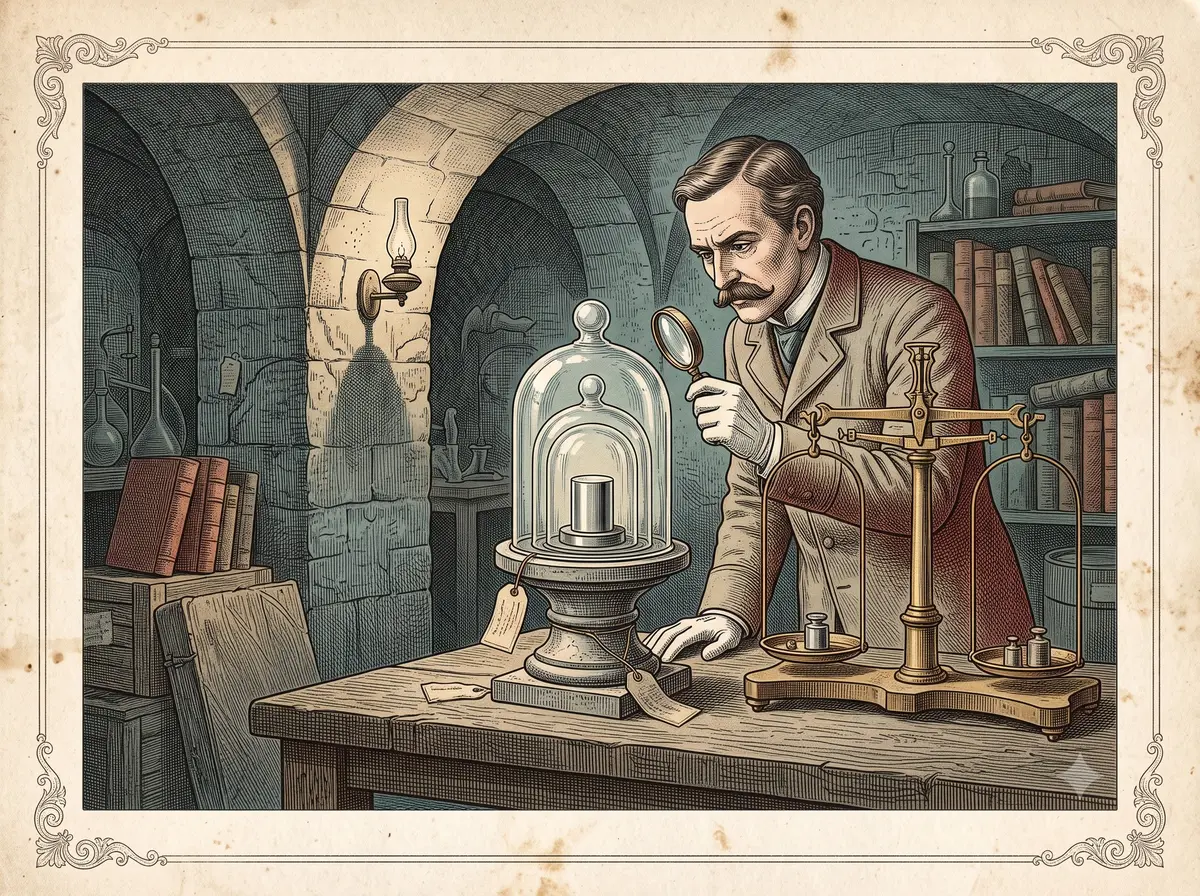
From 1889, for 130 years, the kilogram was a platinum-iridium cylinder nicknamed Le Grand K, locked in a basement vault outside Paris under three nested glass bell jars, behind a door that needed three separately held keys to open. The answer was a small, polished metal cylinder about the size of a golf ball. A kilogram weighed exactly what that cylinder weighed — by definition, forever, no matter what. Which became a problem when the cylinder appeared to start losing weight.
By the Curiosities Desk · · 5 min read · Filed under Physics · Today’s round
What happened: Le Grand K
In 1889, delegates to the first General Conference on Weights and Measures ratified a new international standard of mass: a cylinder of 90% platinum and 10% iridium, about 39 millimeters tall and 39 millimeters across, cast a decade earlier by the London firm Johnson Matthey. It was named the International Prototype of the Kilogram — later nicknamed “Le Grand K” — and installed at the International Bureau of Weights and Measures (BIPM) in Sèvres, on the outskirts of Paris.
The security arrangements were somewhere between a bank and a shrine. The cylinder sat under three nested bell jars in a climate-controlled vault. Opening the vault required three keys, held by three different officials. Official copies were distributed to nations around the world — the United States received copy K20 — and every few decades the copies traveled back to Sèvres for a “periodic verification,” a ceremonial weigh-in against the original.
The logic was elegant and slightly absurd: the kilogram was defined as the mass of this one object. Le Grand K could not, by definition, weigh anything other than exactly one kilogram. If the cylinder gained dust, the kilogram got heavier. If an atom rubbed off, the kilogram got lighter. The entire world’s measurements of mass — every pharmacy scale, every trade agreement, every physics experiment — traced back, through chains of calibration, to this single lump of metal in a French basement.
Then came the third periodic verification, conducted between 1988 and 1992. When the official copies were compared against the original, the masses had drifted apart. Relative to its siblings, Le Grand K appeared to have lost roughly 50 micrograms over the previous century — about the mass of an eyelash, or a fingerprint’s worth of residue.
Fifty micrograms sounds like nothing. For the object that defines mass, it was a quiet crisis. Metrologists — scientists who study measurement itself — couldn’t even say which object had changed. Maybe the copies had absorbed contaminants from the air and gained weight. Maybe the careful cleaning ritual (a gentle rub with chamois leather and a steam bath) was slowly stripping atoms off the original. There was no way to know, because there was nothing more fundamental to check any of them against. The ruler was warping, and it was the only ruler.
In 2011 the General Conference on Weights and Measures resolved to replace the artifact with something that couldn’t drift: a constant of nature. On November 16, 2018, delegates from about 60 nations met in Versailles and voted unanimously to redefine the kilogram in terms of the Planck constant — a fixed number woven into quantum physics, set exactly at 6.62607015 × 10⁻³⁴ joule-seconds. The new definition took effect on May 20, 2019, World Metrology Day. After 130 years of service, Le Grand K was retired to the status of historical object — a very well-guarded paperweight.
Why it was strange: Le Grand K
By the late 20th century, every other base unit had shed its physical props. The meter, once a metal bar in the same French vault, was redefined in 1983 by the speed of light. The second was tied to vibrations of cesium atoms. Mass alone still depended on a specific object you could — in principle — drop, scratch, or steal.
And the definition created a genuine logical trap. Le Grand K was always exactly one kilogram, even as its actual quantity of matter changed. If a speck of dust settled on it, every other mass in the universe technically got a tiny bit lighter by comparison. Scientists in the 1990s and 2000s were in the odd position of admitting that humanity’s standard of mass was wobbling by an amount they could measure but not explain, on an object they were almost afraid to touch — each cleaning was itself a risky intervention in the fabric of the measurement system.
The same thread — Measurement — continues in From a Glass Frog Tied to Your Wrist to 98.6: A Short History of the Thermometer.
What scientists learned: Le Grand K
The redefinition required proving that mass could be measured against pure physics with the same precision as a weigh-in at Sèvres. Two independent approaches had to agree. The Kibble balance — invented in 1975 by physicist Bryan Kibble at Britain’s National Physical Laboratory — balances the weight of an object against a precisely measurable electromagnetic force, linking mass to electrical quantities and, through them, to the Planck constant. The Avogadro project took the opposite road: counting atoms, using nearly perfect spheres of pure silicon-28 to connect mass to a known number of atoms. When both methods converged on the same value of the Planck constant, the constant could be fixed by definition — and the kilogram could be derived from it anywhere, by anyone with the right equipment, forever.
The deeper lesson was about what a standard should be. A good unit isn’t a sacred object; it’s a recipe any lab on Earth (or off it) can follow and get the same answer.
Elsewhere in physics: The Abbé Who Shocked 200 Monks in a Line a Mile Long to Time the Speed of Electricity.
How it reaches us today: Le Grand K
Since May 2019, nothing about your bathroom scale changed — the redefinition was engineered to be seamless at everyday precision. What changed is the foundation underneath. Drug dosing, semiconductor manufacturing, and nanotechnology all push toward measuring ever-tinier masses, and an artifact-based kilogram was a bottleneck: the further your measurement sat from Sèvres in the calibration chain, the more uncertainty crept in. Now a national lab with a Kibble balance can realize the kilogram directly, no pilgrimage to Paris required. The 2019 revision also anchored the ampere, the kelvin, and the mole to fixed constants, completing the transformation of the metric system into one defined entirely by the laws of nature.
Another idea followed the long way: From Ringing Church Bells to Lightning-Rod Hats: A Short History of the Lightning Rod.
FAQ
What was Le Grand K?
Le Grand K was the nickname of the International Prototype of the Kilogram, a cylinder of 90 percent platinum and 10 percent iridium kept at the International Bureau of Weights and Measures in Sèvres, outside Paris. From 1889 until 2019, a kilogram was defined as the mass of that one object.
Why was the kilogram redefined?
Comparisons between 1988 and 1992 suggested Le Grand K had drifted by about 50 micrograms relative to its official copies. In 2018 the General Conference on Weights and Measures voted to define the kilogram from the Planck constant instead. The new definition took effect on 20 May 2019.
Fun fact: Le Grand K
May 20 was chosen for the new kilogram’s debut because it’s World Metrology Day — the anniversary of the Metre Convention, signed in Paris on May 20, 1875. The kilogram artifact was retired 144 years to the day after the treaty that made it famous.
Sources: Le Grand K
- NIST — Kilogram: The Future (SI redefinition)
- BIPM — The International System of Units (SI) and the kilogram
- Scientific American — The Race to Replace the Kilogram
- Phys.org — Adieu, Le Grand K: The kilogram to be redefined for the first time in 130 years
- Wikipedia — International Prototype of the Kilogram (with citations to BIPM verification reports)
Related stories: Le Grand K
- The Self-Taught Carpenter Who Solved the Deadliest Problem in Ocean Navigation — A carpenter built the clock that fixed navigation, then fought to be paid
- The September That Jumped From the 2nd to the 14th — The year Britain skipped eleven days overnight
- The Experiment So Slow Its Keeper Watched for 52 Years and Never Saw a Single Drop Fall — A pitch drop experiment whose keeper watched 52 years in vain