Science Through Time · Physics
From Lanterns on Two Hills to Mirrors Left on the Moon: A Short History of Measuring the Speed of Light
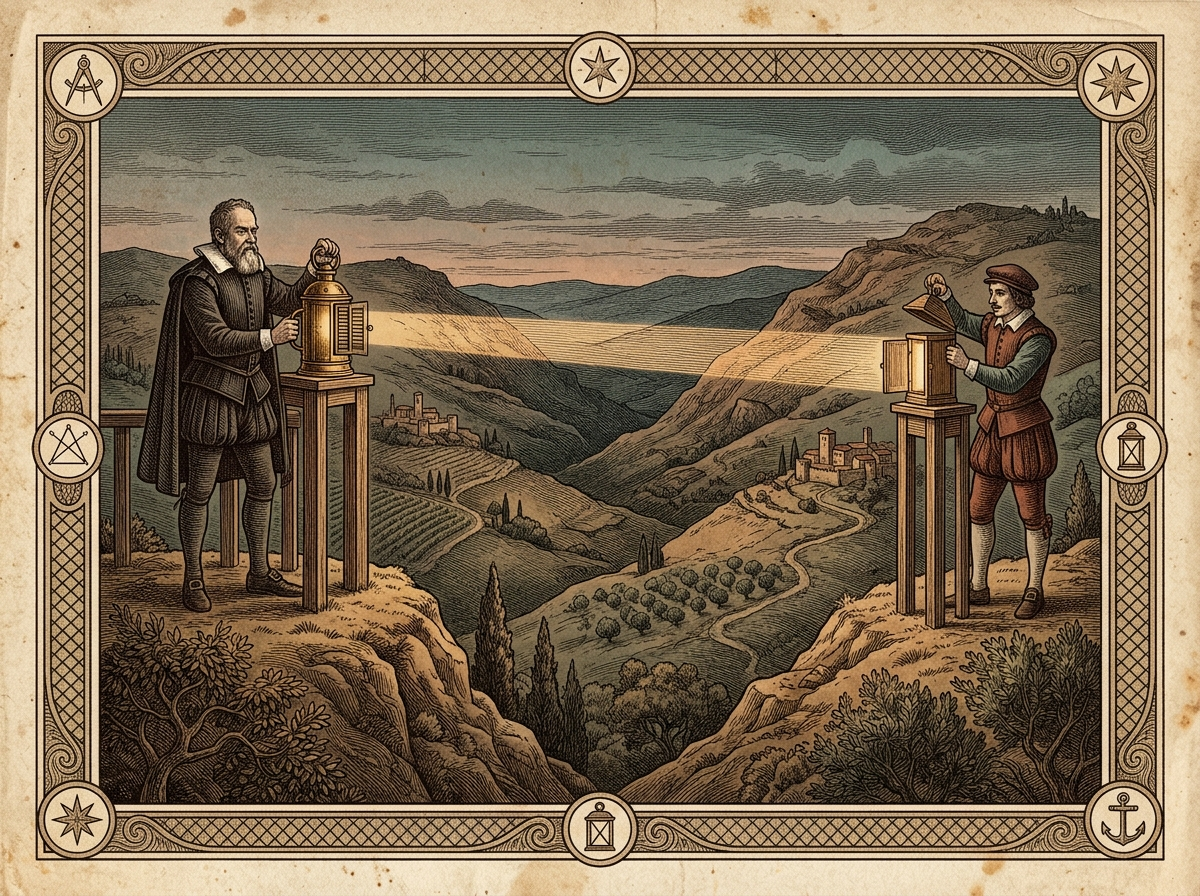
Picture two people standing on hilltops less than a mile apart, each holding a covered lantern. One uncovers his light. The moment the other sees it, he uncovers his own. The first person tries to notice any pause between flashing and seeing the reply. That was Galileo's plan for timing light, and it gave the only answer it could: no delay anyone could see.
By the Curiosities Desk · · 5 min read · Filed under Physics · Today’s round
What happened?
For most of history, the leading view was that light did not travel at all. It simply arrived, everywhere at once. Johannes Kepler and René Descartes both argued that light was instantaneous. Galileo Galilei wasn’t so sure. In Two New Sciences, published in 1638, he described the lantern test and admitted the result was inconclusive. If light was not instantaneous, his character Salviati concluded, it was “extraordinarily rapid.”
The first real clue came from the sky. In the 1670s the Danish astronomer Ole Rømer, working at the Paris Observatory, was timing eclipses of Io, Jupiter’s innermost moon, as it slipped in and out of Jupiter’s shadow. The eclipses ran early when Earth was near Jupiter and late when Earth was far away. Rømer’s explanation was that the light carrying the news had farther to go. In early September 1676 he predicted that an eclipse due on November 9 would come about ten minutes behind the timetable. It did. His paper estimated that light takes about 22 minutes to cross the width of Earth’s orbit.
Rømer never actually stated a speed, despite the many figures later attributed to him. His colleague Christiaan Huygens did the arithmetic around 1678 and got roughly 212,000 kilometers per second, about 30 percent too slow, mostly because the 22 minutes was too long. (The real crossing takes closer to 16 or 17 minutes.) The important part was that light had a speed at all.
In 1728 the English astronomer James Bradley found a second route. While trying to measure the distance to stars, he noticed that their positions shifted slightly over the year in a way distance could not explain. The cause was aberration: because Earth moves through space, starlight appears to arrive at a slight tilt, the way rain seems to slant toward you when you run. A story told decades later says the idea came to him on a boat on the Thames, watching a flag on the mast swing whenever the boat turned. Whatever its origin, the tilt let him calculate a speed within about one percent of today’s value.
Measuring light on Earth took until 1849. The French physicist Hippolyte Fizeau put a telescope in the rooftop lookout of his family’s house at Suresnes, outside Paris, and a mirror in a house on the hill of Montmartre, about 8.6 kilometers away. He shone a beam through the gaps of a spinning wheel with 720 teeth. The light raced to Montmartre and back. At the right speed of rotation, a tooth moved into the gap just as the returning light arrived and blocked it. From the wheel’s speed and the distance, Fizeau got about 315,000 kilometers per second, roughly 5 percent high.
Then came the American who made it a lifelong project. Albert Michelson, a young instructor at the U.S. Naval Academy, timed a beam along a 2,000-foot baseline beside the Severn River in 1879 with a rotating mirror, using about $2,000 from his father-in-law. In the 1920s he moved to the mountains of Southern California, bouncing light between Mount Wilson and a peak about 22 miles away near Mount San Antonio. The U.S. Coast and Geodetic Survey spent months measuring the distance between the two summits, ending up accurate to about three inches. Michelson’s 1926 result of 299,796 kilometers per second was off by about 4.
He wasn’t done. In 1931, at 78, he began a final run inside a mile-long steel pipe on the Irvine Ranch, pumped down to a partial vacuum so the air wouldn’t slow the light. By April he was directing the work from his sickbed. He died that May, before the trials were finished.
Why was it strange?
The thing being measured was so fast that every early attempt was really a contest in building a long enough racetrack. Galileo’s hilltops were far too close together. Rømer and Bradley solved the problem by borrowing the solar system itself. Fizeau and Michelson brought the measurement back to Earth with machines whose moving parts spun quickly enough to keep up.
The answer also turned out to be stranger than a single number. Michelson’s own 1887 experiment with Edward Morley, told in The Ether-Hunting Machine That Found Nothing — and Broke Physics, found that light’s speed did not change with Earth’s motion through space, a result that helped lead Albert Einstein to special relativity.
What did scientists learn?
Light travels about 299,792 kilometers per second in a vacuum, about 186,000 miles per second. Nothing carrying information or mass goes faster. It slows down when passing through air, water, or glass, which is why lenses bend light and why Michelson wanted his pipe empty.
Each new method also taught a lesson about error. Rømer’s timing was off, Huygens’s orbit size was off, and Fizeau’s wheel ran high. The fixes came from better distances and better clocks, not better ideas about light. When a 2011 experiment seemed to clock particles moving faster than light, the culprit was the equipment, as told in The Loose Cable That Made Neutrinos Outrun Light for Five Months.
How does it affect us today?
In 1983 the General Conference on Weights and Measures turned the problem inside out. Rather than measuring the speed of light in meters, it defined the meter as the distance light travels in a vacuum in 1/299,792,458 of a second. The speed of light became exactly 299,792,458 meters per second, by definition, similar to the way the kilogram was later tied to a constant in The Cylinder in a Paris Vault That Defined the Kilogram.
The old racetrack trick also never went away. In 1969 Apollo 11 astronauts left a panel of 100 small mirrors on the Moon. Observatories still fire lasers at it and similar reflectors, time the round trip of about two and a half seconds, and measure the distance to the Moon to within a couple of centimeters. GPS works on the same principle, timing radio signals that travel at light speed from satellites to the phone in your pocket.
Fun fact
When Michelson graduated from the Naval Academy, he ranked first in his class in optics and twenty-fifth in seamanship.
Sources
- Académie des sciences, “Fonds Fizeau” archive guide — the 1849 toothed-wheel experiment between Suresnes and Montmartre and its result.
- Air & Space / Smithsonian, “The Pipeline That Measured the Speed of Light” — Michelson’s mile-long vacuum pipe on the Irvine Ranch and his final measurements.
- BIPM, Resolution 1 of the 17th CGPM (1983): Definition of the metre — the official definition fixing the speed of light.
- Physics Today, “Rømer and the finite speed of light” — Rømer’s November 1676 prediction, his 22-minute estimate, and Huygens’s calculation.
- Michael Fowler, University of Virginia, “The Speed of Light” — Galileo’s lantern test, Bradley’s aberration, and Michelson’s early career.