The Ether-Hunting Machine That Found Nothing — and Broke Physics
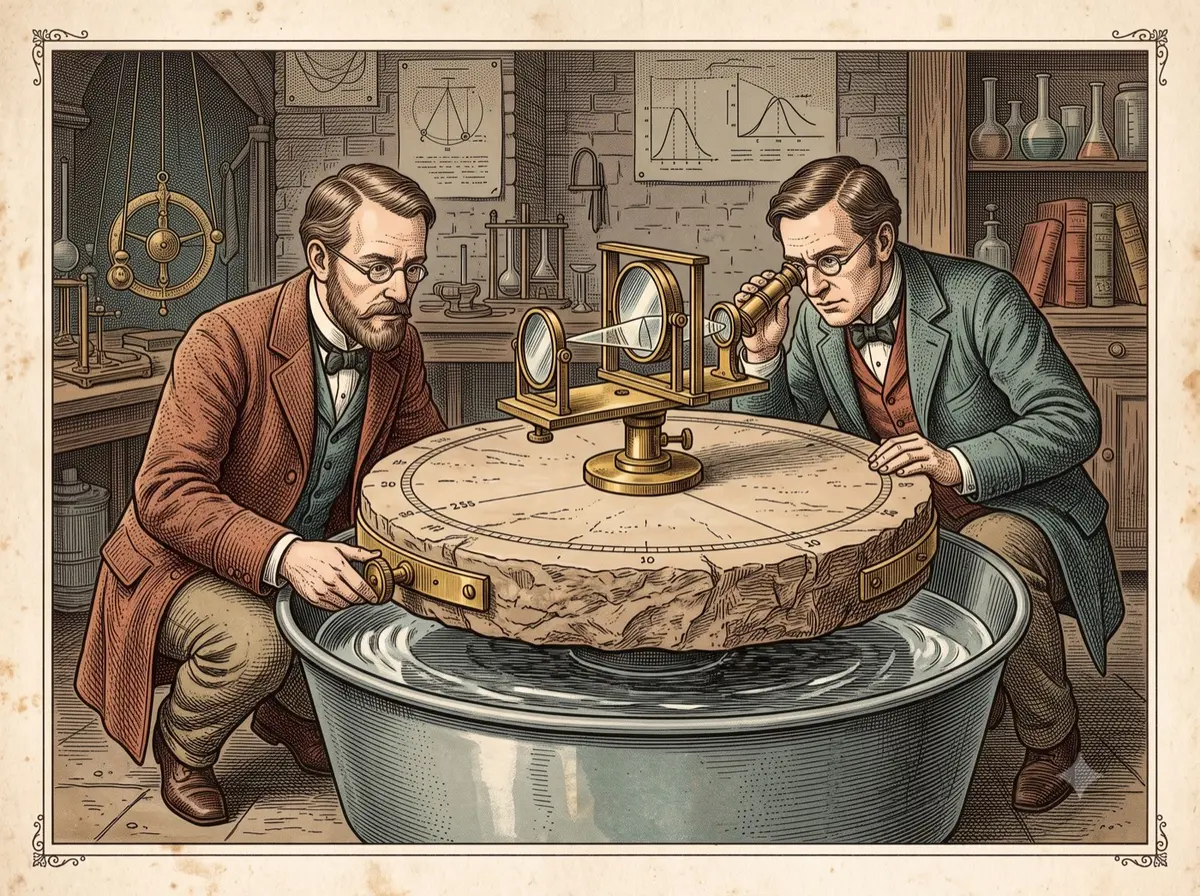
In the basement of a Cleveland dormitory in the summer of 1887, two scientists spun a five-foot slab of sandstone in a slow, silent circle. It floated on a trough of liquid mercury, so smoothly that a light touch could keep it turning for minutes. Mounted on top was the most precise light-measuring instrument ever built. It was designed to catch the Earth in the act of plowing through an invisible substance that, according to every physics textbook of the day, had to be there. It found nothing. Nobody at the time knew that "nothing" was about to become one of the most important results in the history of science.
By the Curiosities Desk · · 6 min read · Filed under Physics · Today’s round
What happened: The Michelson-Morley Experiment
Albert A. Michelson, a physicist at the Case School of Applied Science, and Edward W. Morley, a chemist across the street at Western Reserve University, were hunting for the “luminiferous ether” — a hypothetical medium that 19th-century physicists believed filled all of space and carried light waves, the way air carries sound. If the ether existed, Earth had to be moving through it as it orbited the sun, creating a faint “ether wind.” Light traveling with that wind, physicists reasoned, should move very slightly faster than light traveling against it or across it.
Michelson had tried to measure this back in 1880–81 in Potsdam, Germany, using an instrument of his own invention called an interferometer. It splits a beam of light in two, sends the halves down perpendicular paths to mirrors, and recombines them. Even a tiny difference in travel time between the two paths shows up as a shift in the interference pattern — bands of light and dark, like ripples where two waves meet. That first attempt found no ether wind, but the device wasn’t sensitive enough to fully convince skeptics, Michelson included.
So he teamed up with Morley to build something far more powerful. Their new interferometer bounced light back and forth multiple times, stretching the effective path length to roughly 11 meters, and sat on a massive sandstone block floating in a cast-iron trough of mercury. The mercury bath canceled out vibration from passing carriages and footsteps, and let the whole rig rotate freely so the two light paths could be swapped continuously relative to Earth’s motion. Between April and July 1887, in the basement of Western Reserve’s Adelbert Dormitory, they ran their trials, watching the interference bands as the slab turned.
Based on the ether theory and Earth’s orbital speed, they calculated they should see a fringe shift of about 0.4 — a clearly visible displacement of the light and dark bands. Their apparatus was sensitive enough to detect a shift as small as 0.01. What they measured was, in effect, nothing: a residual wobble far too small to represent real motion through an ether, well under a twentieth of what theory demanded.
Why it was strange: The Michelson-Morley Experiment
This wasn’t a case of an experiment being too crude to see the effect. That was exactly the fear the improved design had been built to eliminate. The instrument was sensitive enough. The math predicting the ether wind was based on accepted, mainstream physics. And still — nothing. It was as if you stuck your arm out of a car window doing sixty miles an hour and felt no wind at all, no matter which direction the car turned. Something Michelson and Morley trusted as physical common sense simply refused to show up in the data, and their instrument was good enough that there was nowhere left to hide the discrepancy.
For years afterward, physicists tried to patch the ether theory rather than abandon it — most notably with the proposal, by physicists George FitzGerald and Hendrik Lorentz, that objects moving through the ether physically contract in the direction of motion by just enough to cancel out the expected shift. It was an ingenious rescue, but it was a rescue built specifically to explain away one experiment, with no independent evidence behind it.
The same thread — Relativity — continues in The Champagne Party Stephen Hawking Threw for Time Travelers — and Sent the Invitations Out Afterward.
What scientists learned: The Michelson-Morley Experiment
The full answer didn’t arrive until 1905, when Albert Einstein published his theory of special relativity — and, notably, did so without ever citing the Michelson-Morley result directly as his starting point, though historians still debate how much it shaped the scientific climate he was working in. Einstein’s insight was that there was no ether to detect in the first place, because the speed of light is the same for every observer, regardless of how they or their light source are moving. There was no wind to feel because the whole premise of a fixed medium moving past the Earth was wrong. Space and time themselves adjust — clocks run differently, lengths measure differently — to keep the speed of light constant for everyone. Viewed through that lens, the Michelson-Morley null result stopped being an embarrassing failure and became a beautifully clean piece of evidence for a deeper truth about the universe.
Another experiment that taught more by not working: The Loose Cable That Made Neutrinos Outrun Light for Five Months.
How it reaches us today: The Michelson-Morley Experiment
Special relativity, first vindicated by an experiment that found nothing, is now load-bearing infrastructure for modern life. GPS satellites carry atomic clocks that must be corrected for relativistic time effects or your phone’s map would drift off by miles within a day. Particle accelerators, nuclear power calculations, and the basic physics behind medical imaging all rest on the framework Einstein built partly on the ruins of the ether. The interferometer itself had its own afterlife: the same principle of splitting and recombining light to detect impossibly tiny differences is the working heart of LIGO, the observatory that first detected gravitational waves in 2015 — ripples in spacetime from colliding black holes, caught by instruments that are, in essence, vastly more sensitive descendants of the sandstone slab floating on mercury in a Cleveland basement.
Elsewhere in physics: The Botanist Who Ground Up a Piece of the Sphinx to See If It Would Wiggle.
Fun fact: The Michelson-Morley Experiment
Michelson went on to win the 1907 Nobel Prize in Physics — the first American ever to win a Nobel Prize in a science — but the prize wasn’t for the famous null result. It honored his precision optical instruments and the spectroscopic measurements he made with them. The experiment now taught in every physics class as a turning point in modern science was, in Michelson’s own lifetime, officially just a footnote to his real work.
Sources: The Michelson-Morley Experiment
- Michelson-Morley Experiment — Encyclopedia of Cleveland History, Case Western Reserve University
- Michelson-Morley Experiment — Encyclopædia Britannica
- November 1887: Michelson and Morley Report Their Failure to Detect the Luminiferous Ether — American Physical Society, APS News
- The Experiment of Michelson and Morley — Resonance, Indian Academy of Sciences
- The Nobel Prize in Physics 1907: Albert A. Michelson — Biographical, NobelPrize.org
Related stories: The Michelson-Morley Experiment
- The Loose Cable That Made Neutrinos Outrun Light for Five Months — A loose fiber-optic cable made neutrinos appear to outrun light
- N-Rays: The Radiation 300 Scientists Saw That Was Never There — Three hundred scientists saw a radiation that did not exist
- Cold Fusion: The Breakthrough That Wasn’t — Two chemists announced fusion in a jar; nobody could repeat it