The Champagne Party Stephen Hawking Threw for Time Travelers — and Sent the Invitations Out Afterward
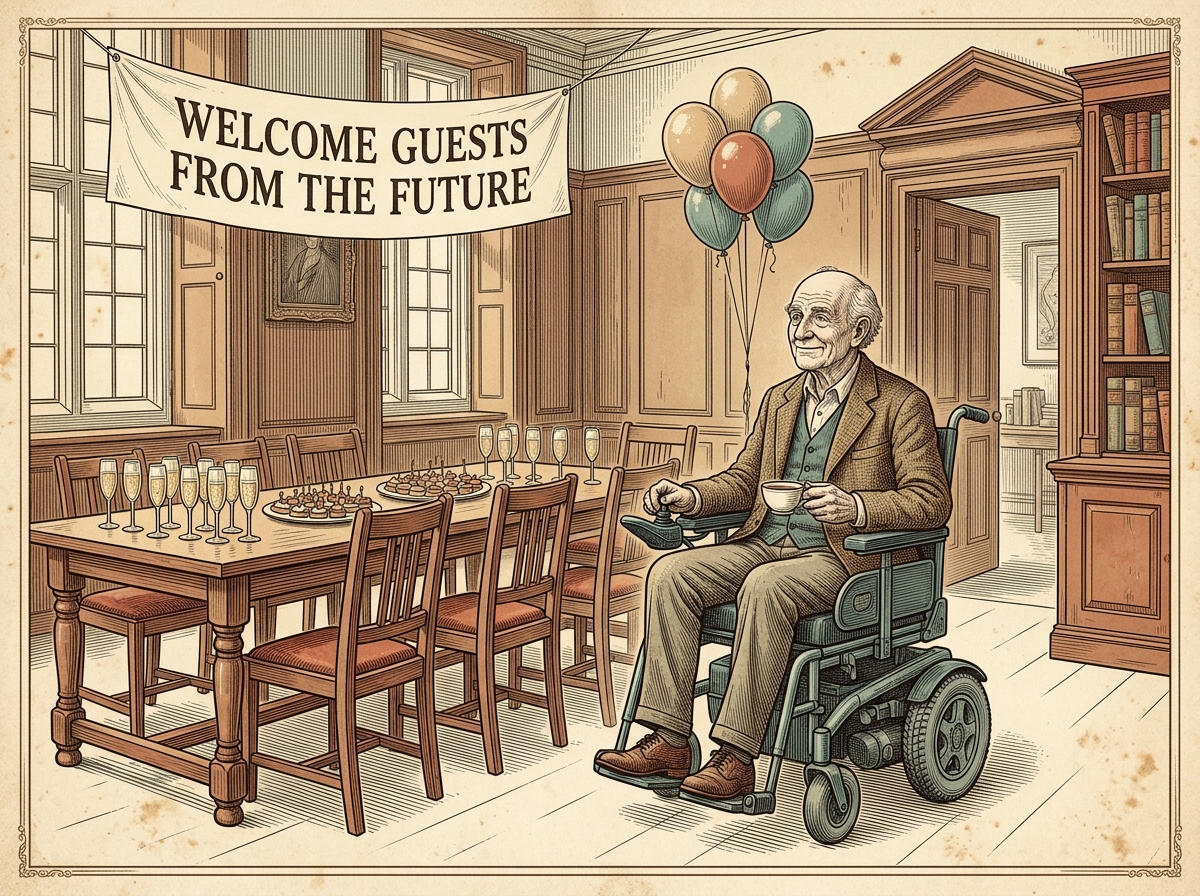
At noon on Sunday, June 28, 2009, Stephen Hawking sat in a room at Gonville & Caius College, Cambridge, under a banner that read "Welcome Time Travellers." There were balloons. There were canapés. There were glasses of champagne poured and waiting. A film crew stood by. And not a single person in the world, apart from the people already in the room, knew the party was happening. That was the whole point.
By the Curiosities Desk · · 5 read · Filed under Physics · Today’s round
What happened?
Stephen Hawking, the Cambridge cosmologist behind A Brief History of Time, loved a good stunt, especially one with a real idea hiding inside it.
In 2009 he was filming Into the Universe with Stephen Hawking, a documentary series that aired on the Discovery Channel in 2010. One episode was about time travel, and Hawking wanted to do more than talk about it. He wanted to run an experiment.
The design was simple. Throw a party. Tell no one. Then, only after the party is over, publish the invitation and spread it as widely as possible. If anyone in the future ever learns how to travel backward in time, they will eventually come across the invitation, see the date and place, and drop by. If guests show up, time travel to the past is possible. If nobody does, that is a small piece of evidence that it isn’t.
The invitation, laid out in old-fashioned type, gave the exact coordinates in both space and time:
You are cordially invited to a reception for Time Travellers, hosted by Professor Stephen Hawking. To be held in the past, at the University of Cambridge, Gonville & Caius College, Trinity Street, Cambridge. 52° 12′ 21″ N, 0° 7′ 4.7″ E. 12:00 UT, 28 June 2009. No RSVP required.
Hawking said he hoped copies would survive for thousands of years, so that one day someone living in the future would find it and use a wormhole time machine to come back to his party.
On the day, he waited in the room for a few hours. The champagne stayed full. Nobody arrived.
At the Seattle Science Festival in 2012, he put it simply: he had experimental evidence that time travel is not possible. “I sat there a long time,” he said, “but no one came.”
Why was it strange?
Most parties fail when people forget to send the invitations. This one only worked as an experiment because the invitations went out late. Any guest who turned up would have needed to read an invitation that, at the moment they arrived, did not yet exist in public.
It was also a real experiment, even if a funny one. It had a clear prediction, a fixed time and place, and an outcome you could observe. The trouble is in reading the result. An empty room proves less than it seems to. Maybe the invitation doesn’t survive long enough. Maybe time travelers have better things to do, or rules against visiting famous people. Maybe time machines can only reach back to the moment they were first switched on, which is a feature of some proposed designs. Hawking knew all this. He was taking a serious question seriously by being playful about it.
He wasn’t the first to try. In 2005, students at MIT held a Time Traveler Convention and publicized its coordinates “indefinitely.” More than 300 people from the present attended. None from the future were confirmed.
The same thread — Relativity — continues in The Ether-Hunting Machine That Found Nothing — and Broke Physics.
What did scientists learn?
The party was a stage-friendly version of an argument Hawking had made years earlier in a much drier format. In 1992 he published a paper in Physical Review D called “Chronology Protection Conjecture.” A conjecture is a claim a scientist thinks is true but can’t yet prove.
His claim was that the laws of physics conspire to prevent closed timelike curves, the technical name for a path through space and time that loops back to its own past. Einstein’s general relativity, in principle, allows some strange shapes of spacetime, including wormholes, which are shortcuts that connect distant points. In theory, a wormhole could be turned into a time machine. Keeping one open, though, would seem to need “exotic matter” with negative energy, something no one has ever produced in usable amounts. Hawking’s calculations suggested that, as you approach the point where a time machine would switch on, quantum effects build up and may tear the structure apart before it can work.
He summed it up with a line that might be the best joke in any physics paper: it seems there is “a chronology protection agency” that makes “the universe safe for historians.” He also pointed out the simplest evidence of all: we have not been invaded by hordes of tourists from the future.
Two important caveats. First, the conjecture is still unproven; physicists debate it, and a full theory of quantum gravity may be needed to settle it. Second, it is only about traveling backward. Traveling forward in time faster than everyone else is real and well measured. Under relativity, clocks that move fast or sit higher in a gravitational field tick at different rates.
Another ambitious failure: The Loose Cable That Made Neutrinos Outrun Light for Five Months.
How does it affect us today?
Forward time travel, in its tiny everyday form, is built into your phone. GPS satellites carry atomic clocks that, thanks to their speed and their height above Earth, run about 38 microseconds a day fast compared with clocks on the ground. Engineers correct for this. If they didn’t, location errors would pile up by kilometers each day. Astronauts on the International Space Station age very slightly less than people on Earth; over Scott Kelly’s nearly year-long mission, the difference was a few thousandths of a second.
The party also lives on as an object. In 2013, the designer Peter Dean printed the invitation as a letterpress poster on a Victorian press, with Hawking’s approval, partly so that more copies would survive into the future. One print that hung in Hawking’s own office is now in the Science Museum Group collection in Britain. In a sense, the experiment is still running.
Elsewhere in physics: The Millionaire Who Declared Gravity ‘Enemy Number One’ — and Paid Colleges to Put Up Monuments Against It.
Fun fact
The joke outlived its host. When the Stephen Hawking Foundation opened a public ballot for his 2018 memorial service at Westminster Abbey, sharp-eyed applicants noticed that the date-of-birth field let you choose years as late as 2038. A spokesperson explained that the possibility of time travel could not be excluded, as it “has not been disproven to our satisfaction.”
Sources
- Hawking, S. W. (1992). “Chronology protection conjecture.” Physical Review D 46, 603–611. https://link.aps.org/doi/10.1103/PhysRevD.46.603
- Science Museum Group Collection, “Time Travellers invitation” (from Stephen Hawking’s office). https://collection.sciencemuseumgroup.org.uk/objects/co8863710/time-travellers-invitation
- Atlas Obscura, “Why We Will Not Have Been Able to Attend Stephen Hawking’s Time Traveler Party” (2018). https://www.atlasobscura.com/articles/stephen-hawking-time-traveler-party
- NBC News, “Stephen Hawking is keeping his eyes on the prize… Nobel Prize, that is” (Seattle Science Festival, 2012). https://www.nbcnews.com/sciencemain/stephen-hawking-keeping-his-eyes-prize-nobel-prize-832621
- IanVisits, “Westminster Abbey invites time travellers to Stephen Hawking’s memorial service” (2018). https://www.ianvisits.co.uk/articles/professor-stephen-hawkings-memorial-service-open-to-the-public-25328/