Impossible Inventions · Physics
The Millionaire Who Declared Gravity 'Enemy Number One' — and Paid Colleges to Put Up Monuments Against It
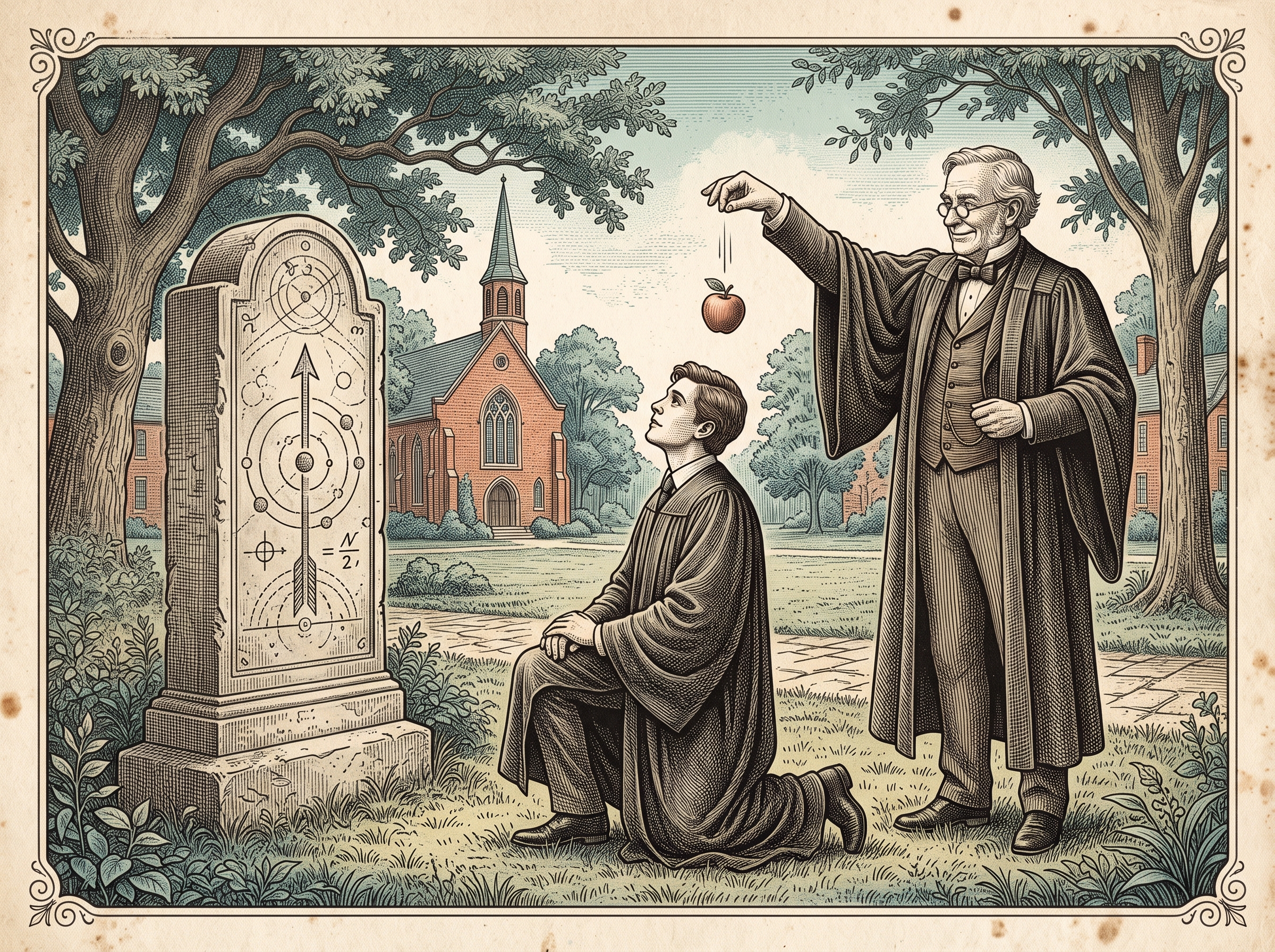
Every so often at Tufts University near Boston, a brand-new doctor of physics kneels on the grass in front of a granite slab, and their thesis advisor drops an apple on their head. The stone behind them, installed in 1961, says it is there "to remind students of the blessings forthcoming" once science finds a way to shield us from gravity. It was paid for by a man who considered gravity his personal enemy, and who spent his last two decades trying to beat it.
By the Curiosities Desk · · 5 read · Filed under Physics · Today’s round
What happened?
Roger Babson was born in 1875 in Gloucester, Massachusetts, and became one of the best-known money men in America. He built a business selling investment advice through a newsletter and a financial analysis firm, later called Babson’s Reports, and he founded the business school that still carries his name, Babson College. He was famous, too, for warning in September 1929 that a stock market crash was coming.
His interest in gravity started with a family tragedy. When Babson was a boy, his older sister Edith drowned in the Annisquam River near Gloucester. Decades later he described the moment in an essay titled “Gravity – Our Enemy Number One”: “She was unable to fight gravity, which came up and seized her like a dragon and brought her to the bottom.” In 1947 his grandson Michael also drowned, reportedly while trying to save a friend in a boating accident. Babson’s long fascination hardened into a mission.
In 1948 he set up the Gravity Research Foundation, according to some accounts at the suggestion of his friend Thomas Edison. Its organizing meeting was held on January 19, 1949. Babson’s dream was a “partial insulator,” a material that would block gravity the way rubber blocks electricity. With it, he imagined, airplanes could fly more safely and machines could run on gravity as free power.
He chose an unusual headquarters: New Boston, New Hampshire. According to the town’s historical society, Babson drew a circle about 60 miles out from Boston, reasoning that a town that far away would be safe if the city were struck in a nuclear war. He bought up many of the town’s buildings, set up a library of gravity books and papers, and hosted annual summer conferences that drew upward of 75 guests, including helicopter pioneer Igor Sikorsky (a foundation trustee) and frozen-food inventor Clarence Birdseye. One attendee later recalled that guests lounged in chairs with their feet raised above their heads “because of gravity,” though that memory comes from a local reminiscence, not a scientific program.
Babson loved Isaac Newton. He applied Newton’s laws to stock forecasting (“What goes up will come down,” as he put it), and he bought a room from Newton’s last London home and had it shipped to America, along with a bed Newton had once slept in.
The foundation also launched an essay contest in 1949, offering prize money for ideas about gravity. Then, in the early 1960s, came the part that still stands today. The foundation gave “gravity grants,” gifts of stock, to more than a dozen American colleges, from Tufts and Colby to Emory, Tuskegee and the University of Tampa. Each grant came with a granite monument. Emory’s stone, dated 1963, says it exists to remind students of the blessings to come when science determines what gravity is, how it works, and how it may be controlled.
Why was it strange?
The monuments celebrate an invention that, as far as physics can tell, is impossible. In Einstein’s general theory of relativity, gravity is not a force passing through space that something could block. It is the bending of space and time itself by mass and energy. There is no known material that can step outside that bending, the way you cannot build a wall against “downhill.”
So Babson’s foundation was offering prizes for a device that cannot be built, from a small New Hampshire town picked to survive the apocalypse, while scattering tombstone-like markers across campuses. College students took notice. At Tufts, in 1962, students and grounds workers dug a hole beneath the stone to see whether it would “defy gravity,” and the burying-and-digging-up cycle continued into the early 1980s. Elsewhere, pranksters reportedly tied balloons to the monuments or roped them down.
Yet it would be unfair to treat Babson as a crank to laugh at. He was grieving, and he put his money where his hope was.
Another machine that should not have worked: The Perpetual Motion Machine Secretly Powered by an Old Man Upstairs Eating Bread.
What did scientists learn?
The surprising twist is that the essay contest grew up. Serious physicists began entering in the 1960s, and from 1971 onward entries no longer had to address gravity shields at all. The winner lists, still posted by the foundation, read like a who’s who of 20th-century physics.
A young Stephen Hawking placed in the contest six times between 1965 and 1974 and took first prize in 1971. Roger Penrose, who won the Nobel Prize in Physics in 2020, won first prize in 1975, and he and Hawking shared a second-place award in 1968. At least six winners went on to Nobel Prizes, including George Smoot, Gerard 't Hooft and Frank Wilczek. Historians, including MIT’s David Kaiser, have looked at how this odd little foundation helped put money and attention behind gravity research in the years after World War II, when general relativity was something of a backwater.
The contest still runs from Wellesley, Massachusetts, with prizes of up to $4,000.
Another invention that refused to stay on paper: The Truck Driver Who Flew a Lawn Chair to 16,000 Feet on 42 Weather Balloons.
How does it affect us today?
Physicists have found a kind of “anti-gravity” after all, just not the kind Babson wanted. In 1998, astronomers discovered that the expansion of the universe is speeding up, driven by something now called dark energy. Alexander Vilenkin, who directs the Tufts Institute of Cosmology (partly funded by Babson’s gift), has noted that his group studies this cosmic acceleration, which Babson would surely have approved of, while admitting they never did reduce airplane accidents.
And the monuments are still out there. Hobart and William Smith Colleges reported that its gravity-grant stocks grew past $1 million and helped fund a science building, Rosenberg Hall, in 1994. Babson’s war on gravity paid for real science, just not the science he expected.
The same thread — Gravity — continues in The Scientist Who Weighed the Earth but Couldn’t Speak to His Housekeeper.
Fun fact
The Gravity Research Foundation once kept a sign declaring New Boston, New Hampshire, the safest town in North America in the event of World War III. Today, the foundation’s last trace in the town is a granite slab on a traffic island.
If you’ve lost someone to drowning or another sudden accident, grief can stay with you for a long time. Talking with friends, family or a grief counselor can help.
Sources
- Gravity Research Foundation — Historic (founding, Babson’s essay)
- Gravity Research Foundation — Award winners by name
- Tufts Now — “Defying Gravity” (the Tufts monument and apple ceremony)
- New Boston Historical Society — The Gravity Research Foundation
- Popular Science — “How One Man Waged War Against Gravity”