Impossible Inventions · Physics
The Truck Driver Who Flew a Lawn Chair to 16,000 Feet on 42 Weather Balloons
Two airline crews on approach to Los Angeles radioed the tower on the afternoon of July 2, 1982 to report a man in a lawn chair, three miles up, holding a pellet gun. He was not a hallucination. He was Larry Walters, he had a CB radio and a two-liter bottle of Coca-Cola, and he was very politely trying to explain himself to anyone who would listen.
By the Curiosities Desk · · 5 min read · Filed under Physics · Today’s round
Part of Built to Do the Impossible
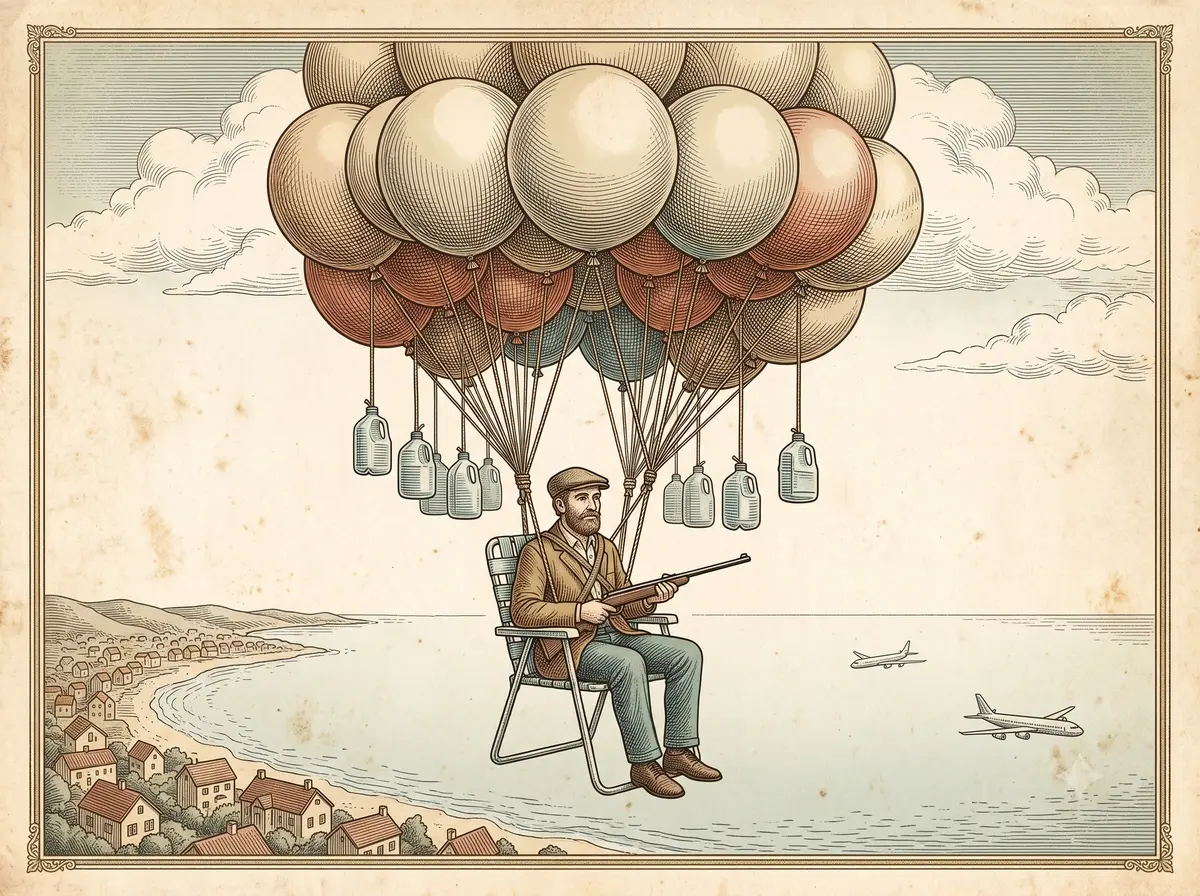
What happened: The Truck Driver Who Flew a Lawn Chair to 16,000 Feet on 42 Weather Balloons
Larry Walters was 33, a truck driver, and a Vietnam veteran who had wanted to fly since he was a boy. Poor eyesight kept him out of the cockpit. But at 13, in a military surplus store, he looked up at weather balloons hanging from the ceiling and had an idea he never stopped having.
Twenty years later he acted on it. He and his girlfriend, Carol Van Deusen, bought forty-five eight-foot weather balloons from a surplus store. He bought an aluminum lawn chair. On July 2, 1982, in the backyard of a house on West 7th Street in the San Pedro neighborhood of Los Angeles, he tied forty-two of the balloons to the chair in tiers, filled them with helium, and loaded up: a parachute, a pellet gun to pop balloons on the way down, plastic gallon jugs of water for ballast, a CB radio, an altimeter, a camera, sandwiches, the Coca-Cola, and some beer. He named the craft Inspiration I. The plan was to drift east over the Mojave Desert and come down gently somewhere in the empty part of California.
The plan lasted about a second. The chair was tethered to a Jeep while the launch crew finished up. The tether broke early — before anyone had notified the authorities — and Walters did not float. He shot upward. He leveled off around 16,000 feet, roughly three miles high, inside the controlled airspace that funnels traffic into Los Angeles and Long Beach.
He stayed up about forty-five minutes. It was cold, the air was thin, and he was sitting in a patio chair. He reached a citizens-band radio group called REACT, whose recording of the exchange survives. Asked what he wanted the airport told, Walters answered: “Ah, the difficulty is, ah, this was an unauthorized balloon launch, and, uh, I know I’m in a federal airspace, and, uh, I’m sure my ground crew has alerted the proper authority. But, uh, just call them and tell them I’m okay.”
Then he started shooting. He popped balloons carefully, a few at a time, trying not to tip the whole cluster — and then dropped the pellet gun overboard, ending his descent controls mid-descent. He came down slowly anyway, over Long Beach, where the dangling cables caught a power line at 423 East 44th Way. The line broke. A neighborhood lost electricity for about twenty minutes. Walters climbed down unhurt and was arrested by Long Beach police, who had been waiting.
An FAA regional safety inspector, Neal Savoy, summed up the agency’s position with admirable honesty: “We know he broke some part of the Federal Aviation Act, and as soon as we decide which part it is, some type of charge will be filed. If he had a pilot’s license, we’d suspend that, but he doesn’t.”
Walters was fined $4,000. He appealed, and the fine was cut to $1,500. One charge — operating a civil aircraft without a valid airworthiness certificate — was dropped, because it did not apply to whatever a lawn chair legally is.
Why it was strange: The Truck Driver Who Flew a Lawn Chair to 16,000 Feet on 42 Weather Balloons
Not that it worked. That’s the strange part. A lawn chair from a department store, tied to surplus rubber, carried a grown man higher than most light aircraft ever go, and it did so exactly the way physics said it would.
The strangeness is that Walters wasn’t wrong about the lift. He was wrong about the steering. He had built an aircraft with an accelerator and no brake — and then thrown the accelerator out of the car.
Another machine that should not have worked: The Perpetual Motion Machine Secretly Powered by an Old Man Upstairs Eating Bread.
What scientists learned: The Truck Driver Who Flew a Lawn Chair to 16,000 Feet on 42 Weather Balloons
Nothing, in the sense that no one learned any new physics from Larry Walters. Everything he demonstrated was already in the textbooks. But it is a very clean demonstration.
Buoyancy is a difference in density. A cubic meter of ordinary air weighs about 1.2 kilograms; a cubic meter of helium weighs about 0.16. The gap — a bit over a kilogram of lift per cubic meter — is all the force there is. Eight-foot balloons hold a lot of cubic meters, and forty-two of them hold enough to pick up a man, a chair, jugs of water, and lunch.
The trouble is control. A real gas balloon has a valve at the top: the pilot vents helium to sink and drops ballast to rise, and can do both repeatedly. A cluster of sealed weather balloons has neither. Every adjustment is permanent. Popping a balloon is a one-way decision, and so is pouring out water. Worse, ambient pressure drops with altitude — at 16,000 feet it’s roughly half what it is at sea level — so the balloons swell as they climb, which is why a craft with too much “free lift” doesn’t drift up gently. It runs away.
Another invention that refused to stay on paper: The Millionaire Who Declared Gravity ‘Enemy Number One’ — and Paid Colleges to Put Up Monuments Against It.
How it reaches us today: The Truck Driver Who Flew a Lawn Chair to 16,000 Feet on 42 Weather Balloons
Walters became briefly famous, appeared on Late Night with David Letterman ten days after landing, quit trucking, and tried motivational speaking. He is generally credited with inspiring cluster ballooning, which is now a real, regulated niche of aviation — practitioners fly with oxygen, transponders, licenses, and, crucially, controlled venting systems rather than a pellet gun. In 2010 Jonathan Trappe crossed the English Channel on a balloon cluster. His story has since produced a film, a musical, and a documentary in progress.
Larry Walters died by suicide in 1993, at 44, after years of struggling to find footing. It’s worth saying plainly rather than skipping past: the man who did the joyful thing did not have an easy life afterward.
A close cousin: The 2,000-Year-Old Computer Found in a Shipwreck.
Fun fact: The Truck Driver Who Flew a Lawn Chair to 16,000 Feet on 42 Weather Balloons
After landing, Walters gave the lawn chair away to a kid from the neighborhood — and later regretted it, because the Smithsonian came asking. Thirty-odd years on, that kid, Jerry Fleck, donated it himself. The chair is now in the National Air and Space Museum’s collection, credited to “the ‘neighborhood kid’ Larry Walters gave his lawnchair to after landing,” water jugs still attached.
Sources: The Truck Driver Who Flew a Lawn Chair to 16,000 Feet on 42 Weather Balloons
- Chair, Lawn, Larry Walters — National Air and Space Museum collection record (object A20181388000)
- “Truck Driver Takes to Skies in a Lawn Chair,” The New York Times, July 3, 1982
- Rebecca Maksel, “How the Balloon-Borne ‘Flying Lawn Chair’ Got Into the Smithsonian,” Air & Space / Smithsonian Magazine, September 2019
- Myrna Oliver, “Larry Walters; Soared to Fame on Lawn Chair,” Los Angeles Times, November 24, 1993
- George Plimpton, “The Man in the Flying Lawn Chair,” The New Yorker, June 1, 1998
This story ends with a death by suicide. If you’re struggling, support is available — in the US you can call or text 988 to reach the Suicide and Crisis Lifeline, and similar services exist in most countries.
Related stories: The Truck Driver Who Flew a Lawn Chair to 16,000 Feet on 42 Weather Balloons
- The Flying Saucer the Air Force Built That Maxed Out at 35 MPH — The Air Force built a flying saucer that hovered at walking speed
- The Rocket-Powered Wheel That Chased Britain’s Admirals Into Barbed Wire — A rocket-propelled wheel that chased its inventors across the beach
- The Motor That Ran for Twenty-Six Years on a Secret Room Full of Compressed Air — A perpetual motion motor secretly fed by a hidden room of compressed air