Impossible Inventions · Physics
The Antigravity Engine That Was Tested on a Bathroom Scale
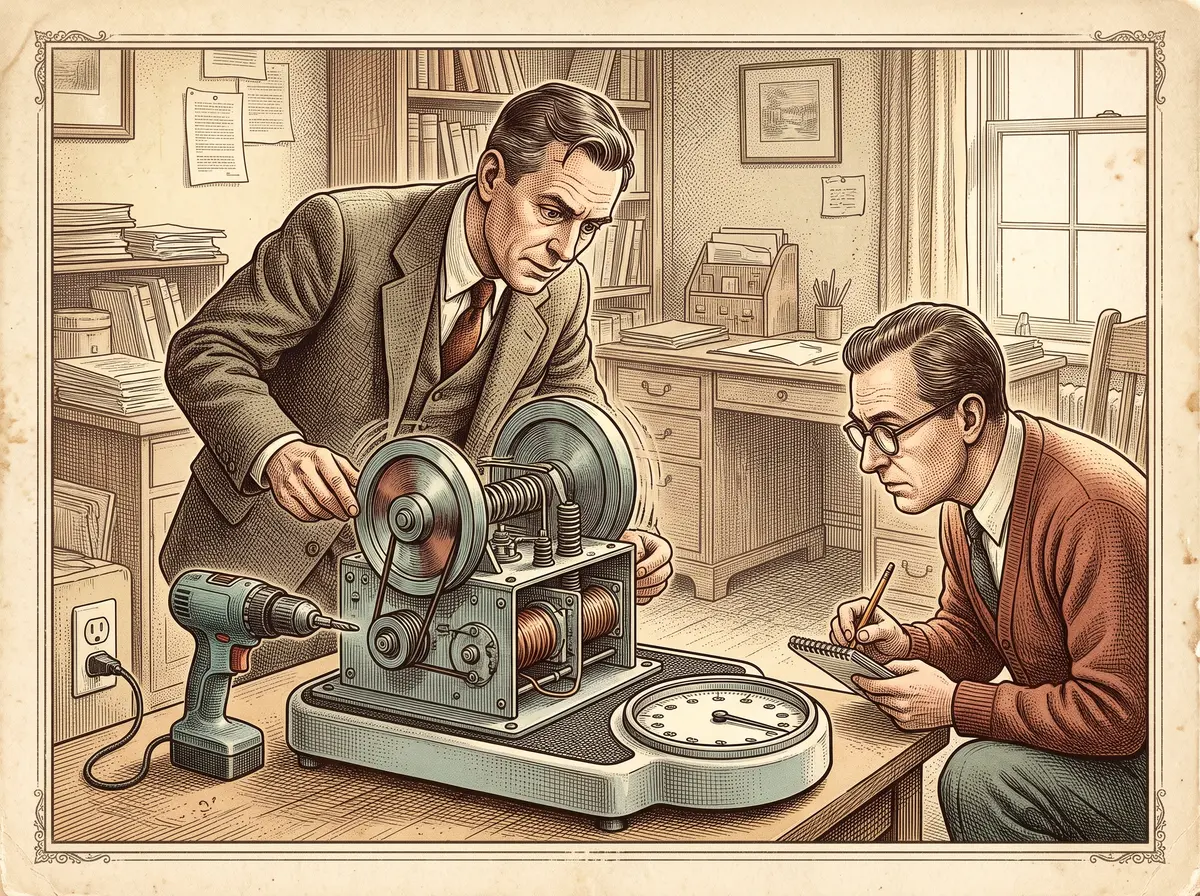
In a house in Washington, D.C., around 1960, a science-fiction editor watched a whirring contraption sit on an ordinary bathroom scale. When the machine was switched on, the needle dipped. Something that weighed about nine pounds now seemed to weigh closer to eight and a half. To John W. Campbell, that half-pound was the start of the Space Age without rockets.
By the Curiosities Desk · · 5 min read · Filed under Physics · Today’s round
Part of Built to Do the Impossible
What happened: The Dean Drive
The man behind the machine was Norman L. Dean, who in 1956 filed for a U.S. patent on a “System for converting rotary motion into unidirectional motion.” Dean was not a physicist. According to Campbell, he was a senior official at the Federal Housing Administration who specialized in mortgage appraisal and tinkered on his own time. Patent 2,886,976 was granted on May 19, 1959.
The idea looked simple on paper. Two weights spun in opposite directions on parallel shafts, so their side-to-side shaking cancelled out and left a back-and-forth vibration along one line. A set of solenoids, cams, and couplings then tried to “catch” the motion on the forward swing and let go on the backward one. Dean believed this could turn spinning into a steady push in one direction, with nothing thrown out the back. Engineers call that kind of device a reactionless drive: one that moves without pushing against anything, the way a rocket pushes against its exhaust.
Campbell edited Astounding Science Fiction, which was being renamed Analog in 1960, and he loved an idea that made the establishment uncomfortable. He drove down from New York, saw a demonstration, and in the June 1960 issue published “The Space Drive Problem.” He described the bathroom-scale test and later ran photographs of the scale with the drive stopped and running. He said plainly that he believed it worked, and noted that NASA and the Office of Naval Research had not come to inspect it. Dean’s own numbers, Campbell reported, suggested a 150-horsepower engine could produce about 6,000 pounds of thrust, friction aside.
Others came knocking. In the 1950s, a young aerospace engineer named Jerry Pournelle, later a well-known science-fiction writer, was sent by his employer with instructions to buy the device if it seemed real. Pournelle later recalled that Dean wouldn’t show the machine until the company paid him first, and also wanted a promise of a Nobel Prize. The company didn’t pay and never saw it run. A team from 3M had a similar experience.
Two investigators did get in the door: William O. Davis and the rocket writer G. Harry Stine. They came away believing they had seen something odd. Davis wrote it up as “The Fourth Law of Motion” in Analog in May 1962, suggesting the missing momentum might be leaking away as an unknown kind of radiation. But when he and Stine tried to reproduce the effect in a more rigorous setup, a rocket-powered ballistic pendulum, they couldn’t. Dean, they reported, would not put his original machine on a pendulum test. Their research stopped in 1965.
Dean died in 1972. Afterward, no working demonstration unit or diagrams for one were found among his things, so the machines Campbell saw can’t be tested today.
Why it was strange: The Dean Drive
Because the claim wasn’t a small improvement on engines. It was a claim against Newton’s third law, the rule that every push comes with an equal and opposite push. That law is why a rocket must throw mass backward to go forward, and why you can’t lift yourself by pulling on your own bootstraps. Inside a closed box, parts can slosh back and forth all day, but the box’s overall center of mass can’t start drifting through empty space on its own.
So the stakes were enormous. If Dean was right, spacecraft wouldn’t need fuel tanks, and a whole branch of physics was wrong. If he was wrong, the needle on the scale still needed an explanation, and that’s the interesting part.
The idea of a machine running on a hidden source of power has a long and lively history, from The Perpetual Motion Machine Secretly Powered by an Old Man Upstairs Eating Bread to The Motor That Ran for Twenty-Six Years on a Secret Room Full of Compressed Air.
What scientists learned: The Dean Drive
The answer turned out to be friction and springs.
A vibrating device sitting on a floor or tabletop can “walk” in one direction through a process called stick-slip: on one stroke it grips the surface and stays put, and on the other it slides. You can do the same thing by scooting across a room in an office chair with little jerks of your body. It works, but only because the floor pushes back. Take away the floor, as in space, and the trick goes nowhere. In 1978, physicist Russell Adams surveyed dozens of U.S. patents for similar devices in Analog and concluded they all relied on that kind of surface contact.
The bathroom scale has its own weakness. A scale is a spring with a needle on it, and a shaking object pounds it with rapid ups and downs. In a 1997 Analog column, physicist John G. Cramer used a juggler as an example: tossing pins makes his weight on a scale jump around, but averaged over time it always equals the juggler plus the pins. A dip at one moment is paid back by a spike at another. A spring that resonates with the vibration can make the needle settle low anyway. Cramer’s verdict: bathroom scales are “not reliable instruments for investigating antigravity.”
How it reaches us today: The Dean Drive
Dean’s machine became a textbook case, and inventors keep reinventing it. NASA’s Breakthrough Propulsion Physics Project once received about one unsolicited proposal every workday, many of them variations on spinning or oscillating masses. In a 2006 technical memorandum, NASA’s Marc Millis and Nicholas Thomas wrote a guide for responding to them. They explain that such “oscillation thrusters” appear to work only through differential friction, or by mistaking a twist for a straight-line push. They suggest a simple entry test: hang the device from a level pendulum and show that it stays deflected.
That’s essentially the test Dean never let his original machine take. The lesson has outlived the drive: an extraordinary claim needs an experiment that can actually catch it being wrong.
For another campaign against gravity, see The Millionaire Who Declared Gravity ‘Enemy Number One’ — and Paid Colleges to Put Up Monuments Against It.
A closed box that was supposed to push itself sits with the other schemes in Built to Do the Impossible.
Fun fact: The Dean Drive
The June 1960 Astounding cover celebrated the Dean drive with a painting by John Schoenherr of a U.S. nuclear submarine cruising through space near Mars, no rocket exhaust required.
Sources: The Dean Drive
- Dean, N. L. “System for converting rotary motion into unidirectional motion.” U.S. Patent 2,886,976, filed July 13, 1956, granted May 19, 1959. Google Patents
- Millis, M. G., and Thomas, N. E. (2006). “Responding to Mechanical Antigravity.” NASA/TM-2006-214390, AIAA 2006-4913. NASA Technical Reports Server
- Campbell, J. W. (1960). “The Space Drive Problem.” Astounding/Analog, June 1960. Transcription at rexresearch.com
- Cramer, J. G. (1997). “Antigravity Sightings.” Analog, March 1997 (Alternate View column AV-83). University of Washington
- Pournelle, J. “The Dean Drive and Other Reactionless Drives.” jerrypournelle.com