Impossible Inventions · Physics
The Perpetual Motion Machine Secretly Powered by an Old Man Upstairs Eating Bread
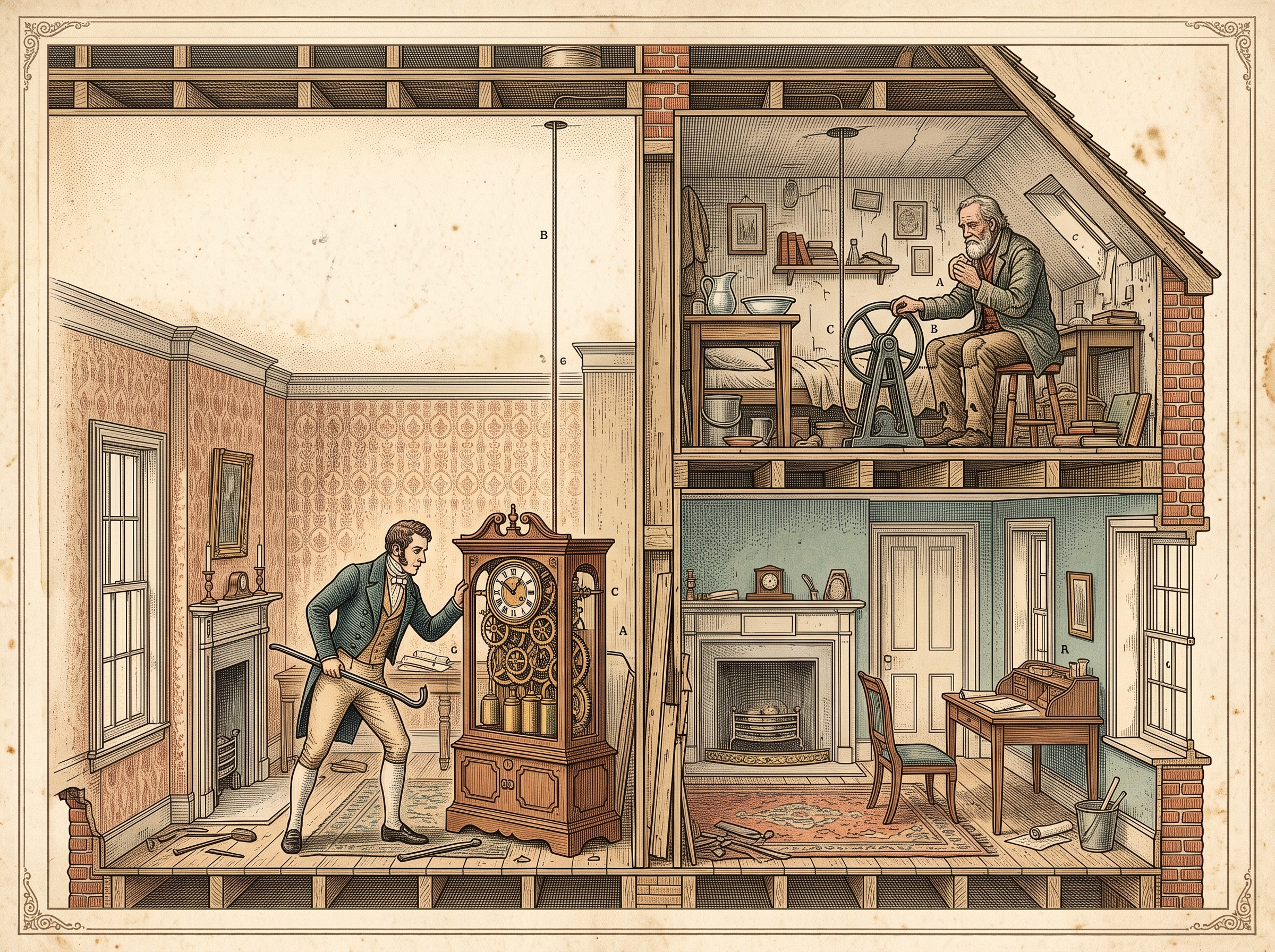
In New York in 1813, Robert Fulton, the engineer who had made steamboats a commercial reality, pried a few boards off a wall beside a "perpetual motion" machine. Behind them ran a thin cord of catgut. He followed it up the stairs and into a small room, where, according to the story as it has been retold ever since, an old man with a long beard sat turning a hand crank with one hand and eating a crust of bread with the other. The machine that needed no power had a power source after all. He was having lunch.
By the Curiosities Desk · · 5 read · Filed under Physics · Today’s round
What happened?
Charles Redheffer first appears in the record in Philadelphia in 1812. Almost nothing is known about his life, not even a firm spelling of his name (contemporaries also wrote “Readhefer” and “Redheiffer”). What everyone agreed on was the machine: a contraption set up in a house near the Schuylkill River, on the edge of the city, that turned steadily with no visible weights to wind, no water wheel, no steam, and no horse. Redheffer said it would run forever on its own.
Philadelphians paid to see it. Accounts differ on the price, but men were reportedly charged as much as $5, with women admitted cheaply or free. The crowds kept coming, and Redheffer asked the Pennsylvania legislature for money to build a bigger version.
That request brought inspectors. In December 1812 the legislature appointed a committee of experts to examine the device. Philadelphia’s scientific community was skeptical from the start. On January 12, 1813, the mathematician Robert Patterson, director of the U.S. Mint, wrote to Thomas Jefferson that Redheffer “most probably never will submit his machine to the examination required,” because he must know it would expose “the fraud he has so successfully practised.” Patterson added that public “mania” for the machine was still growing.
When the inspectors did visit, on January 21, 1813, Redheffer kept them at a distance, and they could view the machine only through a barred window. That turned out to be enough. Redheffer claimed his machine drove a second, separate device. But one sharp-eyed visitor (one account names Coleman Sellers, son of the local engineer Nathan Sellers) noticed that the teeth on the connecting gears were worn on the wrong side. The wear showed the “output” gear was the one doing the pushing. Power was flowing into the machine, not out of it.
Rather than accuse Redheffer outright, the skeptics answered him with a better fake. Isaiah Lukens, a Philadelphia clockmaker and machinist, built a copy powered by a hidden clockwork motor. (Sources disagree about who commissioned it; one local history says it was made for Peale’s museum.) Unlike the original, it could be examined up close. According to the National Archives’ annotated edition of Jefferson’s papers, Redheffer was so puzzled that the copy worked that he offered to pay for its secret. His reputation in Philadelphia did not survive the moment, and he moved to New York.
There, in 1813, he set up a modified machine and began again. Robert Fulton, brought along by friends, noticed something off: the motion sped up and slowed down in a faint, irregular rhythm, the way something does when a person is turning it by hand. Fulton offered Redheffer a deal: let him search for the power source, and if he found nothing, he would pay for any damage. Redheffer agreed.
Fulton removed the boards, found the catgut belt, and followed it upstairs to the old man at the crank. Exactly how that scene played out is told with varying detail (some versions say the man was locked in and fed only bread and water), but the core of it, the cord and the hidden crank-turner, is consistent across accounts. An angry crowd wrecked the machine, and Redheffer left town.
Why was it strange?
The strange part isn’t that someone faked a perpetual motion machine. People had been trying, and faking, for centuries. It’s how close Redheffer came to getting public money for it, and how the fraud was caught. Nobody needed to open the box. In Philadelphia, a pattern of wear on gear teeth told the inspectors which way the energy was flowing. In New York, a slight wobble in the rotation was enough for Fulton to suspect a human hand.
It’s also a reminder of when this happened. In 1813, the laws of thermodynamics, the rules that say a machine like this cannot work, had not yet been written down. Many educated people were fairly sure perpetual motion was impossible (France’s Academy of Sciences had stopped reviewing such proposals in 1775), but there was no tidy law to point to. The detectives had to rely on careful observation instead.
The same thread — Perpetual Motion — continues in The Motor That Ran for Twenty-Six Years on a Secret Room Full of Compressed Air.
What did scientists learn?
Within a few decades, physics caught up with what the skeptics suspected. By around 1850, the work of James Joule, Rudolf Clausius, William Thomson (later Lord Kelvin) and others had produced the first and second laws of thermodynamics, the branch of physics that deals with heat, energy, and work.
The first law says energy can’t be created or destroyed, only changed from one form to another. A machine can’t put out more energy than goes into it. The second law adds that in every real machine, some energy is always lost as heat, through friction in bearings, air resistance, and the flexing of parts. So a machine left to itself doesn’t just fail to gain energy; it steadily loses it and eventually stops. A device that runs forever while also powering something else would break both laws at once.
Redheffer’s gears were a small physics lesson in themselves: wear marks are a physical record of force, and force reveals which direction energy is moving.
Another machine that should not have worked: The Truck Driver Who Flew a Lawn Chair to 16,000 Feet on 42 Weather Balloons.
How does it affect us today?
Perpetual motion claims never fully went away, and neither did the defenses against them. The U.S. Patent and Trademark Office can require a working model for an application that claims perpetual motion, a rare exception to its usual rules. “Where is the energy coming from?” is still the first question to ask of any too-good-to-be-true machine, including modern “free energy” gadgets sold online.
The Redheffer story also shows a habit that still matters in science: when someone won’t let you look closely, that refusal is itself evidence. Today we’d call it independent verification. In 1813 it was a barred window and a few worn gear teeth.
Another invention that refused to stay on paper: The Millionaire Who Declared Gravity ‘Enemy Number One’ — and Paid Colleges to Put Up Monuments Against It.
Fun fact
Despite being exposed twice, Redheffer was granted a U.S. patent in 1820 for “machinery for the purpose of gaining power.” No one can check what it described: the record was lost when the U.S. Patent Office burned in 1836.
Sources
- Robert Patterson to Thomas Jefferson, 12 January 1813, with editorial notes — Founders Online, U.S. National Archives (strongest primary source: a contemporary letter about the Philadelphia investigation)
- Redheffer’s Perpetual Motion Machine — Museum of Hoaxes
- Charles Redheffer — Wikipedia, for its citations to Niles’ Weekly Register and Peter Force’s National Calendar (1821) on the 1816 episode and 1820 patent
- Isaiah Lukens, Clockmaker — Historical Society of Horsham
- MPEP § 608.03: Models, Exhibits, Specimens — U.S. Patent and Trademark Office