Impossible Inventions · Physics
The Math Teacher Who Made Ice Out of Sunshine — Until a Report Poured Cold Water on It
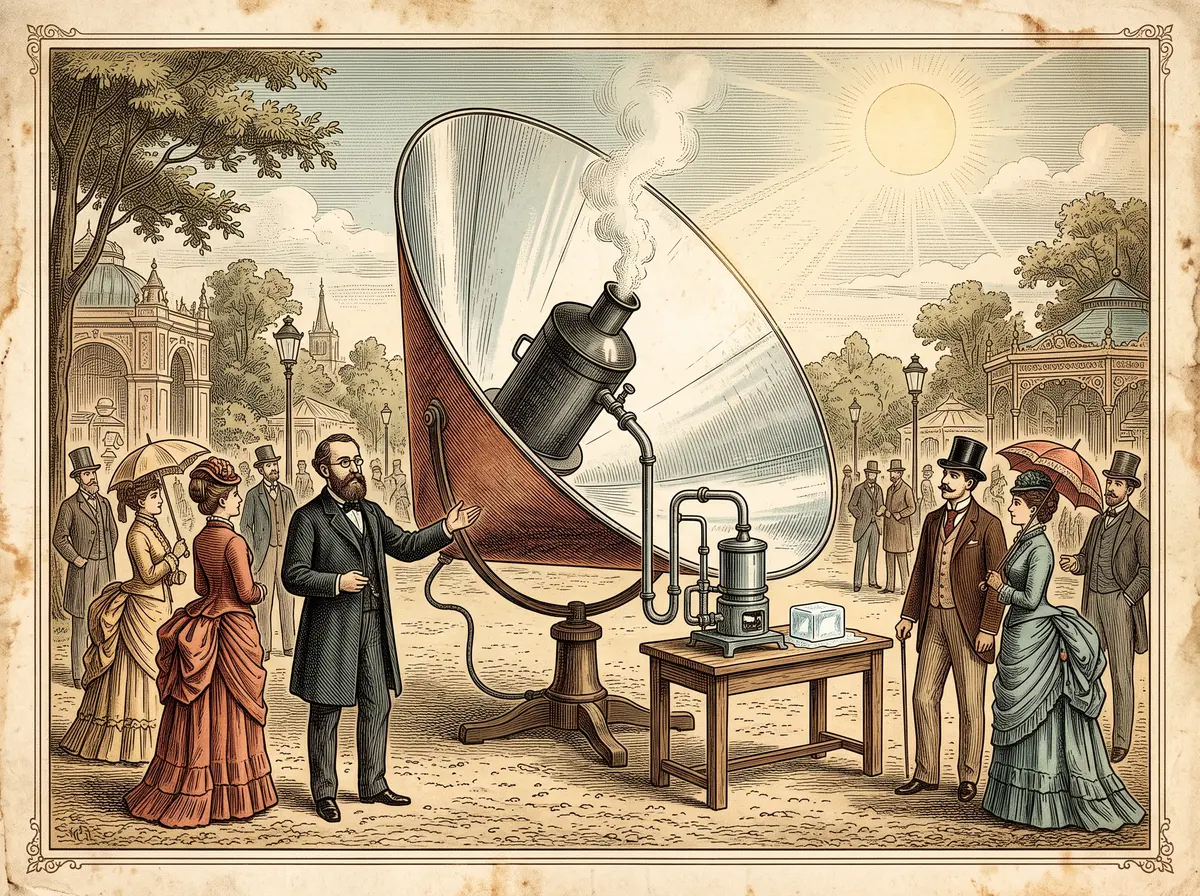
In the summer of 1878, visitors to the Paris World's Fair could walk up to a giant silver cone, roughly five meters across, tilted toward the sky in the park of the Trocadéro. At its center, a blackened boiler hissed with steam. Nothing was burning. The heat came from sunlight, and the man who built it, a provincial math teacher named Augustin Mouchot, used that same sunshine to do something that sounds backwards: make ice.
By the Curiosities Desk · · 5 min read · Filed under Physics · Today’s round
What happened: The Math Teacher Who Made Ice Out of Sunshine — Until a Report Poured Cold
Augustin Mouchot was born in 1825 in Semur-en-Auxois, in Burgundy, and spent most of his working life teaching mathematics in French secondary schools. Around 1860, while teaching at the lycée in Alençon, he began experimenting with sunlight. His first prototype used the blackened inside of a wooden crate to trap heat. Within a year he had produced steam, and in 1861 he patented a solar water heater.
What drove him was coal. Mid-1800s France ran on it, and France didn’t have much. In his 1869 book, La chaleur solaire et ses applications industrielles (“Solar Heat and Its Industrial Applications”), Mouchot warned that, unlike forests, coal stocks are not replenished. He wanted a fuel nobody could run out of.
By 1866, now teaching at the lycée in Tours, he had two small steam engines running on Tours sunshine. They used curved mirrors to focus light onto a glass-covered boiler. That year he presented his apparatus to Emperor Napoleon III, who had the experiments repeated at Biarritz and encouraged him to continue. Mouchot’s biggest machine of the decade was put on display in Paris, but it was lost during the Siege of Paris in 1870–71 and never found.
He kept building. In 1872 the regional council of Indre-et-Loire gave him 1,500 francs so he could work on the sun full time. In 1877 the French government sent him to Algeria, then a French colony with far more reliable sunshine, where he tested solar cooking, baking, distilling and water pumping.
Then came the 1878 Exposition Universelle. Mouchot and his young assistant, engineer Abel Pifre, showed the largest version yet: a silver-plated cone of roughly 20 square meters of mirror, concentrating sunlight onto a boiler that ran a steam engine with no fire at all. The judges awarded him a gold medal, and accounts of the prize single out one feat in particular: he had used concentrated solar heat to produce ice. That October he was made a Knight of the Legion of Honour.
For a moment, the sun looked like France’s next fuel. In 1880 the government even set up a commission to test solar engines for pumping water along a proposed railway across the Sahara. The tests, run through 1881 at a fort in Montpellier on a Pifre-built machine with a 3-meter reflector, were supervised by the physicist André Crova. The machine worked on 189 days that year. But in April 1882, Crova concluded that in France’s cloudy, temperate climate solar power was neither reliable nor economical compared with coal, which was easy to ship. He left open whether sunnier countries might be different.
The funding stopped. Coal had also become cheaper and easier to get in France, thanks to a free-trade treaty with Britain and better rail transport. Pifre’s solar company vanished within a couple of years. Mouchot himself had already retired in 1880, his health failing and his hearing nearly gone. He died in Paris in 1912, poor and nearly blind. His grand machine ended up as a curiosity.
Why it was strange: The Math Teacher Who Made Ice Out of Sunshine — Until a Report Poured Cold
The obvious strangeness is the ice. Using the hottest thing in the sky to freeze water feels like a magic trick. But the deeper surprise is the timing. A schoolteacher was worrying about fuel running out and building working solar power plants in the 1860s, before the light bulb, the car or the telephone.
It’s also strange how the story ended. Mouchot’s machine didn’t fail; it worked. It was beaten by a spreadsheet. One French science writer, Louis Figuier, complained that Crova’s report had poured cold water on Mouchot’s sun. For another giant mirror that tried to bend sunlight to human plans, see The Giant Space Mirror Russia Built to Turn Night Into Day.
What scientists learned: The Math Teacher Who Made Ice Out of Sunshine — Until a Report Poured Cold
Mouchot’s engines relied on a simple idea: concentration. Sunlight is spread thin. If you collect it over a large curved mirror and point all of it at one small target, that target gets very hot, hot enough to boil water and make steam. Painting the boiler black helps it absorb light, and a glass cover traps the heat, a small version of the greenhouse effect.
The ice used a cleverer trick called absorption refrigeration (cooling driven by heat instead of by a mechanical pump). In 1878 Mouchot paired his solar boiler with an ammonia refrigeration machine of the type designed by the Carré brothers. Heat drives ammonia gas out of a water solution. The ammonia condenses into a liquid, and when that liquid evaporates again, it soaks up heat from its surroundings, cold enough to freeze water. Heat in, cold out.
Crova’s tests taught a less glamorous lesson: an invention has to compete on cost and reliability, not just physics. In cloudy France, an engine that only works when the sun is out lost to a lump of coal you can burn at midnight. For another 19th-century story of scientists finding surprises in sunlight, see The Element Discovered on the Sun 27 Years Before Anyone Found It on Earth.
How it reaches us today: The Math Teacher Who Made Ice Out of Sunshine — Until a Report Poured Cold
Mouchot’s basic design is still in use. Concentrated solar power plants use fields of curved mirrors to focus sunlight, boil a fluid and drive turbines. Many now store that heat so they can keep producing electricity after sunset, solving the very problem that sank Mouchot in 1882.
Absorption refrigeration never went away either. It’s the principle behind gas-powered fridges in campers and off-grid cabins, and behind some solar-powered cooling systems. And the question Mouchot asked in 1869, about what happens when the fossil fuel runs out, is now one of the central questions of our century. For the longer story of how we learned to make cold on demand, see From a Cargo of Melting Ice to the Kitchen Fridge: A Short History of Refrigeration.
Fun fact: The Math Teacher Who Made Ice Out of Sunshine — Until a Report Poured Cold
On August 6, 1882, Abel Pifre set up a 3.5-meter solar mirror in the Tuileries Garden in Paris and used it to run a printing press. From 1 p.m. to 5:30 p.m., even under partly cloudy skies, it printed about 500 copies an hour of a newspaper made for the occasion. Its name: the Soleil-Journal, or “Sun Journal.”
Sources: The Math Teacher Who Made Ice Out of Sunshine — Until a Report Poured Cold
- “A Solar Printing Press,” Nature 26, 503–504 (1882): https://doi.org/10.1038/026503a0
- Bureau International des Expositions, “Expo 1878 Paris: The Revelation of Sun Power” (2017): https://bie-paris.org/site/en/latest/blog/entry/expo-1878-paris-the-revelation-of-sun-power
- Archives départementales d’Indre-et-Loire, “Augustin Mouchot”: https://archives.touraine.fr/document/augustin-mouchot
- Frédéric Caille (ENS de Lyon), “Le développement de l’énergie solaire a-t-il été torpillé en 1882 ?” (2025), on the Crova commission and its report: https://www.connaissancedesenergies.org/tribune-actualite-energies/le-developpement-de-lenergie-solaire-t-il-ete-torpille-en-1882
- Carolyn Taratko, essay on Mouchot and coal anxiety, Journal of the History of Ideas Blog: https://jhiblog.org/?p=1180