The Element Discovered on the Sun 27 Years Before Anyone Found It on Earth
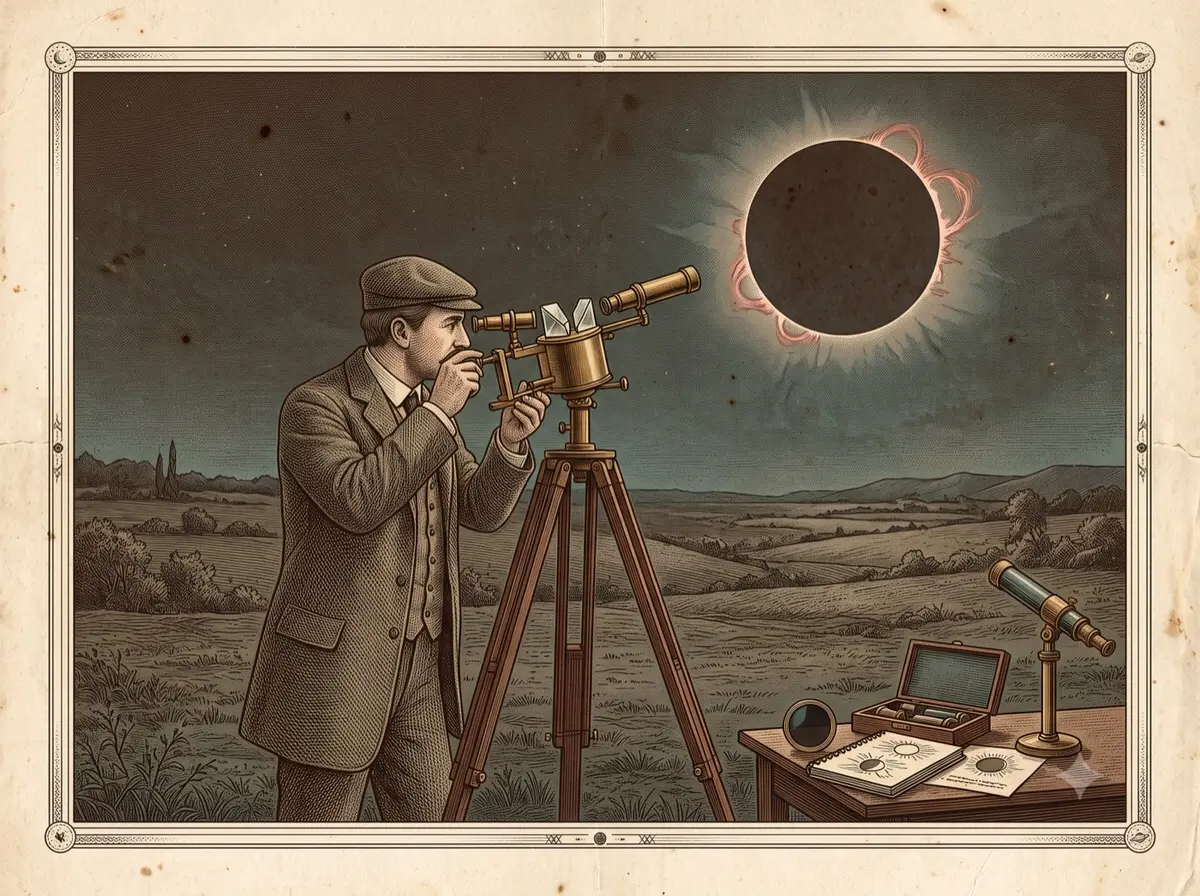
On August 18, 1868, a French astronomer stood in the path of a total solar eclipse in India, pointed an instrument at the edge of the blacked-out Sun, and saw a single bright yellow line of light that did not belong to anything on Earth. It was the signature of an element no one had ever held, weighed, or named. For the next twenty-seven years, the only known sample of it in the universe was 93 million miles away, glowing in the atmosphere of a star.
By the Curiosities Desk · · 5 min read · Filed under Space · Today’s round
What happened: The Element Discovered on the Sun 27 Years Before Anyone Found It on Earth
The astronomer was Pierre Jules César Janssen, who had traveled to Guntur, in southeastern India, to watch the eclipse. As the Moon covered the Sun, the glowing loops of gas at its edge — solar prominences — became visible, and Janssen trained a spectroscope on them. A spectroscope spreads light into its component colors, like a prism, revealing bright or dark lines that act as a fingerprint for the chemical elements producing the light.
Janssen saw a vivid yellow line. It sat very close to the familiar pair of yellow lines given off by sodium, but it was distinct from them — in the wrong place to be sodium. More remarkably, he realized the prominences were so bright in this light that he could study them in broad daylight, without waiting for an eclipse at all. The day after the eclipse, he did exactly that.
Across the world in England, the astronomer Joseph Norman Lockyer was working on the same problem with the same idea. In October 1868, observing the Sun’s prominences with a spectroscope of his own, Lockyer recorded the very same yellow line. The two men had made the discovery independently and almost simultaneously, and they are usually credited together.
Lockyer went further. Working with the chemist Edward Frankland, he compared the yellow line against everything known in the laboratory and concluded it matched no element on Earth. The line was eventually labeled “D3,” to set it apart from the nearby sodium “D” lines. Convinced it belonged to a new element, Lockyer gave it a name drawn from the Greek word for the Sun, helios. He called it helium.
Then came the long wait. Many chemists were skeptical of an element known only from a streak of starlight, and helium stayed a kind of astronomical rumor for decades. It was finally pinned down on Earth in 1895, when the Scottish chemist William Ramsay treated a uranium-bearing mineral called cleveite with acid and collected the gas that bubbled out. When its spectrum was examined, there was the D3 line again — the Sun’s mysterious yellow signature, now glowing in a glass tube in London. Lockyer himself confirmed the match. In the same year, the Swedish chemists Per Teodor Cleve and Nils Abraham Langlet independently isolated helium from the same kind of mineral.
Why it was strange: The Element Discovered on the Sun 27 Years Before Anyone Found It on Earth
Almost every element in the periodic table was discovered the ordinary way: someone isolated a substance, tested it, and catalogued it here on Earth. Helium did it backwards. It was found in the sky first and on the ground second — the only element to be identified in space before it was ever detected on our own planet.
Stranger still is what the discovery implied. Humans had never been to the Sun and never could. The idea that you could know what a star is made of, simply by carefully reading its light, struck many people of the era as nearly impossible. Just a few decades earlier, the philosopher Auguste Comte had famously offered the chemical composition of the stars as an example of something humanity could never hope to learn. Helium was the quiet rebuttal: the stars had been broadcasting their ingredients all along, and we had finally learned to read them.
Another thread pulled across centuries: From a Pilot Cut Out of His Own Suit to Moonwalks Sewn by a Bra Company: A Short History of the Spacesuit.
What scientists learned: The Element Discovered on the Sun 27 Years Before Anyone Found It on Earth
The deeper discovery here wasn’t really one element — it was a method. Every chemical element absorbs and emits light at its own exact set of wavelengths, a pattern as unique as a fingerprint. By splitting light into a spectrum and measuring where the bright and dark lines fall, scientists can identify which elements produced that light, even from impossibly far away. This is spectroscopy, and helium was one of its most dramatic early triumphs.
Researchers later learned that helium is no cosmic oddity but the second most abundant element in the universe, after hydrogen — together the two make up the overwhelming majority of all ordinary matter. It is also the second lightest element and famously unreactive, one of the “noble gases” that almost never bond with anything. On Earth, most helium isn’t left over from the planet’s formation at all; it is produced underground by radioactive decay, since the alpha particles thrown off by elements like uranium are simply helium nuclei. That buried, decay-made helium slowly accumulates and is collected today from certain natural gas fields.
Another idea followed the long way: The Astronomer Who Spent Eleven Years at Sea to Watch Venus Cross the Sun — and Missed It Anyway.
How it reaches us today: The Element Discovered on the Sun 27 Years Before Anyone Found It on Earth
The technique that found helium became the backbone of modern astronomy. Everything we claim to know about the composition of distant stars, glowing nebulae, and even the atmospheres of planets orbiting other suns rests on reading starlight the way Janssen and Lockyer first did. When astronomers announce that an exoplanet’s air contains water vapor or carbon dioxide, they are using a far more refined version of the same trick.
Helium itself turned out to be quietly essential. Cooled to about minus 269 degrees Celsius, liquid helium is one of the coldest practical substances on Earth, and it chills the superconducting magnets inside MRI scanners in hospitals around the world. It is used to pressurize and purge rocket fuel systems, to detect tiny leaks in machinery, in deep-sea breathing mixtures, and — most visibly — to lift party balloons. Because usable helium is gathered slowly from underground and easily escapes into space once released, supplies are genuinely limited, and periodic helium shortages have forced hospitals and laboratories to ration a gas first spotted in the corona of the Sun.
A close cousin: The September That Jumped From the 2nd to the 14th.
Fun fact: The Element Discovered on the Sun 27 Years Before Anyone Found It on Earth
In 1872 the French government struck a commemorative medal honoring the study of the Sun’s light — and to settle the question of credit gracefully, it bore the portraits of both Janssen and Lockyer, side by side. Two scientists, one element, discovered on a star neither of them could ever visit.
Sources: The Element Discovered on the Sun 27 Years Before Anyone Found It on Earth
- “Helium,” Wikipedia — https://en.wikipedia.org/wiki/Helium
- “Helium,” Royal Society of Chemistry, Periodic Table — https://www.rsc.org/periodic-table/element/2/helium
- “Norman Lockyer,” Encyclopaedia Britannica — https://www.britannica.com/biography/Joseph-Norman-Lockyer
- “Helium Discovered in the Sun,” American Physical Society, APS News (This Month in Physics History) — https://www.aps.org/publications/apsnews/200902/physicshistory.cfm
- “The Solar Eclipse of 1868 and the Discovery of Helium,” NASA / Goddard Space Flight Center — https://eclipse.gsfc.nasa.gov/
Related stories: The Element Discovered on the Sun 27 Years Before Anyone Found It on Earth
- The Blank Squares That Predicted Three Undiscovered Elements — Mendeleev left gaps in his table, and the missing elements showed up
- The Seaweed Ash That Ate Its Own Vats — and Gave Up a New Element — Seaweed ash corroded its own vats and gave up a new element
- The Graduate Student, the ‘Little Green Men,’ and the Nobel That Got Away — She found pulsars; the Nobel went to her supervisor