Science Through Time · Chemistry
The Blank Squares That Predicted Three Undiscovered Elements
In 1875, a French chemist named Paul-Émile Lecoq de Boisbaudran announced he'd found a new element, one he could see in a spectroscope but had never held. Before he'd even finished celebrating, a letter arrived from a Russian chemist he had never met, telling him his measurements were wrong. The Russian had never seen the element either. He'd never even left St. Petersburg. He was right anyway.
By the Curiosities Desk · · 6 min read · Filed under Chemistry · Today’s round
What happened: The Blank Squares That Predicted Three Undiscovered Elements
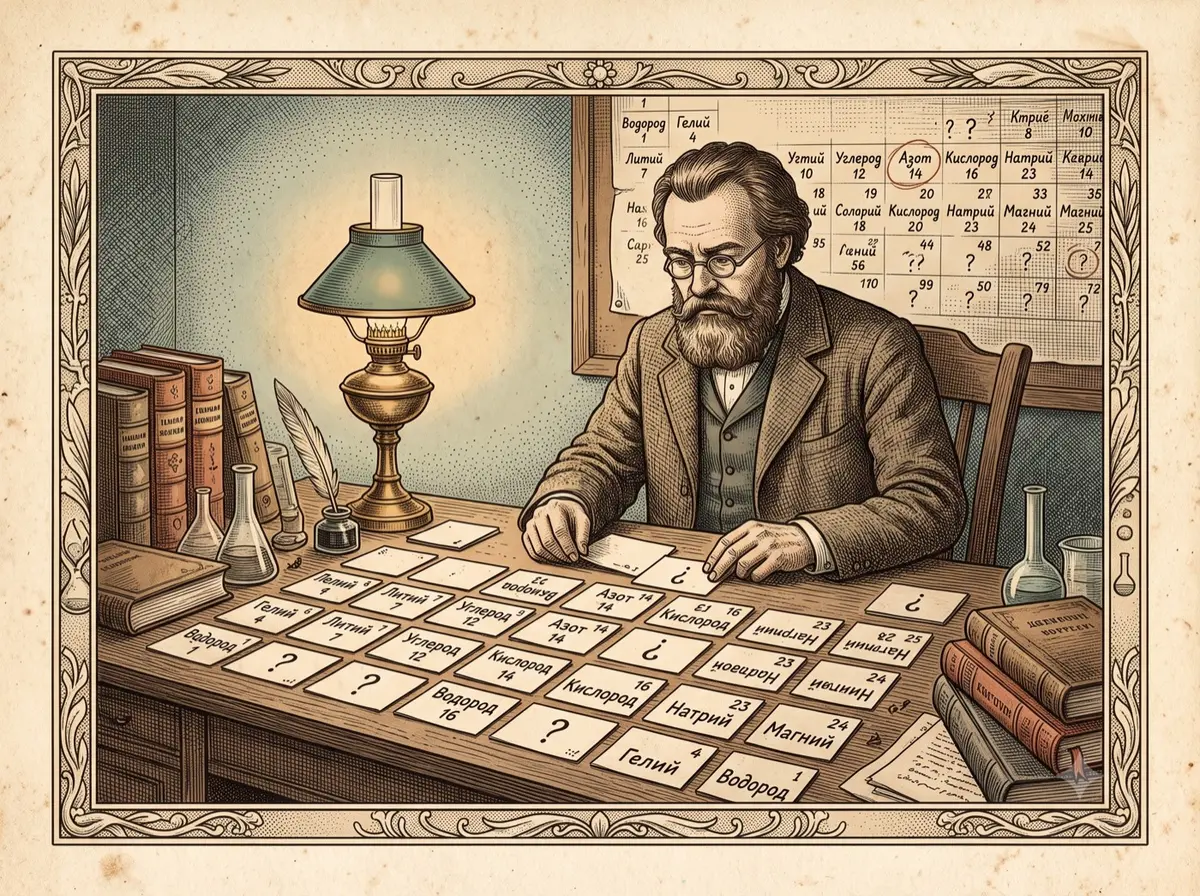
By the 1860s, chemists had identified around 63 elements, and the field was drowning in loose facts: atomic weights, melting points, reactivity, with no obvious order tying them together. Dmitri Mendeleev, a Russian chemistry professor writing a textbook, set out to organize them. According to an account he gave later in life, he wrote the name, atomic weight, and key properties of each known element on its own card, then arranged and rearranged the cards like a hand of solitaire, searching for a pattern. A popular version of the story adds that the final arrangement came to him in a dream — Mendeleev himself later wrote, “I saw in a dream a table where all elements fell into place as required.” No such deck of cards has ever turned up among his papers, so historians treat the dream, and possibly the cards themselves, as legend layered onto a real breakthrough rather than a confirmed fact.
What is well documented is the moment of publication. On March 6, 1869 (by the calendar used in Western Europe; Russia still used the older Julian calendar at the time), a paper titled “The Relation of the Properties to the Atomic Weights of the Elements” was read aloud to the Russian Chemical Society in St. Petersburg. Mendeleev wasn’t there to deliver it himself — he was traveling through the Tver and Novgorod provinces on assignment for the Free Economic Society, inspecting cheese dairies. A colleague, Nikolai Menshutkin, read the paper in his place.
Mendeleev wasn’t the first to notice patterns among the elements. The French geologist Alexandre-Emile Béguyer de Chancourtois had plotted elements on a spiraling cylinder in 1862. The British chemist John Newlands spotted a repeating pattern every eight elements in 1865 and called it the “Law of Octaves” — an idea the Chemical Society mocked so thoroughly that one reviewer suggested he might as well have arranged the elements alphabetically. The German chemist Lothar Meyer built a table strikingly similar to Mendeleev’s, organized by how many other atoms each element could bond with, but didn’t publish it until 1870, a year after Mendeleev.
What set Mendeleev apart was his willingness to trust the pattern over the data. When an element’s known atomic weight put it in a spot that didn’t match its chemical behavior, he moved it. Iodine and tellurium, for instance, appeared out of order by weight, but he placed them according to how they actually behaved, and later measurements proved him right. More strikingly, when the pattern demanded an element that hadn’t been discovered yet, he simply left the square blank and predicted what would eventually fill it. He identified gaps for at least three such elements, nicknaming them eka-aluminium, eka-boron, and eka-silicon, from the Sanskrit word for “one,” meaning “one place beyond” their neighbors on the table.
Why it was strange: The Blank Squares That Predicted Three Undiscovered Elements
Predicting the past is easy; explaining known facts after the fact is what most science does. Predicting the future is much riskier, especially when you’re predicting the existence of matter nobody has ever detected. Mendeleev didn’t just guess that gaps existed. He forecast specific, checkable numbers: atomic weight, density, melting point, even the color and behavior of compounds these unnamed elements would form. That is the equivalent of describing a stranger’s face, build, and voice in detail before ever meeting them, and then having them walk through the door.
The stranger part came a few years later. When Lecoq de Boisbaudran discovered gallium in 1875 by spotting its unique spectral lines in zinc ore, he measured its density at about 4.7 grams per cubic centimeter. Mendeleev, reading the announcement in Russia, wrote back insisting the density had to be closer to 5.9, matching his prediction for eka-aluminium, and suggested Boisbaudran’s sample was simply impure. Boisbaudran repurified his gallium and measured again. The new figure came in at 5.9. A theorist who had never touched the element corrected the man who discovered it, based on nothing but a pattern on paper.
Another idea followed the long way: From a Beach Bonfire to a Cake in a Battery Jar: A Short History of Glass.
What scientists learned: The Blank Squares That Predicted Three Undiscovered Elements
The periodic table’s deeper lesson wasn’t really about gallium, germanium (discovered in 1886, filling the eka-silicon slot), or scandium (1879, filling eka-boron). It was that the properties of matter aren’t a random pile of facts to memorize — they follow an underlying order tied to the internal structure of the atom. Mendeleev built his table around atomic weight because that was the measurable quantity available to him; it took until 1913, six years after his death, for the English physicist Henry Moseley to show that the true organizing principle is atomic number, the number of protons in an atom’s nucleus, measured directly from the X-rays each element produces. That discovery explained the handful of spots, like iodine and tellurium, where Mendeleev’s weight-based ordering had needed a manual correction.
The predictions also validated a way of doing science: building a model, then testing it against something that doesn’t exist yet. When the noble gases (helium, neon, argon, and their relatives) were discovered in the 1890s, they initially looked like they might not fit anywhere on Mendeleev’s table. Instead, they slotted in as an entirely new column, further confirming that the underlying structure was real rather than a coincidence of the elements already known.
Another thread pulled across centuries: From Frog Legs to Lithium: A Short History of the Battery.
How it reaches us today: The Blank Squares That Predicted Three Undiscovered Elements
The periodic table hanging in classrooms worldwide is a direct descendant of Mendeleev’s 1869 arrangement, extended with the atomic-number ordering and the noble gas column, and now stretching to 118 confirmed elements. It remains one of science’s most efficient pieces of information design: a single chart that tells a chemist an element’s likely reactivity, bonding behavior, and physical properties just from its position. Element 101, discovered in 1955, was named mendelevium in his honor, one of the rare elements named directly for a person rather than a place or mythological figure. Every gallium arsenide chip in an LED, every germanium transistor in early computing, and every scandium alloy in aerospace parts sits in a spot on the table that a Russian professor, sorting cards or not, described before anyone had isolated a single atom of the metal.
A close cousin: The Experiment So Slow Its Keeper Watched for 52 Years and Never Saw a Single Drop Fall.
Fun fact: The Blank Squares That Predicted Three Undiscovered Elements
Mendeleev’s outside interests were almost as wide-ranging as his periodic table: he consulted on Russia’s oil industry, studied the physics of gases, and, as noted above, was literally inspecting cheese production on government business the day his most famous paper was read to the scientific world.
Sources: The Blank Squares That Predicted Three Undiscovered Elements
- Royal Society of Chemistry, “Development of the periodic table” — https://periodic-table.rsc.org/history/about
- Royal Society Publishing, “The periodic law of the chemical elements,” Philosophical Transactions A — https://royalsocietypublishing.org/rsta/article/378/2180/20190537/41062/The-periodic-law-of-the-chemical-elements-The-new
- Le Moyne College, “Mendeleev’s First Periodic Table” (annotated translation) — https://web.lemoyne.edu/~giunta/ea/mendeleevann.html
- Encyclopaedia Britannica, “Dmitri Mendeleev” — https://www.britannica.com/biography/Dmitri-Mendeleev
- Royal Society of Chemistry, “Gallium — Element information, properties and uses” — https://periodic-table.rsc.org/element/31/gallium
Related stories: The Blank Squares That Predicted Three Undiscovered Elements
- The Alchemist Who Boiled Urine Looking for Gold and Found Phosphorus — An alchemist boiled urine looking for gold and found glowing phosphorus
- The Element Discovered on the Sun 27 Years Before Anyone Found It on Earth — Helium was found in sunlight 27 years before anyone found it here
- The Superheavy Element That Only Existed in One Scientist’s Data — An element that existed only in one researcher’s fabricated data