The Superheavy Element That Only Existed in One Scientist's Data
On June 7, 1999, Lawrence Berkeley National Laboratory announced that its scientists had created a brand-new element, heavier than any atom ever made — three atoms of it, born and gone in less than a second apiece, deep inside a particle accelerator. Two years later, the lab admitted something stranger than the discovery itself: the atoms had never existed. The evidence for them lived only in the private analysis of one physicist, and when other people finally checked his raw numbers, the decay chains he'd reported simply weren't there.
By the Curiosities Desk · · 6 min read · Filed under Physics · Today’s round
Part of When the Experiment Left the Lab
What happened: The Superheavy Element That Only Existed in One Scientist's Data
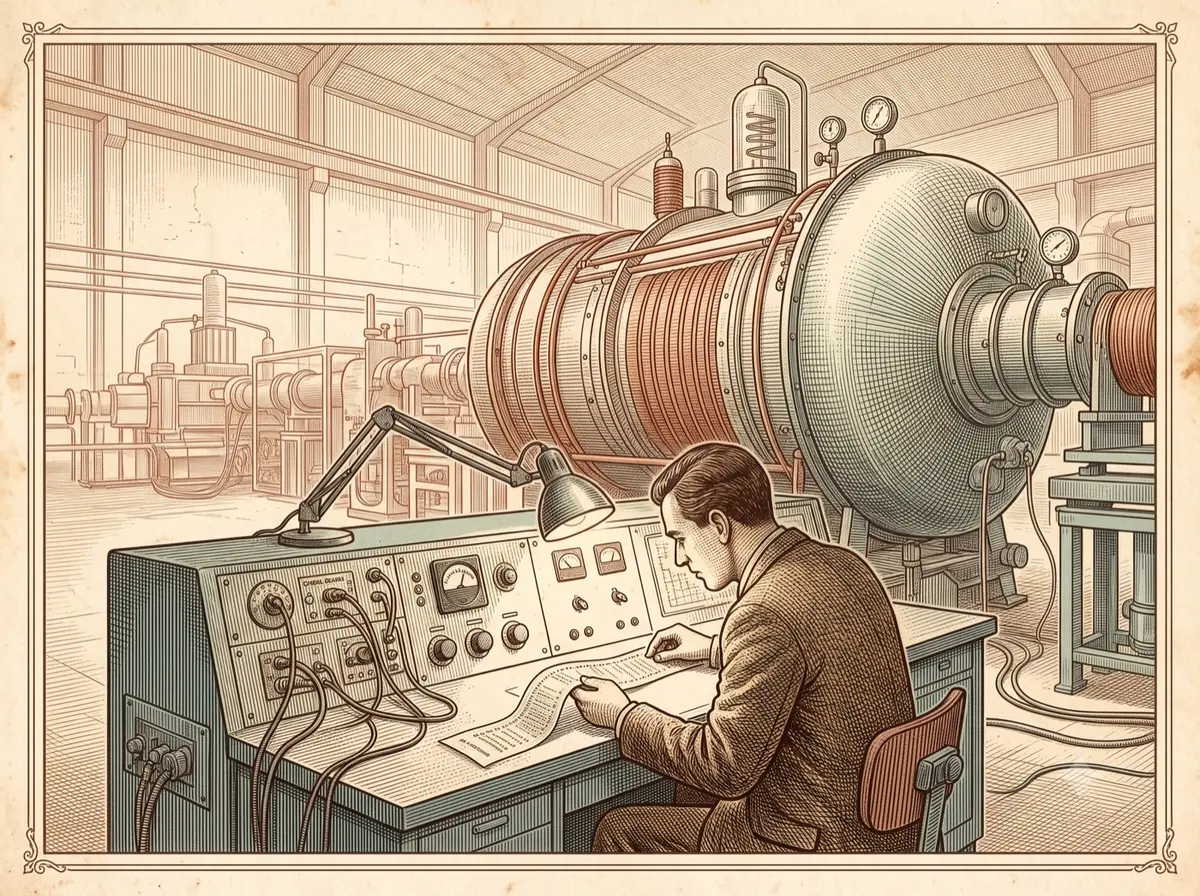
The element was number 118 — one proton heavier than anything on the periodic table at the time. The team, led by nuclear chemist Kenneth Gregorich with nuclear physicist Victor Ninov as first author, worked at Berkeley Lab’s 88-Inch Cyclotron, using a newly built instrument called the Berkeley Gas-filled Separator (BGS) to sort the debris from atomic collisions. Their approach followed a theoretical prediction, nicknamed “Robert’s magic recipe” after visiting Polish physicist Robert Smolańczuk, that firing krypton-86 ions at a lead-208 target could fuse the two nuclei into something new — a reaction the field had mostly written off as too unlikely to try.
Over 11 days of bombardment, the team reported three separate decay chains: an atom of element 118 that formed for a fraction of a millisecond, then shed a rapid sequence of six alpha particles as it decayed down through elements 116, 114, and on to lighter, already-known elements. That signature — six correlated, high-energy alpha decays within about a second — was the fingerprint of a genuinely new nucleus, and it lined up with a decades-old prediction that certain superheavy atoms, with roughly 114 protons and 184 neutrons, should sit on an “island of stability,” lasting far longer than their neighbors on the chart. Team member Darleane Hoffman said she wished Nobel laureate Glenn Seaborg, who had died just months earlier, could have lived to see it.
One detail took on enormous importance later: Ninov was the only person on the team who knew how to run the software that combed the raw accelerator data for these decay signatures. As had also happened during his earlier, legitimate work at Germany’s GSI laboratory, he effectively worked alone at the analysis stage, and colleagues had to take his results on faith.
The trouble started almost immediately. Labs at GSI in Germany and RIKEN in Japan tried to reproduce the result and found nothing; Berkeley’s own follow-up runs failed too. When Ninov reported another possible sighting in a later experiment, a colleague reviewing the same data disagreed, and this time the lab convened a technical committee to re-examine the original 1999 files from scratch with independent software. They searched the raw binary data for the three reported decay chains. None of them were there. In a short statement submitted to Physical Review Letters in July 2001, the research team retracted the claim outright: “We conclude that the three reported chains are not in the 1999 data.” A follow-up investigation concluded that Ninov had fabricated the results, and Berkeley Lab dismissed him in 2002. Every co-author but Ninov signed the formal published retraction; he has maintained his innocence ever since.
Why it was strange: The Superheavy Element That Only Existed in One Scientist's Data
Most retractions in science come from honest mistakes: a miscalibrated instrument, a statistical fluke, a reaction nobody else could repeat. This one was different. The problem wasn’t that the data had been misread — the specific evidence being pointed to didn’t exist in the underlying files at all. A discovery that had briefly extended the periodic table turned out to rest on numbers that one person had apparently typed rather than measured. It’s a rare case where “science is self-correcting,” as Berkeley Lab’s director put it at the time, had to correct not a flawed theory but an invented one.
Another time it went sideways: The Manhole Cover a Nuclear Test Fired Into the Sky — and the Single Camera Frame That Caught It.
What scientists learned: The Superheavy Element That Only Existed in One Scientist's Data
The deeper lesson wasn’t about nuclear physics — it was about how physics keeps its books. Letting one specialist have exclusive, unverifiable control over the software that turns raw detector output into a claimed discovery was a structural weak point, and this episode exposed it. Afterward, the American Physical Society pushed for clearer co-authorship standards, requiring every listed scientist to vouch for their specific contribution rather than trust a single analyst’s word. The reforms landed around the same time as physics’s other major fraud scandal of that era, Bell Labs researcher Jan Hendrik Schön’s fabricated semiconductor results, and together the two cases reshaped how the field thinks about verifying data.
On the nuclear physics side, the actual science behind the claim wasn’t wrong — it was just unearned in 1999. The island-of-stability prediction that inspired the experiment held up. A Russian-American collaboration between the Joint Institute for Nuclear Research in Dubna and Lawrence Livermore National Laboratory legitimately produced element 118 starting around 2002, through a different fusion reaction, with results that other labs could actually reproduce.
Another good intention with a bad landing: The Navy That Swapped Lemons for Limes — and Forgot How to Cure Scurvy.
How it reaches us today: The Superheavy Element That Only Existed in One Scientist's Data
Element 118 is real. It sits on the periodic table today as oganesson, confirmed by the International Union of Pure and Applied Chemistry in 2015 and formally named in 2016 in honor of physicist Yuri Oganessian, who led the team that actually found it. It’s a noble gas by position, though so radioactive — its longest-lived isotope survives less than a millisecond — that no one has observed enough of it to test whether it behaves like one. The retraction also left a quieter legacy: modern superheavy-element labs now build in redundant, cross-checked analysis pipelines specifically so that no single researcher’s unverified word can stand in for a discovery, a safeguard that traces directly back to the 1999 affair.
A close cousin: The Turkey Benjamin Franklin Tried to Electrocute — and Shocked Himself Instead.
Fun fact: The Superheavy Element That Only Existed in One Scientist's Data
For a brief window between the 1999 announcement and the 2001 retraction, chemistry textbooks and periodic table posters around the world listed element 118 under its placeholder name, “ununoctium” — Latin-Greek shorthand for “one-one-eight” — making it, for a couple of years, the periodic table’s only entry that was later un-discovered and then rediscovered for real under a different name entirely.
Sources: The Superheavy Element That Only Existed in One Scientist's Data
- “New Superheavy Elements 116 and 118 Discovered at Berkeley Lab,” Lawrence Berkeley National Laboratory press release, June 7, 1999 (with 2001 editor’s retraction note) — https://enews.lbl.gov/Science-Articles/Archive/elements-116-118.html
- “Results of Element 118 Experiment Retracted,” Lawrence Berkeley National Laboratory press release, 2001 — https://enews.lbl.gov/Science-Articles/Archive/118-retraction.html
- Schwarzschild, Bertram, “Lawrence Berkeley Lab Concludes that Evidence of Element 118 Was a Fabrication,” Physics Today, September 2002 — https://physicstoday.aip.org/news/lawrence-berkeley-lab-concludes-that-evidence-of-element-118-was-a-fabrication
- Dalton, Rex, “California lab fires physicist over retracted finding,” Nature 418, 261 (2002) — https://doi.org/10.1038/418261b
- “Victor Ninov,” Wikipedia (cross-referenced against the primary sources above) — https://en.wikipedia.org/wiki/Victor_Ninov
Related stories: The Superheavy Element That Only Existed in One Scientist's Data
- Cold Fusion: The Breakthrough That Wasn’t — Two chemists announced fusion in a jar; nobody could repeat it
- The Blank Squares That Predicted Three Undiscovered Elements — Mendeleev left gaps in his table, and the missing elements showed up
- Piltdown Man: The Fake Fossil That Fooled Science for 40 Years — A skull that fooled paleoanthropology for four decades