The Manhole Cover a Nuclear Test Fired Into the Sky — and the Single Camera Frame That Caught It
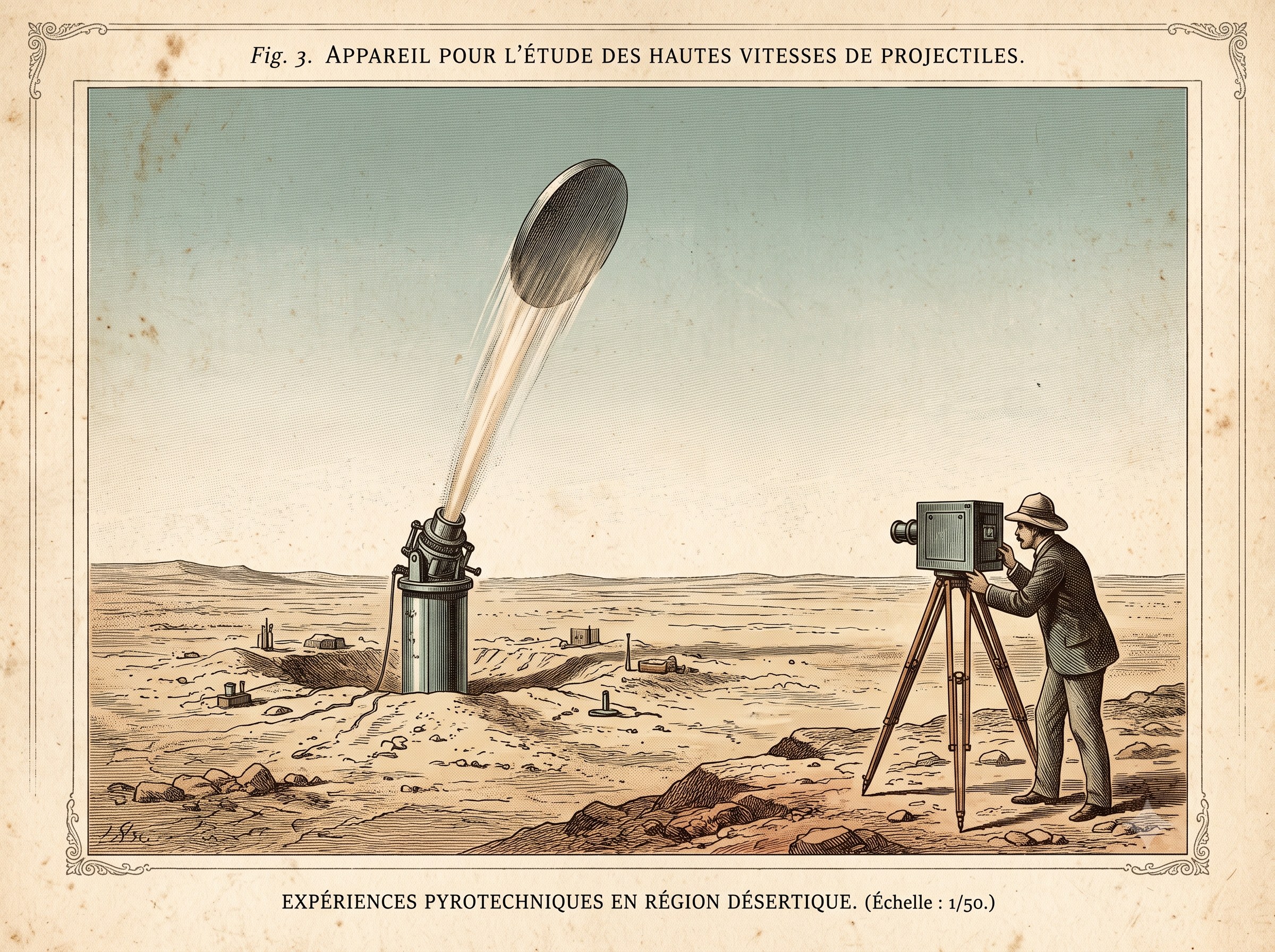
On the afternoon of August 27, 1957, a high-speed movie camera in the Nevada desert was pointed at a four-inch-thick steel plate welded over a hole in the ground. Five hundred feet below the plate sat a nuclear device. The camera was there to answer one question: how fast does the lid come off? The lid appears in exactly one frame — a smear, already leaving. Then it is gone, and it has never been seen again.
By the Curiosities Desk · · 6 read · Filed under Physics · Today’s round
What happened?
In 1956, Alvin Graves, head of the Test Division at Los Alamos, told a young astrophysicist named Robert Brownlee that America was going to have to move its nuclear tests underground to cut down on fallout. Then he asked Brownlee to figure out whether that was even possible.
Brownlee had almost nothing to work with. Computers in 1956 were, in his own words, “laughable, and miniscule, and arguably nonexistent.” He had equations of state — the physics describing how a material behaves under extreme pressure and temperature — for exactly four substances: air, water, aluminum, and uranium. Nevada soil is full of aluminum, so aluminum stood in for dirt. Uranium he called “fire.” As he later wrote: “with earth, air, fire and water, how could I fail?”
He and deputy division leader Bill Ogle designed a stepwise series: fire a device at the bottom of an open shaft, then cap the shaft, then add plugs, moving them closer and closer to the bomb.
Step one was Pascal-A, fired on July 26, 1957, at the bottom of a 485-foot shaft. It was a one-point safety test — an experiment meant to confirm that if a warhead were set off accidentally at a single point, it would barely react at all. The predicted yield was one to two pounds of TNT equivalent. The actual yield was roughly 55 tons. Test director Robert Campbell described the result in a Department of Energy oral history: “Biggest damn Roman candle you ever saw! It was beautiful. Big blue glow in the sky.” There had been a lid on that hole, too. Nobody ever found it.
Step two was Pascal-B, a near-duplicate device fired at 3:35 p.m. local time on August 27, 1957, in a shaft 500 feet deep and four feet across. This time the shaft was capped with welded steel four inches thick, and — the crucial change — a concrete plug was set in the shaft just above the device. The prediction was again one to two pounds. The yield was about 300 tons.
Before the shot, Ogle wanted a number. Brownlee’s account of the conversation is the reason any of us know this story:
Ogle: “How fast does it go?” RRB: “My calculations are irrelevant on this point… I have only a vacuum above the cap. No air, no gravity, no real material strengths in the iron cap.” Ogle: “And how fast is it going?” RRB: “Six times the escape velocity from the earth.”
Ogle was thrilled — he had never heard a speed quoted in units of escape velocity — and he told the story to anyone who would listen. “The legend was now born,” Brownlee wrote. So they aimed a high-speed camera at the cap to get a real number. They got one frame: no velocity, only a floor. Brownlee’s summary was that when last seen, it was “going like a bat!!”
Why was it strange?
Here is the part that shouldn’t work. A nuclear fireball loses its punch fast; by the time a 300-ton blast has expanded a few meters, its energy density is no better than ordinary high explosive. The cap was more than 150 meters away. It should have been shoved, not launched.
The concrete plug is what changed the math. Sitting right on top of the device, it absorbed a large share of the energy and vaporized into a column of superheated gas, which expanded up a four-foot pipe with nowhere else to go. Pascal-B had accidentally become an enormous single-shot gun, with the steel cap as its bullet. The whole point of the experiment was containment. The lid was the containment.
Another time it went sideways: The Superheavy Element That Only Existed in One Scientist’s Data.
What did scientists learn?
Practical answers, mostly. Plugs helped, and the closer to the device the better. Packing the shaft — “tamping” — was better still. Even a bare, open hole, Brownlee found, could cut the release to the atmosphere by as much as 90 percent. Three weeks after Pascal-B, the Rainier shot was fired 899 feet inside a Nevada mesa and was fully contained. Underground testing was suddenly a real option.
And the cover? Almost certainly, it did not reach space. Brownlee’s number described a plate in a vacuum with no air, no gravity, and no material strength. The actual plate had to cross sixty miles of atmosphere. Analysis published by the Nuclear Weapon Archive notes that incoming meteoroids under about eight tonnes retain none of their cosmic velocity after that trip; a steel disc weighing a fraction of that would fare no better. Nor does losing it prove anything — Pascal-A’s cap also vanished, with no hypersonic launch involved. Brownlee was clear: “of course we did not believe that would ever happen.”
Another good intention with a bad landing: The ‘Demon Core’: The Plutonium Sphere That Killed Two Scientists.
How does it affect us today?
Containment research is why the 1963 Limited Test Ban Treaty was possible at all: it pushed testing underground, and underground testing only worked because of experiments like these. The stakes were not theoretical. Operation Plumbbob released about 58,300 kilocuries of radioactive iodine-131 — more than twice any other continental test series — and the National Cancer Institute later linked that fallout to tens of thousands of expected thyroid cancer cases among American civilians.
The cover has had a second life as folklore, endlessly reposted as “the fastest object humans ever made” — a clean case study in how a carefully hedged calculation escapes its caveats and becomes a fact. The fastest human-made object we can actually measure is NASA’s Parker Solar Probe, clocked at roughly 430,000 miles per hour as it whips past the Sun.
This story touches on the health effects of nuclear testing. Readers who want the documented record can start with the National Cancer Institute’s I-131 study, summarized in the Plumbbob source below.
A close cousin: The Turkey Benjamin Franklin Tried to Electrocute — and Shocked Himself Instead.
Fun fact
Pascal-A went off late at night only because the crew had fought equipment problems all day and someone suggested they just fire it rather than come back in the morning. The result, Brownlee wrote, was “the world’s finest Roman candle” — blue fire hundreds of feet into the desert sky, and a group of the country’s best physicists driving away very quickly without stopping to count heads.
Sources
- Robert R. Brownlee, “Learning to Contain Underground Nuclear Explosions”, June 2002 — Brownlee’s own first-person account, written for the Nuclear Weapon Archive.
- “Operation Plumbbob”, Nuclear Weapon Archive — test-by-test data for Pascal-A, Pascal-B, and Rainier, including yields, depths, and the physics analysis of the cap’s velocity.
- James Carothers et al., Caging the Dragon: The Containment of Underground Nuclear Explosions, DOE/NV-388 — the U.S. Department of Energy oral history containing the Campbell and Brownlee interviews.
- “The (Unfounded) Legend of a Manhole Cover Launched into Space By a Nuke”, Snopes — traces how the claim spread and why Brownlee rejected it.
- Robert R. Brownlee (1924–2018), Bulletin of the American Astronomical Society — obituary and career summary.