The Turkey Benjamin Franklin Tried to Electrocute — and Shocked Himself Instead
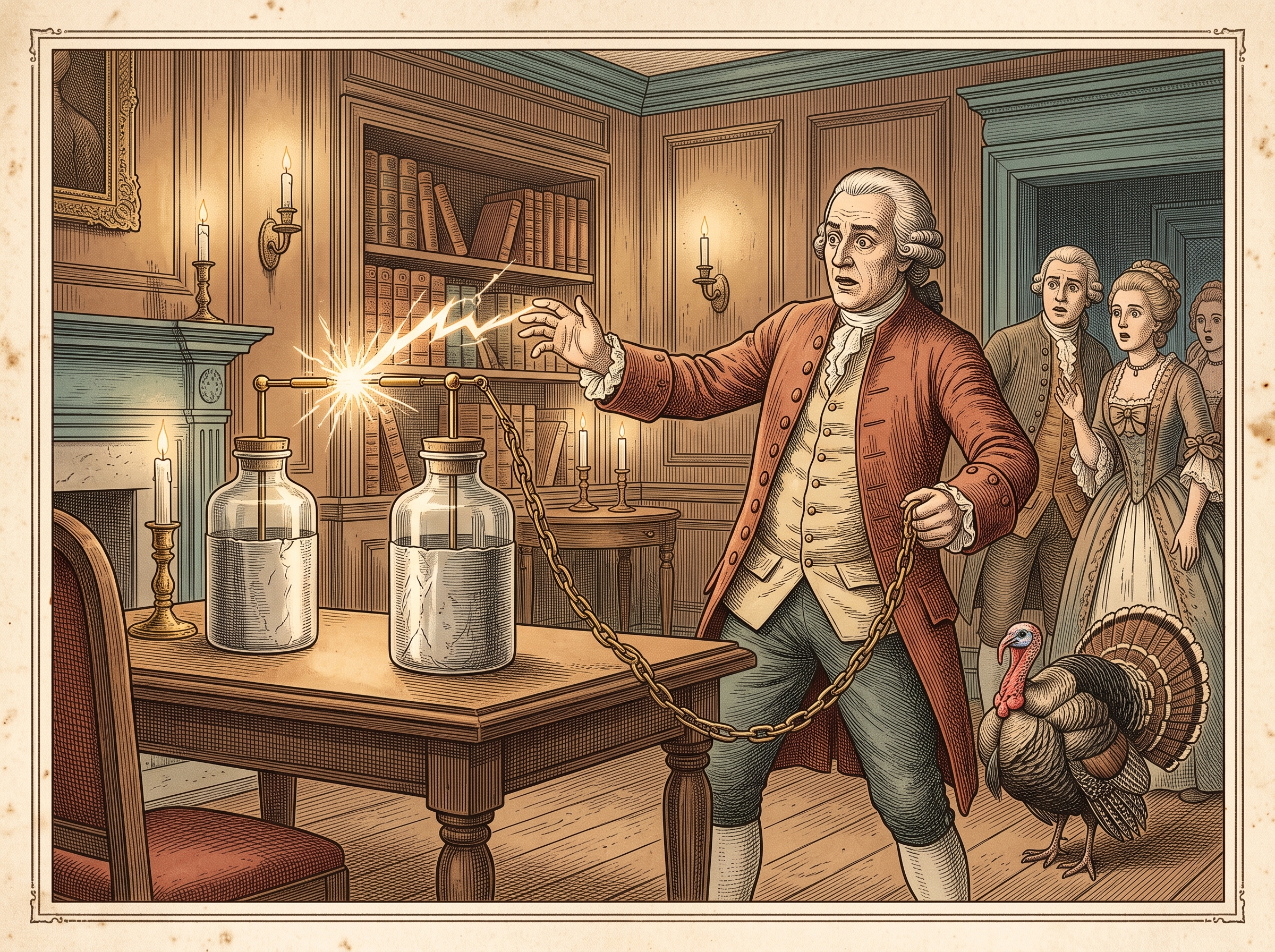
On the evening of December 23, 1750, in Philadelphia, Benjamin Franklin stood before a small audience with a turkey, two six-gallon glass jars packed with electricity, and a plan. The plan was for the turkey to receive the shock. Then, distracted by chatter from his guests, Franklin grabbed the wrong things at the wrong moment. The room saw a flash and heard a crack "as loud as a Pistol." Franklin saw and heard nothing at all — his senses, he later wrote, were "instantly gone." Nobody recorded what happened to the turkey.
By the Curiosities Desk · · 5 min read · Filed under Physics · Today’s round
What happened?
In 1750, Benjamin Franklin was 44, retired from printing, and devoted to the scientific craze of the day: electricity. Since 1746 he had been experimenting with Philadelphia friends including Ebenezer Kinnersley. Their key tool was the Leyden jar — a glass jar coated with metal foil inside and out that could store an electric charge and release it all at once. Today we’d call it a capacitor (a device that stores electrical energy between two conductors separated by an insulator). Wire several together and you had what Franklin called an “electrical battery.”
Franklin was also a little frustrated. In April 1749 he wrote to his London correspondent Peter Collinson that the group was “Chagrin’d a little” at having discovered nothing “of Use to Mankind.” So he proposed ending the season “somewhat humorously” with a party on the banks of the Schuylkill River. A turkey would be killed by electric shock, roasted on a spit turned by an electrically driven wheel, over a fire lit by an electric spark, while guests toasted famous electricians with “Electrified Bumpers” — wine glasses charged to zap the drinker’s lips. The letter describes the party as planned; how closely the real picnic matched the menu isn’t recorded in detail.
Killing a turkey this way turned out to be harder than it sounded. Franklin reported that two big jars would kill a hen outright, but turkeys, “tho’ thrown into violent Convulsions, and then lying as dead for some Minutes, would recover in less than a quarter of an Hour.” Only when the team combined five jars did they manage to kill a turkey of about 10 pounds.
Somewhere in these trials came the blunder. Franklin described it in a letter dated Christmas Day, 1750, most likely to his brother John. “Two nights ago,” he wrote, he had been about to kill a turkey using two large jars holding “as much electrical fire as forty common Phials.” He was checking whether the jars were fully charged — something he often did safely by drawing a small spark to his hand. But this time his other hand was holding the chain connected to the outside of both jars. The charge went “thro’ my own Arms and Body.”
He felt “an universal Blow thro’out my whole Body from head to foot,” followed by violent shaking. As his senses returned, he couldn’t work out why the jars were empty until he noticed the chain in his hand. The part of his hand that held it stayed white “as tho’ the Blood had been Driven Out” for eight or ten minutes. His arms and neck were numb until the next morning, and his breastbone stayed sore — in a second account to Collinson, he said for a week.
He asked that the story go no further than fellow experimenter James Bowdoin: “I am Ashamed to have been Guilty of so Notorious A Blunder.” Bowdoin made a copy — which survives today at the Massachusetts Historical Society.
Why was it strange?
Franklin was one of the leading electrical experimenters in the world. He had personally worked out many of the rules his mishap broke. He was the one who described electricity as a single “fire” with plus and minus states, and who explained that a Leyden jar only discharges when something connects its inside to its outside.
His accident was a textbook demonstration of his own theory — performed on himself. One hand touched the wires to the inside of the jars; the other held the chain to the outside. His body completed the circuit. And the man soon to be famous for taming lightning blamed it, in part, on his guests talking to him.
The same thread — Leyden jar — continues in The Abbé Who Shocked 200 Monks in a Line a Mile Long to Time the Speed of Electricity.
What did scientists learn?
Franklin, being Franklin, took notes on his own electrocution. Because he didn’t see the flash, hear the crack, or feel the spark hit his hand, he concluded that electricity moved faster than “Sound, Light and animal Sensation” — faster, in other words, than his nerves could report it.
He also wrote to Collinson that “a Man can without great Detriment bear a much greater Electrical Shock than I imagin’d,” while wondering what would happen if a shock like that passed through the head. That was a real, if accidental, data point in an era when nobody knew how much electricity a human body could survive.
Then there was the turkey itself. Franklin noted that birds killed by electricity seemed to “eat uncommonly tender.” In 1773, French friends asked him about electric meat tenderizing, and he answered that he could only offer “conjectures,” since he lacked enough experiments. He compared it to lightning splitting a tree’s fibers, then signed off with a warning that the operator should be careful not to “mortify his own flesh instead of that of his hen.”
Elsewhere in physics: From Ringing Church Bells to Lightning-Rod Hats: A Short History of the Lightning Rod.
How does it affect us today?
Franklin’s hunch about tender meat turned out to have something to it. Beginning in the 1950s, researchers studied carcass electrical stimulation — running current through meat shortly after slaughter — and the technique came into commercial use in the early 1970s. A 2014 review in the Asian-Australasian Journal of Animal Sciences explains that it speeds up the chemical changes after death that lead into rigor mortis, which can improve tenderness. The same review, which cites Franklin, notes the results vary between species and muscles, and the underlying mechanisms are still debated.
The bigger legacy is the vocabulary. Franklin helped give us positive, negative, charge, and battery — the same words on the batteries and capacitors inside nearly every device you own. And the basic lesson of his turkey mishap still holds for anyone working with electricity: a charge needs a complete path, and you never want that path to be you.
Another time it went sideways: The Superheavy Element That Only Existed in One Scientist’s Data.
Fun fact
Franklin’s “Electrified Bumper” — a wine glass that shocked your lips — came with a footnote. It only worked, he explained, “if the Party be close shaved, and does not breathe on the Liquor.”
Please don’t try to recreate any of this: large capacitors can deliver dangerous or fatal shocks even when a device is unplugged.
Sources
- Benjamin Franklin to [John Franklin?], 25 December 1750 — Founders Online, National Archives
- Benjamin Franklin to Peter Collinson, 4 February 1751 — Founders Online, National Archives
- Benjamin Franklin to Peter Collinson, 29 April 1749 — Founders Online, National Archives
- Benjamin Franklin Tries to Electrocute a Turkey — Massachusetts Historical Society
- Efficacy of Carcass Electrical Stimulation in Meat Quality Enhancement: A Review — Asian-Australasian Journal of Animal Sciences (2014), via PMC
#Benjamin Franklin #electricity #Leyden jar #Turkey #18th century #history of physics