Science Through Time · Physics
From Ringing Church Bells to Lightning-Rod Hats: A Short History of the Lightning Rod
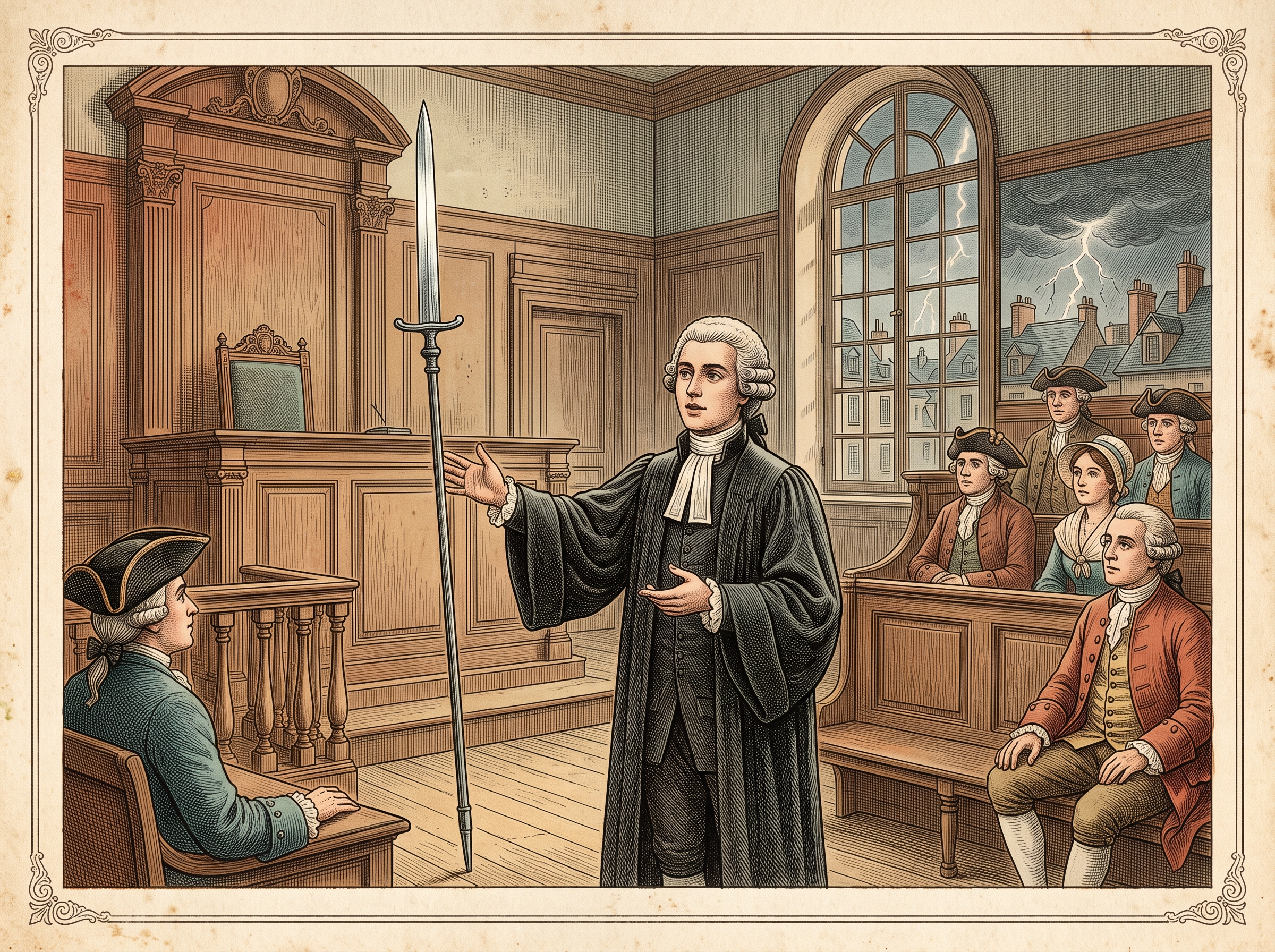
In May 1783, in a courtroom in Arras, France, a 25-year-old lawyer stood up to defend a piece of metal on a chimney. His client's neighbors had called it a danger to the whole town of Saint-Omer. The young lawyer argued that it was perfectly safe — and he won. His name was Maximilien de Robespierre, and his first famous case was a lawsuit over a lightning rod.
By the Curiosities Desk · · 5 min read · Filed under Physics · Today’s round
What happened?
For centuries, the standard defense against lightning in much of Europe was sound. When a storm rolled in, people climbed church towers and rang the bells, a custom rooted in the belief that bells could break up storms. Some bells even carried a Latin motto along the lines of fulgura frango — “I break the lightning.” The trouble was that a church steeple is often the tallest thing in town, which makes it one of lightning’s favorite targets, and the person ringing the bell was standing right underneath it holding a long rope. An often-quoted 18th-century tally — usually traced to a 1784 pamphlet by Johann Fischer arguing that storm bell-ringing did more harm than good — counted 103 bell ringers killed over roughly three decades. The figure circulates mostly secondhand, so treat it as a period estimate, not a census.
The alternative came from Philadelphia. In letters to his London correspondent Peter Collinson around 1750, Benjamin Franklin proposed that lightning was electricity and that a sharp iron rod, run down a building into the earth, could carry it safely to the ground. The proof arrived in France before Franklin got to try it himself: on 10 May 1752, at Marly-la-Ville near Paris, a retired dragoon following Franklin’s plan drew sparks from a tall insulated iron rod during a storm. Franklin’s own kite experiment came that June. In the 1753 edition of Poor Richard’s Almanack, he told readers how to put up a pointed rod with its lower end in moist ground, promising that a house so equipped “will not be damaged by Lightning.”
Franklin put one on his own house — with a twist. He split the conductor and hung two small bells between the ends, with a little brass ball dangling between them, so that the bells would chime whenever a charged cloud passed overhead. He got an early-warning doorbell for thunderstorms.
Then the rod became fashionable — literally. Around 1778, Parisians could buy a chapeau paratonnerre, a lightning-rod hat with a metal band and a little chain that trailed down the back of the wearer’s clothes to drag on the ground. Gentlemen could carry an umbrella with a metal spike and a grounding chain to match. How many people actually wore them is unclear.
Not everyone was charmed. Around 1780 in Saint-Omer, a retired lawyer named Charles Dominique de Vissery de Bois-Valé mounted a rod on his chimney topped with a blade shaped like a sword. A neighbor complained, and the town’s aldermen ordered it taken down. Vissery appealed to the Council of Artois in Arras. His legal team, including young Robespierre, argued in May 1783 that experience had shown lightning rods to be safe and useful, and on 31 May the court let Vissery put his rod back up. Robespierre had the pleas printed and mailed a copy to Franklin himself.
Across the Channel, the argument was about the tip. In 1772 a Royal Society committee that included Franklin and Henry Cavendish recommended pointed rods for the gunpowder magazines at Purfleet, east of London. One member, the painter and experimenter Benjamin Wilson, dissented and insisted that blunt, rounded ends were safer. When lightning damaged a Purfleet building in 1777, Wilson staged a giant demonstration in London’s Pantheon to make his case — and King George III, then at war with Franklin’s side of the Atlantic, sided with the blunt rods. According to a story that is repeated often but hard to document, the king ordered the Royal Society’s president, Sir John Pringle, to endorse knobs, and Pringle replied that he could not change the laws of nature. Pringle did resign the presidency in 1778; whether the quip is real is another matter.
Why was it strange?
The lightning rod asked people to trust something deeply counterintuitive: that the safest move was to put a metal spike on your roof and invite the lightning in. To a public raised on church bells, that looked like tempting fate — Saint-Omer’s neighbors were reasoning from what they knew.
And the argument over points versus knobs wasn’t settled by evidence at the time. It was settled by politics and personalities — Franklin was a rebel, and the king picked the other guy’s tip.
The same thread — Benjamin Franklin — continues in The Turkey Benjamin Franklin Tried to Electrocute — and Shocked Himself Instead.
What did scientists learn?
Lightning, it turned out, doesn’t need to be stopped. It needs a path. A rod at the top of a building, connected by a thick conductor to a ground electrode, gives a strike an easier route to earth than through wood, brick, or people. Franklin’s basic design — a rod on top, a conductor down, and a solid connection to the ground — remains the foundation of lightning-protection practice.
The tip debate got a surprising update in 2000. Researchers led by Charles Moore at New Mexico’s Langmuir Laboratory spent seven years mounting pairs of sharp and blunt rods on a 10,000-foot-plus mountain summit. Twelve blunt rods, with tips 12.7 to 25.4 millimeters across, were struck. None of the sharp Franklin rods were. The team concluded that a moderately blunt tip actually makes a rod more likely to catch a strike — a point, of sorts, for Benjamin Wilson. Both shapes still protect a building when properly grounded; the shape matters less than the connection to the earth.
Another idea followed the long way: From Frog Legs to Lithium: A Short History of the Battery.
How does it affect us today?
Every lightning protection system on a skyscraper, barn, church, or wind turbine traces back to Franklin’s sketch. Modern rods follow written standards for conductor size and grounding, and some now use rounded tips.
The lightning-rod hat, sadly, did not make a comeback.
Another thread pulled across centuries: From a Glass Frog Tied to Your Wrist to 98.6: A Short History of the Thermometer.
Fun fact
Franklin’s storm-warning bells may have rattled his wife, Deborah. In a June 1758 letter from London, he told her that if the bells bothered her, she could tie a wire from one bell to the other so the electricity would pass “silently” — though he thought it was better to let them ring, so she’d know to keep her distance.
A note: the bell ringers in this story learned the hard way that tall structures attract lightning. If you can hear thunder, you’re close enough to be struck — the U.S. National Weather Service’s advice is to head indoors and wait 30 minutes after the last thunder before going back out.
Sources
- Maximilien de Robespierre, letter to Benjamin Franklin, 1 October 1783, Founders Online, National Archives — with editorial notes on the Saint-Omer case, the Council of Artois appeal, and the 31 May 1783 ruling.
- Benjamin Franklin, letter to Deborah Franklin, 10 June 1758, Founders Online, National Archives — the advice about wiring the lightning bells.
- E. Philip Krider, “Benjamin Franklin and Lightning Rods”, Physics Today 59(1), 2006 — on the 1750 proposal, Marly-la-Ville, the kite, and Poor Richard’s instructions.
- University of St Andrews, Philosophical Transactions project, “The Acts of God Committee” — the 1772 Royal Society committee, Purfleet, and Benjamin Wilson’s dissent.
- C. B. Moore, G. D. Aulich and W. Rison, “Measurements of lightning rod responses to nearby strikes”, Geophysical Research Letters, 2000 — the seven-year sharp-versus-blunt rod field test.