Science Through Time · Physics
From a Glass Frog Tied to Your Wrist to 98.6: A Short History of the Thermometer
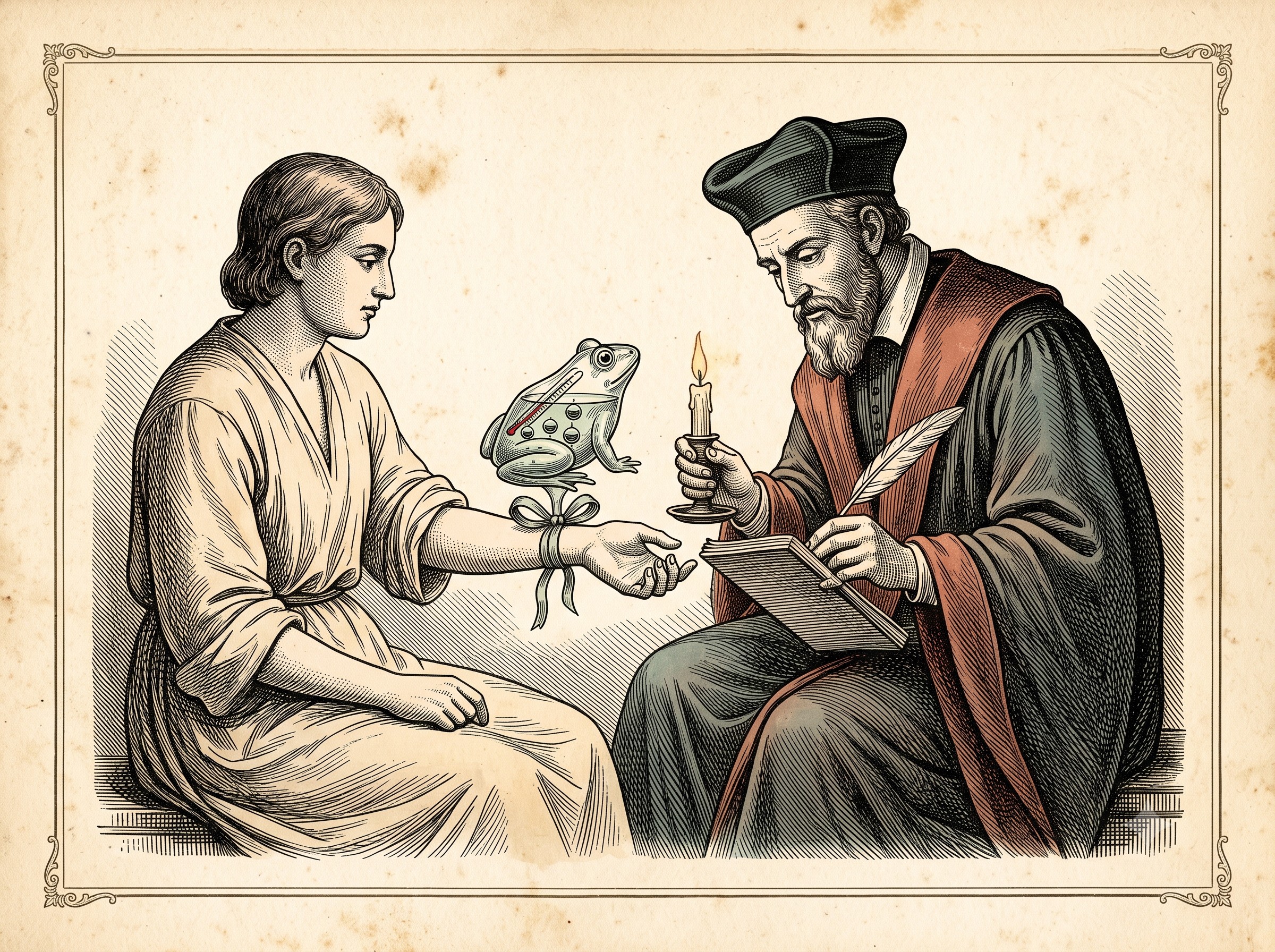
In a case in Florence sits a small glass frog, about three inches long, cracked and empty. In the mid-1600s it was full of grape spirit and a scatter of tiny glass spheres, and it was tied to a sick person's wrist, head pointing upward. As the patient warmed, the liquid expanded and the little spheres sank — the lightest first, then the next. That was the reading. The scholars who used it nicknamed the thing *infingardo*: the lazy one, because the spheres took so long to make up their minds.
By the Curiosities Desk · · 5 min read · Filed under Physics · Today’s round
What happened?
For nearly all of human history, “how hot is it?” was answered with a hand and an opinion. A physician could tell you a patient was burning up. He could not tell you by how much, or compare that patient to one he had seen the previous winter.
The first crack came in Padua, around 1600, when Galileo Galilei began working with a device now called a thermoscope — an instrument that shows changes in heat without measuring them. Warm a glass bulb with your hands, turn it upside down with its long neck standing in water, and let go: as the trapped air cools and contracts, water climbs the neck. An elegant demonstration, and a useless measuring device. It had no scale, and being open to the room it also responded to air pressure — a phenomenon nobody had yet identified.
In Venice in 1612, the physician Santorio Santorio built a similar instrument and did the thing that turned it into a tool: he put numbers on it, setting the top of his scale with a candle flame held to the bulb and the bottom with melting snow. He was also among the first to point one at a person and read a patient’s heat as data.
The next leap came from a Grand Duke. Around 1654, Ferdinand II de’ Medici had glassblowers fill a slender tube with acquarzente — distilled grape spirit — and melt the open tip shut. Sealing the tube cut the atmosphere out of the experiment: what the liquid did now depended on temperature alone. The Accademia del Cimento, the experimental society run out of the same court, turned these “Florentine thermometers” out in coils, clusters, tall stems — and frogs, for the wrist.
But every one was blown by hand, so every one had its own private scale. A degree in Florence meant nothing in London. Readings could not travel.
Fixing that took another lifetime. Daniel Gabriel Fahrenheit, an instrument maker who had visited the Danish astronomer Ole Rømer in 1708, settled on mercury and three anchor points, publishing with the Royal Society in 1724. Zero was the coldest he could reliably reach, a slush of water, ice, and ammonium chloride. Thirty-two was plain ice and water. Ninety-six was the heat of a healthy body — arbitrary-looking until you notice it sits exactly 64 degrees above 32, a span you can halve six times, which is how you graduate a tube by hand with dividers.
Then, in 1742, the Swedish astronomer Anders Celsius published a paper on two dependable fixed points, having shown that water’s freezing point does not shift with latitude or altitude, and that its boiling point, while it moves with air pressure, can be pinned down exactly once pressure is known. He numbered the scale with 0 at boiling and 100 at freezing.
Not a typo. On Celsius’s own thermometer, a hot day scored low and a Swedish January scored high. He died in 1744, and within a few years the scale had been turned right-side up — by Jean-Pierre Christin in Lyon in 1743, by Märten Strömer, Celsius’s successor at Uppsala, and by the botanist Carl Linnaeus in 1745, who later claimed the idea as his own. Which of them did it first is still argued.
Why was it strange?
The strange part is the gap. The instrument arrived around 1600; a number that meant the same thing in two different cities took another century and a half. In between, Europe had thermometers the way it had miles — everyone had one, no two agreed, and comparing them was a translation problem rather than a measurement.
And the man whose name now appears on every weather forecast on earth got his own scale backwards on the first try, in a paper that was otherwise careful and genuinely important.
The same thread — Measurement — continues in The Cylinder in a Paris Vault That Defined the Kilogram — Until It Started Losing Weight.
What did scientists learn?
The real lesson wasn’t about glass or mercury. It was about fixed points — reproducible physical events, like ice melting or water boiling, that anyone anywhere can recreate to anchor a scale. Fahrenheit’s contribution was insisting a thermometer be defined by such points rather than by whatever mark the glassblower scratched. Celsius’s wasn’t the numbering, which got flipped anyway; it was proving the points he chose held still.
Once temperature became portable, medicine could use it. In 1868 the German physician Carl Wunderlich published an analysis built on more than a million readings from roughly 25,000 patients, using a thermometer about a foot long that had to sit in the armpit for twenty minutes. Out of that mountain of data came one famous number: 37 °C, or 98.6 °F. Fever stopped being an impression and became something you could chart. Two years earlier, the English physician Thomas Clifford Allbutt had shrunk the instrument to six inches and the wait to five minutes.
Another idea followed the long way: From Ringing Church Bells to Lightning-Rod Hats: A Short History of the Lightning Rod.
How does it affect us today?
That 98.6 is doing more work than it deserves. It’s an average, converted from a round metric number, drawn from one nineteenth-century German patient population — and the underlying figure appears to have drifted. A 2020 study in eLife pooled body temperatures from three American groups spanning 157 years: 23,710 Union Army veterans, 15,301 people in a 1970s health survey, and 150,280 Stanford patients from 2007–2017. Adjusted for age, height, weight and time of day, mean body temperature fell steadily — about 0.03 °C per decade of birth. The authors suggest we simply run cooler now, plausibly because we carry less chronic inflammation and live in heated buildings. It’s one country’s data, describing populations rather than individuals, but it makes the “normal” on the box look like a historical artifact.
Meanwhile the instrument kept shrinking. The infrared thermometer aimed at your forehead reads in about a second — down from Wunderlich’s twenty minutes, which was itself down from a glass frog that had to think about it.
Elsewhere in physics: The Abbé Who Shocked 200 Monks in a Line a Mile Long to Time the Speed of Electricity.
Fun fact
The frog in the Museo Galileo’s collection — inventory number 2449, about 80 millimeters long — is still on display, still cracked, its grape spirit long since gone. After nearly four centuries, the laziest thermometer ever built has settled into registering nothing at all.
A note: if you’re using a thermometer because someone is sick, the number matters less than the person. Any fever that worries you — especially in an infant, or alongside confusion, difficulty breathing, or a stiff neck — is worth a call to a clinician rather than a comparison against 98.6.
Sources
- Daniel Gabriel Fahrenheit, “Experimenta circa gradum caloris liquorum nonnullorum ebullientium instituta”, Philosophical Transactions of the Royal Society, 1724 — Fahrenheit’s own account of his thermometer and its fixed points.
- Museo Galileo, “Frog” thermometer (Inv. 2449) — object record for the surviving Florentine clinical thermometer, including the infingardo nickname.
- Museo Galileo, Thermometer / thermoscope — museum overview of Galileo’s and Santorio’s thermoscopes and the Accademia del Cimento instruments.
- Linda Hall Library, Anders Celsius — on Celsius’s 1742 paper, his fixed-point experiments, and the inverted original scale.
- Myroslava Protsiv et al., “Decreasing human body temperature in the United States since the industrial revolution”, eLife 9:e49555, 2020 — the three-cohort study behind the drifting average.