The Scientist Behind It · Physics
The Abbé Who Shocked 200 Monks in a Line a Mile Long to Time the Speed of Electricity
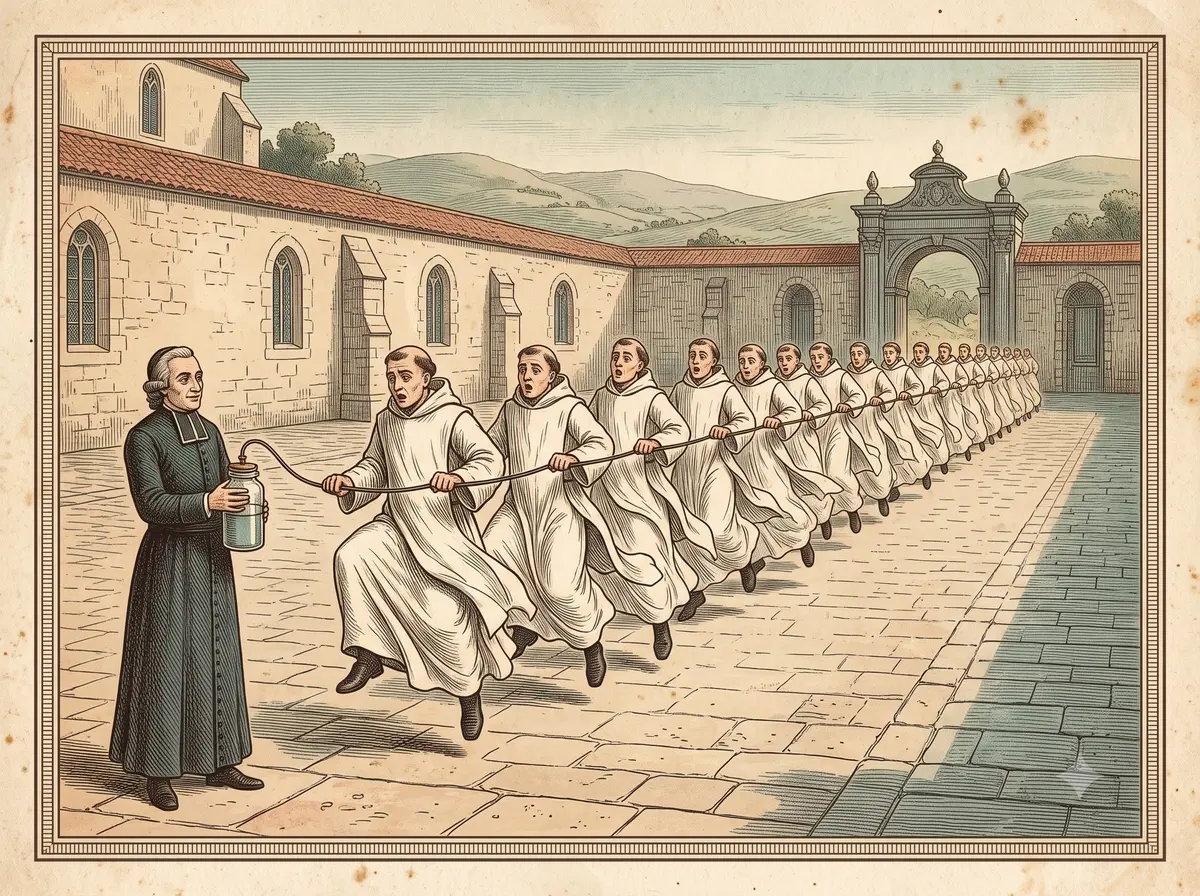
Somewhere in Paris in 1746, roughly two hundred Carthusian monks stood in a line more than a kilometre long, each man gripping the end of an iron wire that connected him to the brother beside him. At one end stood a deacon-turned-physicist with a glass jar full of stored charge. He touched the wire. Every monk in the line jumped at what appeared, to everyone watching, to be exactly the same instant.
By the Curiosities Desk · · 5 min read · Filed under Physics · Today’s round
Part of The Person Who Would Not Drop It
What happened: The Abbé Who Shocked 200 Monks in a Line a Mile Long to Time the Speed of
The man holding the jar was Jean-Antoine Nollet (1700–1770), a French clergyman who had drifted out of a clerical career and into experimental physics without ever dropping the title abbé. He assisted the chemist Charles Du Fay on electrical experiments in the early 1730s, was elected to the Royal Society of London in 1734, and by 1743 the French Royal Academy of Sciences had effectively made him its designated expert on electricity. In 1753 he became the first professor of experimental physics in France.
What set the stage was a new device. In 1745, Pieter van Musschenbroek in Leiden — and, independently, the German cleric Ewald von Kleist — found that a glass jar of water with a wire through the cork could hold a shocking amount of static charge. Musschenbroek described the resulting jolt in a January 1746 letter to his Paris correspondent René Réaumur, warning him never to try it: he would not repeat the experience, he wrote, for the whole kingdom of France. Nollet translated that letter, and he is generally credited with giving the device the name that stuck — the Leyden jar.
Nollet then did what almost nobody else was equipped to do: he asked how fast the effect travelled, and how far.
He had no instrument that could measure a fraction of a second. So he used the only detector available in 1746 that came in large quantities and could report what it felt: people. In April of that year, in Paris, he discharged a Leyden jar through a chain of 180 royal guards holding hands, a demonstration he repeated for King Louis XV. The entire company leapt at once. Soon after, he scaled it up at a Carthusian house, running iron wire between monks strung out over more than a kilometre — Britannica describes the white-robed monks as reportedly leaping simultaneously into the air.
The numbers wobble depending on which account you read. The most commonly repeated figure is about 200 monks over roughly 1.6 km, but some sources say 700, some describe a closed circle rather than a line, and some have the men holding brass rods rather than wire. Nollet’s own published accounts are the anchor; the retellings have drifted. What every version agrees on is the result: nobody could detect a delay.
Why it was strange: The Abbé Who Shocked 200 Monks in a Line a Mile Long to Time the Speed of
The strangeness isn’t the monks. It’s that this was a serious measurement, and the instrument was a crowd.
Nollet was trying to answer a real question that nobody had an answer to. Did electricity take time to get from one place to another? Did it weaken over distance? If it moved at some finite speed, a long enough line should reveal it — the far end would flinch after the near end, and an observer could see the ripple travel.
So he built the longest measuring device he could staff and watched for the ripple. It never came. The near end and the far end reacted together, as far as any human eye could tell. Nollet concluded that conduction happens with, in his phrasing, unlimited rapidity.
He was wrong in the specific and right in the general — which is a very ordinary way for an experiment to end, and an underrated one.
The same thread — Leyden jar — continues in The Turkey Benjamin Franklin Tried to Electrocute — and Shocked Himself Instead.
What scientists learned: The Abbé Who Shocked 200 Monks in a Line a Mile Long to Time the Speed of
Electricity in a wire does not travel at infinite speed. The signal propagates as an electromagnetic wave guided by the conductor, at a large fraction of the speed of light — typically somewhere around two-thirds of it in an ordinary cable.
That is fast enough to make Nollet’s experiment hopeless. Over 1.6 km, the delay between the first monk and the last is on the order of a hundred-thousandth of a second. Human reaction time is roughly twenty thousand times longer than that, and it varies from person to person by more than the entire quantity being measured. His instrument’s noise swamped his signal by four orders of magnitude.
The same wall stopped everyone else. In England, William Watson strung wire across the Thames at Westminster Bridge in 1747 and ran circuits at Shooter’s Hill of 6,732 feet and later 12,276 feet, eventually extending the loop to about four miles. He and his colleagues found no perceptible interval either, and concluded, as Nollet had, that transmission was instantaneous.
The problem wasn’t the idea. It was the clock. It took until 1834, when Charles Wheatstone discharged a Leyden jar through half a mile of copper wire in the vaults beneath King’s College London and photographed the sparks in a rapidly revolving mirror, for anyone to get a number. Wheatstone read the displacement of the image and calculated about 288,000 miles per second — an overestimate, since that is faster than light itself, but the first measurement in history that wasn’t a shrug.
Another person who would not drop the question: The Needle Isaac Newton Slid Behind His Own Eyeball to Find Out Where Color Comes From.
How it reaches us today: The Abbé Who Shocked 200 Monks in a Line a Mile Long to Time the Speed of
Nollet’s failed question is now a design constraint. Signal propagation delay is why transatlantic fibre has a floor of about 60 milliseconds no matter how much you pay, why high-frequency traders buy shorter cable routes, and why chip designers care about the length of a trace. Every engineer who has ever budgeted for latency is working on the problem Nollet couldn’t detect.
He also left a stranger legacy. In 1750 he noticed that water flowing from an electrified vessel would break into a fine mist — the first recorded observation of what we now call electrospray. That effect is the basis of electrostatic painting, and of electrospray ionization, the technique that finally let mass spectrometers weigh intact proteins and earned John Fenn a share of the 2002 Nobel Prize in Chemistry.
A brief note: Leyden jar discharges of this era were not trivial. Musschenbroek’s terror was real, and no contemporary account suggests the monks or guards were injured, but early electrical showmen across Europe did occasionally hurt themselves and their volunteers. Please don’t recreate this one.
Another scientist, told from the human side: The Physicist Who Cleaned His 40-Foot Spectrograph by Sending the Family Cat Through It.
Fun fact: The Abbé Who Shocked 200 Monks in a Line a Mile Long to Time the Speed of
Nollet’s other crowd-pleaser was the “electric boy” — a child suspended from the ceiling on silk cords and charged up until gold leaf flew to his hands and sparks jumped from his nose to anyone who leaned in. It was a party trick, but it was also a real demonstration that charge sits on a body’s surface and can be held there if you insulate it well enough.
Sources: The Abbé Who Shocked 200 Monks in a Line a Mile Long to Time the Speed of
- Britannica — Electromagnetism: Invention of the Leyden jar (the 180 royal guards before Louis XV, and the kilometre-long line of Carthusian monks joined by iron wire)
- Jean-Antoine Nollet, “Part of a Letter … to Martin Folkes Esq., concerning Electricity,” Philosophical Transactions 45 (1748): 187–194 — Nollet reporting his electrical work directly to the Royal Society
- Institute of Physics (IOP Spark) — “Electric monks” (the ~200 monks, the ~1.6 km chain, and Nollet’s “unlimited rapidity” conclusion)
- Engineering and Technology History Wiki — “Nollet Electrifies Royal Guard” (April 1746 dating, the 5,400-foot figure, and Watson’s follow-up)
- Linda Hall Library — Scientist of the Day: William Watson (Watson’s Thames and Shooter’s Hill circuits, and the completed-circuit insight)
Related stories: The Abbé Who Shocked 200 Monks in a Line a Mile Long to Time the Speed of
- The Horses That Battled an Army of Electric Eels — Humboldt drove horses into a pond full of electric eels
- From Frog Legs to Lithium: A Short History of the Battery — Twitching frog legs to the lithium cell in your pocket
- Nikola Tesla and the Pigeon He Loved — The inventor of AC power fell in love with a pigeon