The Scientist Behind It · Physics
The Needle Isaac Newton Slid Behind His Own Eyeball to Find Out Where Color Comes From
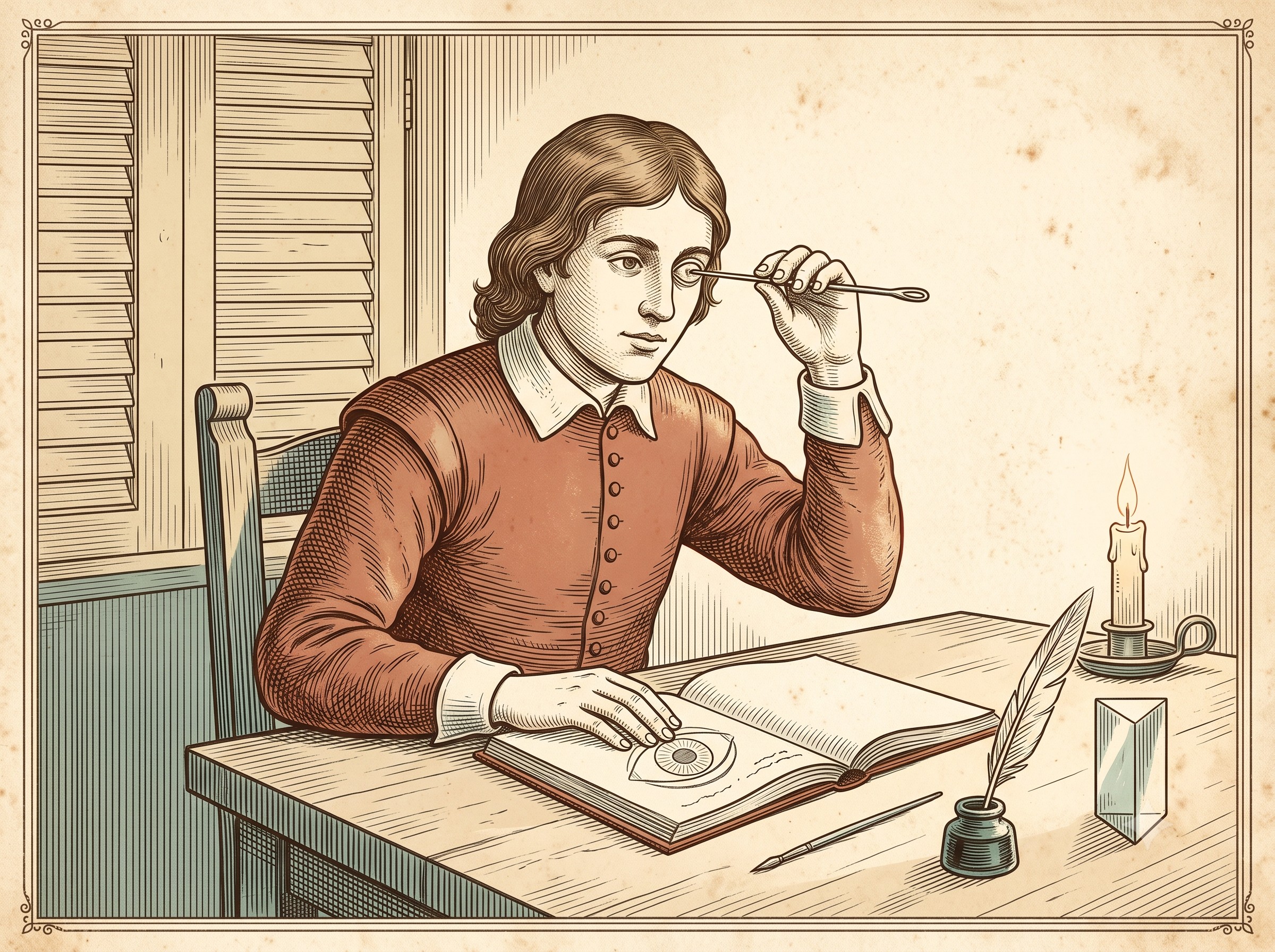
On a notebook page from 1665 or 1666, now kept in Cambridge University Library, Isaac Newton drew a careful diagram of his own eyeball. Curving in from the left, labeled *g* and *h*, is a needle. Underneath, in his handwriting, he explains that he slid the needle between his eye and the bone of the socket, pressed until the eyeball changed shape, and wrote down the colors that appeared. He was about twenty-three, and he wanted to know whether color lives in the light or in the person looking.
By the Curiosities Desk · · 5 read · Filed under Physics · Today’s round
What happened?
The notebook is catalogued as MS Add. 3975 at Cambridge University Library, and the essay in it is titled “Of Colours.” The Newton Project, the scholarly edition of Newton’s papers based at Oxford, dates it to 1665–66 — years Newton spent working largely alone, much of it while Cambridge was shut down by plague.
The experiment is numbered 58 in his own list. His description is worth reading in his spelling:
“I tooke a bodkin gh & put it betwixt my eye & the bone as neare to the Backside of my eye as I could: & pressing my eye with the end of it (soe as to make the curvature a, bcdef in my eye) there appeared severall white darke & coloured circles r, s, t, &c.”
A bodkin is not a sewing needle. It is a thick, blunt-tipped tool for threading ribbon through cloth — closer to a fat darning needle than to anything sharp. That matters, because Newton did not stab his eye. He worked the blunt end into the gap between the eyeball and the bony orbit that holds it, reached as far back as he could, and pushed. The eyeball deformed. Colored rings appeared.
Then he did what makes him Newton rather than merely reckless: he ran variations. The circles faded if he held both eye and bodkin perfectly still, and returned the moment he moved either one. In a lit room, a broad “blewish darke circle” appeared at the outer edge; in a very dark room, that same outer ring came back reddish instead. He sketched which parts of the retina — the light-sensitive tissue lining the back of the eye — were being stretched and which were being squeezed, and matched each region to the color it produced.
It was not his only experiment on himself. Around the same period he stood in a darkened room, which widens the pupil, and looked at the sun’s reflection in a mirror with his right eye, then turned to a dark corner to watch the afterimage fade. He did it three times. He described the aftermath twenty-seven years later, in a letter to the philosopher John Locke dated 30 June 1691: “in a few hours time I had brought my eys to such a pass that I could look upon no bright object with either eye but I saw ye sun before me, so that I durst neither write nor read.” He shut himself in a blacked-out room for three days. His vision returned over the following weeks, though for months the ghost of the sun came back whenever he thought hard about it — “even tho I lay in bed at midnight wth my curtains drawn.” His biographer Richard Westfall’s summary runs four words: “Newton left the sun alone after that.”
Why was it strange?
Strip away the wincing and there is a real question underneath — the central question of seventeenth-century optics. Was color a property of light itself, or something the eye and the mind manufactured, with light being merely white and colors being modifications introduced by the glass, or the eye, or the observer?
That is why the bodkin was not just self-harm with a notebook. If Newton could produce vivid colored rings with no light entering his eye at all — just pressure — then the eye clearly can generate color sensations on its own, and any theory of color had to account for it. He was attacking his own question from the inside, using the only piece of optical apparatus he had unrestricted access to.
It shares a shelf with The Doctor Who Ate, Slept, and Worked on a Giant Scale for 30 Years, in The Scientists Who Ran the Experiment on Themselves.
What did scientists learn?
Newton’s public answer, worked out with prisms rather than needles, was that white light is a mixture of rays that bend by different amounts. A prism does not add color; it separates what was already there. He argued this before the Royal Society in 1672, laid it out fully in Opticks in 1704, and it underlies every spectrum-splitting instrument we have.
What the bodkin itself revealed took longer to name. The rings Newton saw are now called phosphenes — the sensation of light produced by something other than light. Mechanical pressure deforms the retina, and the deformed cells fire the same signal they would send if photons had hit them. The brain does the only thing it knows how to do with that signal: it sees. The Czech physiologist Jan Evangelista Purkyně published the first systematic study in 1819, and the pressure variety is still called a deformation phosphene.
It would overstate things to say Newton got to the modern explanation. He was collecting data on a phenomenon nobody yet had a framework for. The framework — that a sensory nerve produces its own characteristic sensation no matter how you provoke it — arrived with nineteenth-century physiology.
The same thread — Self Experimentation — continues in The Doctor Who Rode a Rocket Sled at 632 MPH — and Gave Us Murphy’s Law.
How does it affect us today?
Phosphenes are no longer a curiosity; they are a design target. Retinal implants for some forms of blindness place an electrode array against the retina and stimulate it electrically, producing patterns of phosphenes that a trained user learns to read as shape and motion. Astronauts on Apollo, Skylab, and the International Space Station have reported light flashes with their eyes closed — the leading explanation is cosmic-ray particles passing through the eye and visual pathway.
The everyday version costs nothing: the swimming colors you see when you rub your closed eyes are Newton’s experiment, run without the bodkin.
Also in The Scientists Who Ran the Experiment on Themselves: The Doctor Who Drank a Beaker of Bacteria to Prove Ulcers Weren’t Caused by Stress.
FAQ
Did Isaac Newton stab his eye?
Around 1665–66 Isaac Newton slid a bodkin between his eyeball and the bone of the socket and pressed until the eye changed shape. He wrote down the colors that appeared. The account is in his essay “Of Colours,” in Cambridge University Library manuscript MS Add. 3975. He pressed on the eye. He did not pierce it.
What color were Isaac Newton’s eyes?
The notebook records the colors Newton saw when he deformed his own eyeball — phosphenes, produced by pressure — not the color of his iris. The experiment was about whether color lives in the light or in the person looking.
Fun fact
The notebook page still exists, and it is online. Newton’s own sketch — the eyeball, the bodkin labeled gh, the concentric circles labeled r, s, t — has been digitized by Cambridge University Library, so anyone with an internet connection can look at the drawing a twenty-three-year-old made of the inside of his own eye in the plague year of 1665.
A note: please don’t repeat either experiment. Pressing on the eye can damage the retina, and looking at the sun — even briefly, even in a mirror — can cause permanent vision loss with no pain to warn you. If you notice a persistent spot, flash, or shadow in your vision, that’s worth a same-day call to an eye doctor.
Sources
- Isaac Newton, “Of Colours,” MS Add. 3975, pp. 1–22 (c. 1665–6) — transcription of the bodkin experiment, The Newton Project, University of Oxford (primary source)
- MS Add. 3975 — Newton’s laboratory notebook, digitized manuscript images, Cambridge Digital Library (primary source)
- Newton to John Locke, 30 June 1691, in The Correspondence of Isaac Newton, vol. III (Cambridge University Press), pp. 153–154 (primary source)
- O.-J. Grüsser and M. Hagner, “On the history of deformation phosphenes and the idea of internal light generated in the eye for the purpose of vision,” Documenta Ophthalmologica 74 (1990)
- Andrew T. Young, “Eye injuries of early solar observers,” San Diego State University — full text of the Newton–Locke letter with citation