The Scientist Behind It · Medicine
The Doctor Who Ate, Slept, and Worked on a Giant Scale for 30 Years
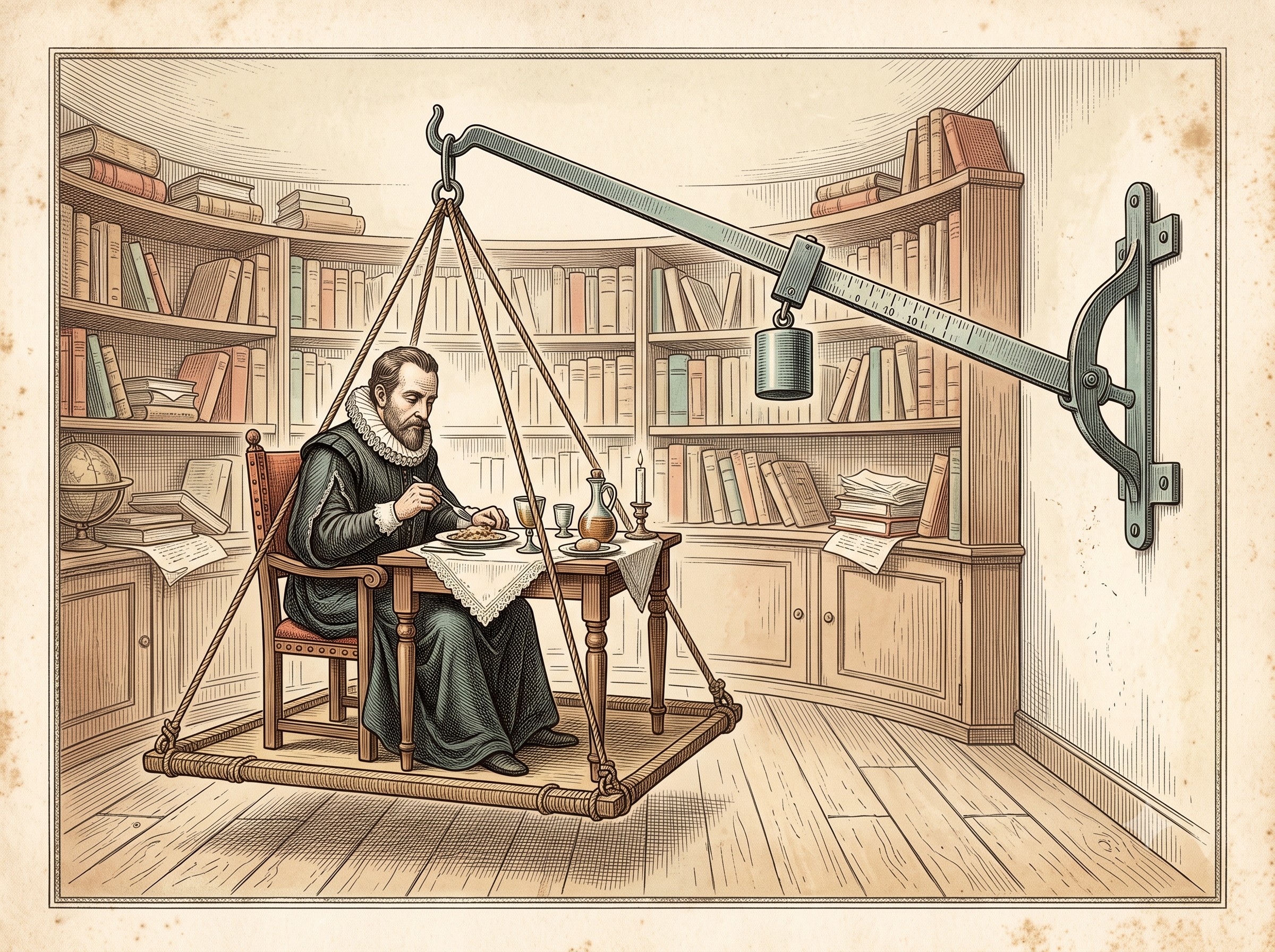
Somewhere in Padua around 1610, a respected professor of medicine sat down to dinner in a chair hanging from a giant steelyard scale. He ate on the scale. He worked on it. He slept on it. He got off it to use the chamber pot, weighed what came out, and climbed back on. He did this for roughly thirty years, and he did it because his own arithmetic kept coming up short: he was eating more than he was, by any visible measure, getting rid of.
· 5 read · Filed under Medicine
What happened?
The man in the chair was Santorio Santorio, born in Capodistria — modern Koper, Slovenia — on 29 March 1561, and known across Europe by the Latinized name Sanctorius. He took his medical degree at the University of Padua in 1582 and returned there as professor of theoretical medicine from 1611 to 1624. Padua at that moment was one of the best places in the world to be curious. Galileo had taught mathematics there until 1610, and the two men were friends and correspondents.
Santorio’s question was old and Galenic: health, in the medicine he was trained in, was a balance between what goes into a body and what comes out. Nobody had checked the books. Santorio decided to check them, on himself, with a scale.
His instrument was a platform holding a chair and a table, suspended from a steelyard — the arm-and-sliding-weight balance used by merchants. He weighed himself before and after meals, before and after sleep, before and after exercise, before and after using the chamber pot, and, according to the surviving accounts, before and after sex. He weighed the food going in. He weighed the urine and faeces coming out. And the two columns never matched.
The gap was enormous. Santorio concluded that the body was constantly shedding matter through routes nobody could see — through the pores of the skin and through the breath — and he gave the process a name that stuck for centuries: perspiratio insensibilis, insensible perspiration. Not sweat you can feel. The invisible kind.
In 1614 he published the results in Venice as Ars de statica medicina, “the art of static medicine.” It is a strange little book: no long arguments, just 552 numbered aphorisms, terse enough to memorize, in the tradition of Hippocrates. Aphorism five explains that insensible perspiration leaves either through the skin, “which is all over perspirable, and cover’d with a Skin like a Net,” or through the breath — a loss you can demonstrate, he notes, simply “by breathing upon a Glass.” He calculated that of eight pounds of food and drink taken in a day, about five pounds left the body invisibly.
It was a hit. De statica medicina went through edition after edition and translation after translation for more than a century. In February 1615 Santorio posted a copy to Galileo with a letter making his case: “It is clear that this art, invented by me, is indeed very important because it can measure precisely the perspiration that we cannot see.”
Why was it strange?
The balance is one of humanity’s oldest instruments — merchants had been weighing grain with steelyards for millennia. What nobody had done was point one at a living person and leave it there for three decades.
That is the genuinely odd part. Santorio wasn’t running an experiment; he was running a residency inside one. The chair was furniture and apparatus at once, and the data came from a man who had rearranged his entire domestic life — meals, sleep, digestion, marriage — around a measuring device. He also gathered weight records from patients and friends, reportedly including Galileo himself.
And he was chasing something no one could see, smell, or feel, using nothing but the discrepancy between two numbers. That is a very modern way to find an invisible thing.
What did scientists learn?
Santorio’s specific number was too big. Modern physiology puts insensible water loss — evaporation through skin and the humidifying of every breath — at roughly 600 to 800 millilitres a day in an unstressed adult, split fairly evenly between the two routes. That is a bit over a pound, not five.
But the shape of his answer was right, and the method mattered more than the figure. He had established that a body’s mass changes continuously through channels invisible to the senses, and that the way to find out is to measure. De statica medicina is generally described as the first systematic study of basal metabolism — the baseline energy and matter a body burns through simply by existing. Santorio also built a pulsilogium to time the pulse against a pendulum, and he was the first to put a numbered scale on the thermoscope, turning it into something a physician could read as a number rather than eyeball as a trend.
His theoretical framework was still Galenic. He thought insensible perspiration flushed harmful matter out through the pores, and that keeping it flowing was the key to health. Wrong mechanism, real phenomenon, and — crucially — a number attached to it.
How does it affect us today?
Two inheritances. The first is clinical: fluid balance charts, the daily weights taken on hospital wards, the calculations that account for insensible losses in patients on drips or in intensive care. That accounting starts with Santorio’s realization that the invisible column is not zero.
The second is that we finally know where the mass goes. A 2014 analysis in the BMJ traced the atoms in body fat during weight loss and found that about 84% of it leaves as carbon dioxide, exhaled through the lungs, with the remaining 16% leaving as water. Lose ten kilograms of fat and roughly 8.4 of those kilograms depart, quietly, on your breath. Santorio’s missing pounds were mostly going out of his mouth — and he had figured out how to prove they were going somewhere four hundred years before anyone could say what they were.
Fun fact
Santorio’s chair became a fad. In 1711 The Spectator ran a letter from an English gentleman who had built his own: “Having provided my self with this Chair, I used to Study, Eat, Drink, and Sleep in it; insomuch that I may be said, for these three last Years, to have lived in a Pair of Scales. As soon as I find my self duly poised after Dinner, I walk till I have perspired five Ounces and four Scruples.” The piece was satire. He was, arguably, the first person to be gently mocked for oversharing his fitness tracker data.
Sources
- Santorio, S. (1614). Ars de statica medicina. Venice. — the primary text; see the National Library of Medicine’s account of its 1614 first edition, including a translation of Santorio’s 1615 letter to Galileo.
- University of Virginia, Claude Moore Health Sciences Library. “Santorio Santorio (1561–1636)” — holds the 1737 Quincy translation and quotes the fifth aphorism directly.
- Hollerbach, T. (2018). “Sanctorius Sanctorius: The Beginning of Self-Quantification.” Max Planck Institute for the History of Science — includes the reconstruction of the weighing chair and the 1711 Spectator quotation.
- Hollerbach, T. (2018). “The Weighing Chair of Sanctorius Sanctorius: A Replica.” NTM Zeitschrift für Geschichte der Wissenschaften, Technik und Medizin, 26, 121–149.
- Meerman, R., & Brown, A. J. (2014). “When somebody loses weight, where does the fat go?” BMJ, 349, g7257.
A note: daily self-weighing works well for some people and badly for others. If tracking your weight has started to feel less like curiosity and more like a rule you can’t break, that’s worth talking through with a clinician — or, for eating-related concerns, the National Alliance for Eating Disorders helpline.
Related stories
- The Beef and Cabbage Lowered Into a Man’s Stomach on a Silk String — A hole in a man’s stomach taught the world how digestion works
- The Experiment So Slow Its Keeper Watched for 52 Years and Never Saw a Single Drop Fall — A pitch drop experiment whose keeper watched 52 years in vain
- The Surgeon Who Threaded a Tube Into His Own Heart — He threaded a catheter into his own heart and walked to the X-ray room