Science Through Time · Physics
The Experiment So Slow Its Keeper Watched for 52 Years and Never Saw a Single Drop Fall
For half a century, a physicist named John Mainstone tended a glob of black tar in a funnel, waiting for it to drip. He waited through a dozen Australian prime ministers, the moon landings, and the birth of the internet. In 1988 a drop finally let go — while he had stepped away for a drink. In 2000 another fell, but the webcam he had set up to catch it had crashed. He died in 2013 having never once, with his own eyes, seen the thing he had guarded for 52 years actually fall.
By the Curiosities Desk · · 6 min read · Filed under Physics · Today’s round
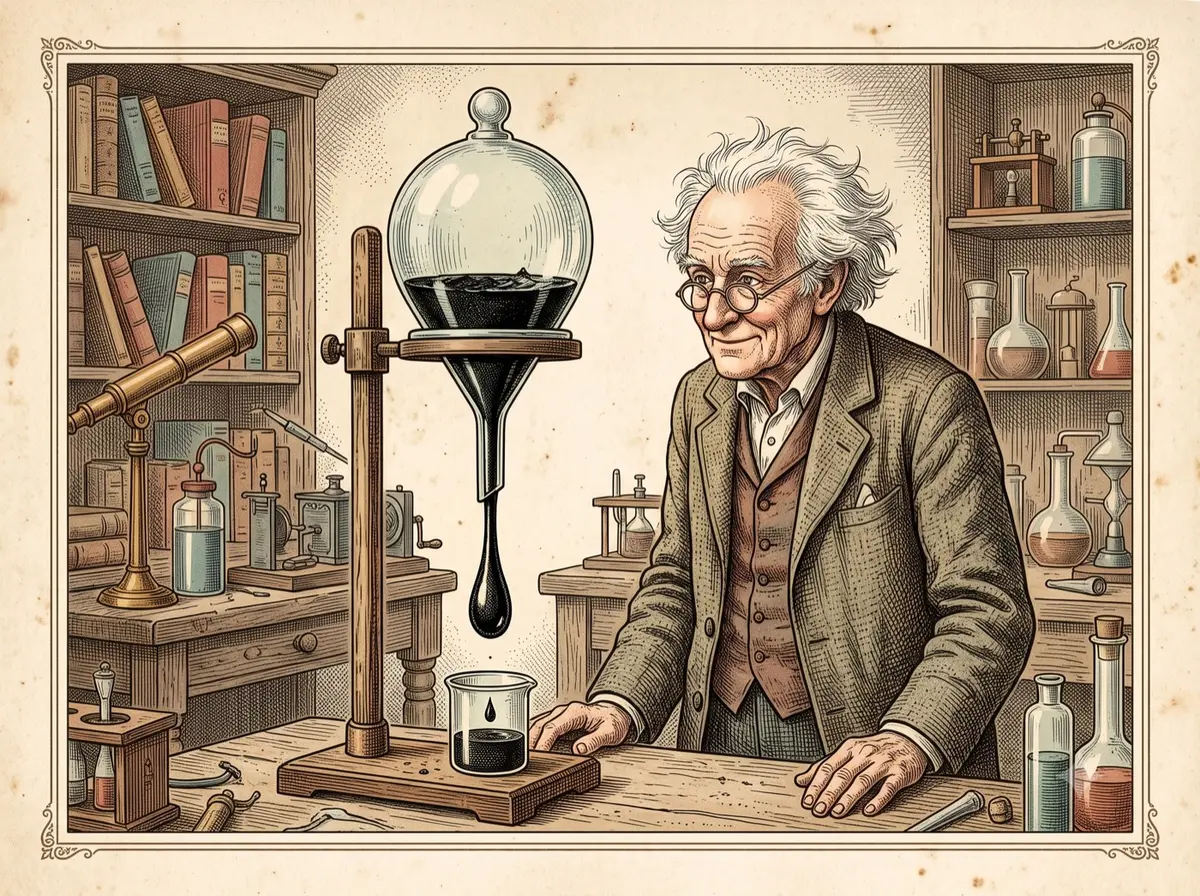
What happened: The Pitch Drop Experiment
In 1927, a physics professor at the University of Queensland in Brisbane, Australia, named Thomas Parnell wanted to make a point. Pitch — the tar-black residue left over from distilling things like coal or petroleum — looks and behaves like a solid. You can hit a lump of it with a hammer and it shatters into shards. Parnell wanted to show his students that this seemingly rock-hard substance is actually a liquid, just an absurdly slow one.
So he heated a sample of pitch, poured it into a glass funnel with a sealed stem, and let it settle for three years. In October 1930, he snipped the bottom of the stem open and let nature take over. Then everyone waited.
The first drop took eight years to form and fall, dripping silently sometime in December 1938. A second followed in 1947, a third in 1954, and on it went — roughly one drop per decade, each one swelling for years before stretching, thinning, and finally breaking away. As of today, nine drops have fallen and a tenth is slowly forming. The apparatus still sits on public display in the Parnell Building at the university’s St Lucia campus, under a glass dome, doing almost nothing, very impressively.
In 1961 the experiment passed to John Mainstone, who would become its devoted custodian for the next 52 years. He turned a dusty teaching demonstration into one of the most beloved objects in science — and spent decades being narrowly, almost comically, denied the payoff.
The seventh drop fell at about 4:45 p.m. on July 3, 1988, while the experiment was on display at Brisbane’s World Expo 88. Nobody saw it. Mainstone had stepped out briefly to get a drink. The eighth drop fell on November 28, 2000, and this time a webcam was trained on the funnel to capture the moment for the world. A technical glitch meant the camera recorded nothing. Mainstone died on August 13, 2013, at age 78, after a stroke. The drop he had waited a lifetime for had never let itself be watched.
Why it was strange: The Pitch Drop Experiment
The strangeness isn’t really the tragedy of the timing — it’s that the experiment overturns one of our most basic intuitions about matter. We sort the world into solids, liquids, and gases and assume the categories are obvious. Pitch quietly refuses to cooperate. Strike it and it behaves like glass. Leave it alone for a decade and it behaves like cold honey, pooling and dripping under nothing but its own weight.
There is no dramatic moment of melting, no phase change, no trick. The pitch is flowing the entire time, every second of every year — just far too slowly for a human to perceive. The experiment doesn’t demonstrate a one-time event. It demonstrates a process that is always happening and that we are simply too short-lived to notice.
Another thread pulled across centuries: From a Glass Frog Tied to Your Wrist to 98.6: A Short History of the Thermometer.
What scientists learned: The Pitch Drop Experiment
The key concept is viscosity — a fluid’s resistance to flowing. Water has low viscosity; honey has more; pitch has an almost unfathomable amount. When the eighth drop fell in 2000, researchers were finally able to calculate it: the pitch in the Queensland funnel is roughly 230 billion times more viscous than water. Put another way, it flows, but on a timescale closer to geology than to a kitchen.
That single number is the entire scientific payoff, and it’s why the experiment is more than a curiosity. It is direct, visible proof that the line between “solid” and “liquid” is blurrier than everyday language suggests. Many materials we treat as rigid — glass, certain plastics, even rock under enough pressure and time — are better understood as fluids whose flow is just too slow to matter on human timescales. Parnell’s tar is the clearest, simplest demonstration of that idea ever built, precisely because it asks for nothing but patience.
In 2005, Parnell and Mainstone were jointly awarded the Ig Nobel Prize in physics, the cheerful annual award for research that “first makes people laugh, and then makes them think.” It’s hard to imagine a better fit.
Another idea followed the long way: From Ringing Church Bells to Lightning-Rod Hats: A Short History of the Lightning Rod.
How it reaches us today: The Pitch Drop Experiment
The pitch drop holds the Guinness World Record as the longest continuously running laboratory experiment, and there’s enough tar left in the funnel to keep it going for another century. It has become a kind of patron saint of slow science — a reminder that not every worthwhile result arrives within a grant cycle, a career, or even a lifetime.
It also finally gave up its secret, just not in Brisbane. In July 2013, physicists at Trinity College Dublin, watching a near-identical pitch drop experiment that had been quietly dripping since 1944, caught a drop falling on camera for the very first time in history. It happened about a month before Mainstone died. The man who waited longest never saw it; the breakthrough went to a rival funnel on the other side of the world. Today hundreds of thousands of people each year keep a live webcam open on the Queensland funnel, taking shifts watching tar, hoping to be the one who finally catches a drop the moment it falls.
A close cousin: The Cylinder in a Paris Vault That Defined the Kilogram — Until It Started Losing Weight.
Fun fact: The Pitch Drop Experiment
The Queensland pitch drop isn’t even the oldest of its kind. A forgotten pitch experiment dating to 1914 was rediscovered at Aberystwyth University in Wales — but its tar is so stiff (or its room so cool) that it isn’t expected to produce its first drop for more than a thousand years. Somewhere in Wales, an experiment is running that will outlast nearly everything we build.
Sources: The Pitch Drop Experiment
- University of Queensland, School of Mathematics and Physics — “The Pitch Drop Experiment”: https://smp.uq.edu.au/pitch-drop-experiment
- R. Edgeworth, B. J. Dalton, T. Parnell, “The pitch drop experiment,” European Journal of Physics 5 (1984) 198–200: https://doi.org/10.1088/0143-0807/5/4/003
- R. Johnston, “World’s slowest-moving drop caught on camera at last,” Nature (18 July 2013): https://doi.org/10.1038/nature.2013.13418
- J. Webb, “Tedium, tragedy and tar: The slowest drops in science,” BBC News (26 July 2014): https://www.bbc.com/news/science-environment-28319117
- Improbable Research — 2005 Ig Nobel Prize winners: https://improbable.com/ig/winners/#ig2005
Related stories: The Pitch Drop Experiment
- The Cylinder in a Paris Vault That Defined the Kilogram — Until It Started Losing Weight — The cylinder that defined the kilogram, until it mysteriously slimmed
- The Doctor Who Ate, Slept, and Worked on a Giant Scale for 30 Years — A doctor who spent 30 years living on a giant weighing chair
- The Schoolboy Whose Hot Ice Cream Froze Faster — and Baffled Physicists for 60 Years — A schoolboy insisted hot ice cream froze faster and stumped physicists