Accidental Discoveries · Physics
The Schoolboy Whose Hot Ice Cream Froze Faster — and Baffled Physicists for 60 Years
A thirteen-year-old in Tanzania was in a hurry to make ice cream. The other boys were letting their sugary milk cool before putting it in the freezer, the way the recipe said. He skipped the wait and shoved his mixture in while it was still hot. His froze first. When he asked his teacher why, he was told, in effect, that he was confused. He was not. He had just stumbled onto a question that would still be dividing physicists more than half a century later.
By the Curiosities Desk · · 5 min read · Filed under Physics · Today’s round
What happened: The Mpemba Effect
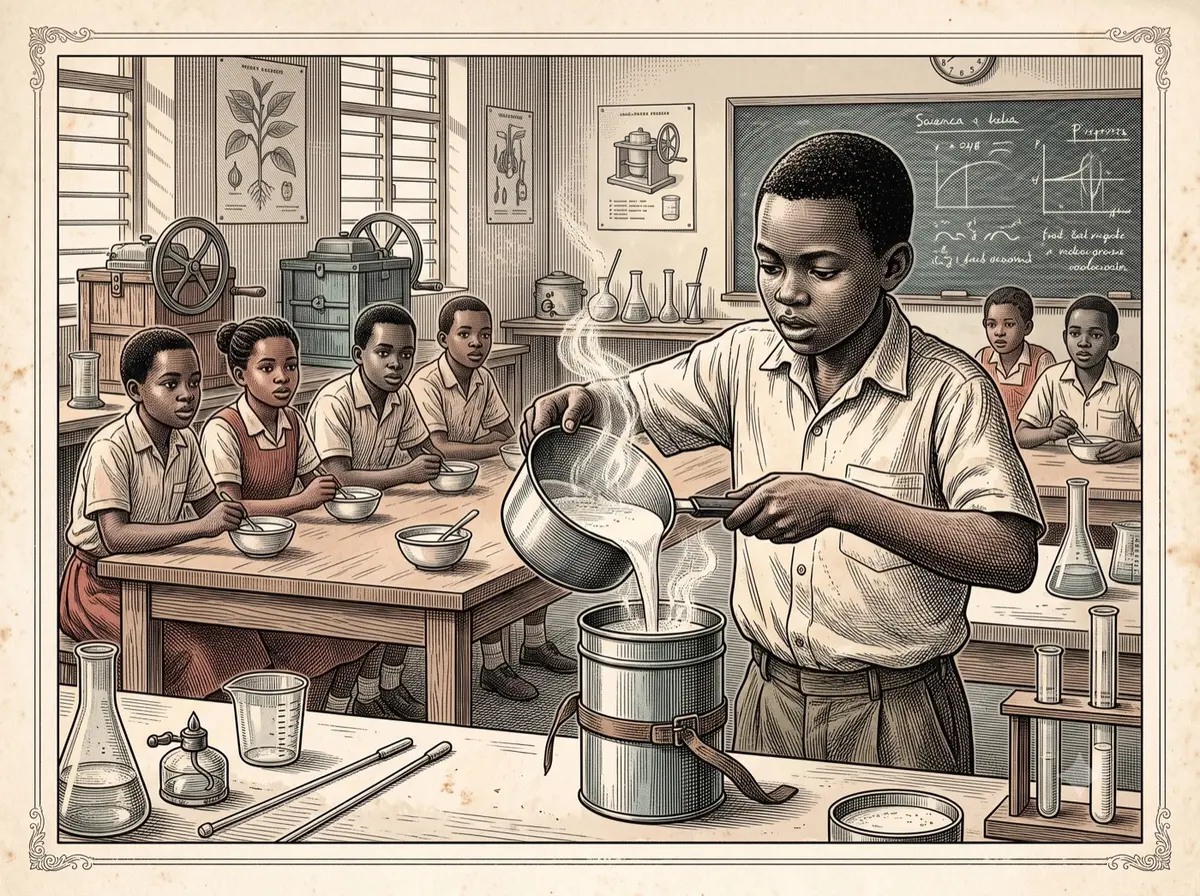
The year was 1963, and Erasto Mpemba was a Form 3 student at Magamba Secondary School in what was then Tanganyika. In cookery class the students made ice cream by boiling milk, mixing in sugar, letting it cool, and freezing it. Freezer space was limited, so it was first come, first served. Rushing to claim a spot, Mpemba put his mix in while it was still hot rather than waiting for it to cool. To his surprise, his hot mixture froze into ice cream before his classmate’s cooled one.
He asked his teacher to explain it. According to the account Mpemba later co-wrote, the teacher dismissed the result as a mistake — joking that it was “Mpemba’s physics,” not real physics. The puzzle stuck with him for years.
The breakthrough came almost by accident. When Mpemba was at Mkwawa Secondary School in Iringa, the headmaster invited Dr. Denis Osborne, a physicist from the University College in Dar es Salaam, to give a lecture. Mpemba seized the chance and asked his question directly: if you take two equal volumes of water, one at 35 °C and one at 100 °C, and put both in a freezer, why does the hotter one freeze first? Osborne assumed the boy was mistaken — but instead of brushing him off, he went back to his lab and tried it. To his amusement, the strange result held up. In 1969 the physicist and the student published their findings together in the journal Physics Education, in a paper titled, fittingly, “Cool?” By then Mpemba was studying at the College of African Wildlife Management, and the phenomenon carried his name.
Why it was strange: The Mpemba Effect
It seems to break a rule everyone feels they know: hot things take longer to cool than cold things, so colder water, already closer to freezing, should win the race to ice every time. Mpemba’s hot mixture jumping ahead felt like watching someone who started a marathon late cross the finish line first.
The strangeness runs deeper than a single classroom. When Osborne and Mpemba ran controlled tests — 70 ml of water in 100 ml beakers, sitting on a slab of polystyrene foam inside an ordinary refrigerator’s icebox — they found water starting near 90 °C began freezing sooner than water starting around 25 °C. They checked the obvious escape hatches: maybe the hot water lost enough volume to evaporation to cheat, or maybe dissolved air was the trick. Neither explained it. The effect refused to disappear.
And the most unsettling part: a Tanzanian teenager was not the first to notice this. Aristotle described warmed water freezing quickly more than two thousand years earlier. Francis Bacon and René Descartes both remarked on it. The Scottish chemist Joseph Black studied a version of it in 1775. The observation had been made, written down, and forgotten over and over for millennia — and still nobody had nailed down why.
Another time the mistake was the invention: The Spotted X-Ray Film That Traced the First Atomic Bomb — Through a Cardboard Box.
What scientists learned: The Mpemba Effect
Here is where the story earns its reputation as one of science’s stubborn puzzles. Decades of experiments have produced a genuinely mixed verdict, and that uncertainty is the real lesson.
Researchers have floated many candidate explanations. Boiling can drive out dissolved minerals and gases that change how water freezes. Hot water sets up stronger convection currents that stir heat to the surface faster. A hot container can melt the frost beneath it, improving its thermal contact with a freezer shelf. And supercooling — where pure water drops below 0 °C while staying liquid — seems to play a role, with previously hot water sometimes beginning to freeze at a higher temperature than cold water does. Each idea explains some experiments and fails for others.
Then came a serious challenge. In 2016, physicists Henry Burridge and Paul Linden ran careful experiments and reviewed earlier work, and concluded that the dramatic effect simply did not reproduce reliably. Their verdict, as they put it, was that “there is no evidence to support meaningful observations of the Mpemba effect.” Many scientists took that as the case closed.
But it wasn’t. In 2020, Avinash Kumar and John Bechhoefer used a single microscopic bead in a carefully tuned setup and showed that a “hotter” system really can cool dramatically faster than a colder one — clean, repeatable evidence of Mpemba-like behavior in a controlled physical system, published in Nature. The takeaway is subtle and honest: the kitchen version with a beaker of water may be too messy to pin down, but the underlying physics of how far-from-equilibrium systems relax toward cold can produce exactly this counterintuitive overtaking.
Another accident worth keeping: The Botanist Who Ground Up a Piece of the Sphinx to See If It Would Wiggle.
How it reaches us today: The Mpemba Effect
The Mpemba puzzle has quietly become a launchpad for studying how systems reach equilibrium — not just water, but magnetic alloys, tiny mechanical resonators, and even quantum systems. In 2024, a team at Trinity College Dublin described a “quantum Mpemba effect,” where a hotter quantum system can settle into its cold final state faster than a cooler one. That has potential implications for how quickly quantum computers might be reset between operations. A schoolboy’s question about ice cream turned into a tool for probing the frontier of physics.
A close cousin: The Glow Across the Room That Let Us See Inside the Body.
Fun fact: The Mpemba Effect
Erasto Mpemba is one of the very few people to have a physical effect named after them while they were still a teenage student — and he shares the credit on the original paper with the professor who first assumed he was wrong.
Sources: The Mpemba Effect
- Mpemba, E. B. & Osborne, D. G., “Cool?”, Physics Education 4(3): 172–175 (1969) — the original paper — https://doi.org/10.1088/0031-9120/4/3/312
- “Mpemba effect,” Wikipedia — https://en.wikipedia.org/wiki/Mpemba_effect
- Burridge, H. C. & Linden, P. F., “Questioning the Mpemba effect: hot water does not cool more quickly than cold,” Scientific Reports 6: 37665 (2016) — https://www.nature.com/articles/srep37665
- Kumar, A. & Bechhoefer, J., “Exponentially faster cooling in a colloidal system,” Nature 584: 64–68 (2020) — https://www.nature.com/articles/s41586-020-2560-x
Related stories: The Mpemba Effect
- The Bathtub That Took 24 Hours to Drain to Test a Myth — A physicist drained a bathtub for a day to test the Coriolis myth
- The Duck Borrowed From a Farm to Prove That Quacks Do Echo — Researchers borrowed a duck to settle whether quacks echo
- The Experiment So Slow Its Keeper Watched for 52 Years and Never Saw a Single Drop Fall — A pitch drop experiment whose keeper watched 52 years in vain