The Bathtub That Took 24 Hours to Drain to Test a Myth
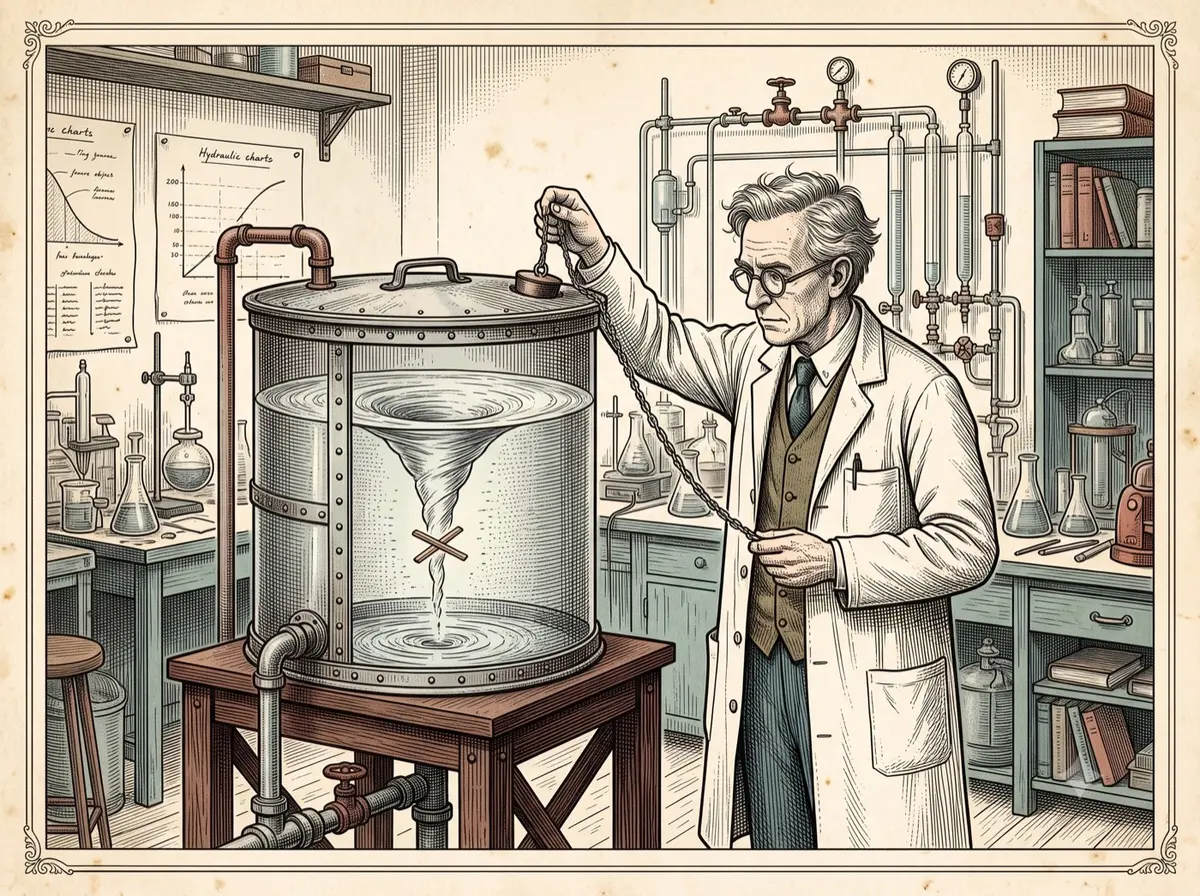
In the fall of 1962, an MIT engineering professor named Ascher Shapiro filled a six-foot metal tank with water, covered it with a sheet of plastic, and then did nothing for a full day. No one touched the tank, no one opened a window near it, and no one so much as breathed on the surface. Twenty-four hours later, Shapiro pulled a stopper at the end of a 20-foot hose, floated two tiny crossed slivers of wood over the drain, and watched. For fifteen minutes, nothing happened. Then, almost too slowly to see, the wood began to turn.
By the Curiosities Desk · · 5 min read · Filed under Physics · Today’s round
Part of The Version Everyone Remembers
What happened: The Bathtub That Took 24 Hours to Drain to Test a Myth
The question Shapiro was trying to settle had been floating around for decades: does the water in your bathtub or sink really spin one way as it drains in the Northern Hemisphere and the opposite way in the Southern Hemisphere, because of the Earth’s rotation? The idea traces back to the Coriolis effect, first worked out mathematically in 1835 by the French engineer Gustave-Gaspard Coriolis, who was studying rotating machinery, not weather. The effect describes how anything moving across a rotating surface — like the surface of a spinning Earth — appears to curve relative to that surface. It’s the reason hurricanes in the Northern Hemisphere spin counterclockwise and cyclones south of the equator spin clockwise.
It’s a real, well-documented effect at the scale of storm systems hundreds of miles wide. Whether it was strong enough to matter at bathtub scale was a much harder question, and by the early 1960s no one had shown it convincingly. So Shapiro, a specialist in fluid mechanics, built an experiment designed to eliminate every other explanation. He used a circular, flat-bottomed tank six feet across and six inches deep, with a centered drain hole connected to a long hose plugged at the far end. He filled it with room-temperature water, deliberately swirling it clockwise while filling — so that a later counterclockwise drain couldn’t be blamed on the way it went in. He covered the tank to block air currents and kept the room’s temperature steady, since even a slight temperature difference can set up currents that swamp something as faint as the Coriolis effect. Then he left it alone for 24 hours, so any leftover motion from filling could die down completely.
When he finally pulled the plug, the tank took about 20 minutes to empty. For the first 12 to 15 minutes, the wood-sliver float above the drain didn’t move at all. Then it began rotating counterclockwise, slowly at first, eventually reaching about one full turn every three to four seconds as the last of the water spiraled out. Shapiro published the results in the journal Nature in December 1962 under the plain title “Bath-Tub Vortex.” Three years later, a team at the University of Sydney — Lloyd Trefethen, R. W. Bilger, P. T. Fink, R. E. Luxton, and R. I. Tanner — ran a version of the same experiment in the Southern Hemisphere and published their own paper in Nature in 1965. Their water spiraled the opposite way: clockwise, exactly as the theory predicted.
Why it was strange: The Bathtub That Took 24 Hours to Drain to Test a Myth
The strangeness here cuts two ways. First, it’s genuinely surprising that a force this faint could be measured at all in a household-sized container. At MIT’s latitude of 42° north, the Coriolis acceleration acting on the water was only about thirty-millionths as strong as gravity — a signal so weak that ordinary disturbances like a draft, a splash, or a few degrees of temperature difference would completely bury it. Getting a clean result required extraordinary patience and control.
But the deeper twist is that Shapiro’s success proved something narrower than what most people assumed. His sealed-tank, 24-hour-wait experiment showed that the Coriolis effect is real at small scales under laboratory conditions. It did not show that your bathtub at home drains a particular way depending on which hemisphere you live in. In an ordinary tub or sink, leftover motion from filling it, the shape of the basin, and the position of the drain all produce forces far stronger than the Coriolis effect, and any of them can dominate which way the water spins. A toilet is an even clearer case: the water in most bowls is pushed around by angled jets built into the rim, not by the rotation of the planet — so toilets flush the same direction regardless of hemisphere.
The same thread — Meteorology — continues in The Park Ranger Struck by Lightning Seven Times.
What scientists learned: The Bathtub That Took 24 Hours to Drain to Test a Myth
Shapiro’s experiment is a case study in something fluid dynamicists call the Rossby number, a way of comparing how much a fluid’s motion is shaped by its own inertia versus by the Earth’s rotation. When the Rossby number is small — as with slow, large-scale flows like ocean currents or storm systems — Coriolis effects dominate. When it’s large — as with the fast, small-scale swirl of water leaving a sink — other forces win easily. Shapiro’s tank only produced a Coriolis-driven vortex because he pushed the fluid speed down to an almost imperceptible crawl, letting the tiny rotational signal finally show through. The experiment is less a story about plumbing than about the importance of scale in physics: the same underlying law can be the dominant force in one setting and a rounding error in another.
Elsewhere in physics: The Spaghetti That Stumped Richard Feynman by Refusing to Break in Two.
How it reaches us today: The Bathtub That Took 24 Hours to Drain to Test a Myth
Understanding when the Coriolis effect matters, and when it doesn’t, underpins modern meteorology and oceanography — it’s why hurricane forecasters can predict which way a storm will rotate, and why ocean current models account for the deflection of water moving across the globe. It also matters for anything that travels very fast over very long distances, from long-range artillery calculations to the trajectories used in satellite and spaceflight navigation. Shapiro’s tank experiment, meanwhile, became a small teaching classic: it’s often cited as a model of how to design an experiment that isolates one faint variable from everything else trying to drown it out.
Another claim that stuck harder than the correction: The Warship That Never Actually Teleported to Norfolk.
Fun fact: The Bathtub That Took 24 Hours to Drain to Test a Myth
Shapiro’s bathtub result made him an unlikely celebrity. For more than a decade afterward, he received letters from strangers around the world — students trying to repeat the experiment for class projects, a schoolteacher who said pulling bathtub plugs on her travels had “become a hobby,” and at least one correspondent convinced, incorrectly, that drain direction was linked to barometric pressure. Shapiro answered many of them personally, patiently explaining just how much effort it had taken to see an effect that small.
Sources: The Bathtub That Took 24 Hours to Drain to Test a Myth
- Shapiro, A. H. “Bath-Tub Vortex.” Nature 196, 1080–1081 (1962).
- Trefethen, L. M., et al. “The Bath-Tub Vortex in the Southern Hemisphere.” Nature 207, 1084–1085 (1965).
- Myhrvold, Conor. “Verifying a Vortex.” MIT Technology Review, October 24, 2012.
- “Shapiro’s Bathtub Experiment.” MIT Scope.
- Feinstein, Matthew (updated by DK). “Which Way Will My Bathtub Drain?” UC Riverside Physics FAQ.
Related stories: The Bathtub That Took 24 Hours to Drain to Test a Myth
- The Duck Borrowed From a Farm to Prove That Quacks Do Echo — Researchers borrowed a duck to settle whether quacks echo
- The Schoolboy Whose Hot Ice Cream Froze Faster — and Baffled Physicists for 60 Years — A schoolboy insisted hot ice cream froze faster and stumped physicists
- The Park Ranger Struck by Lightning Seven Times — A park ranger who survived seven lightning strikes