The Park Ranger Struck by Lightning Seven Times
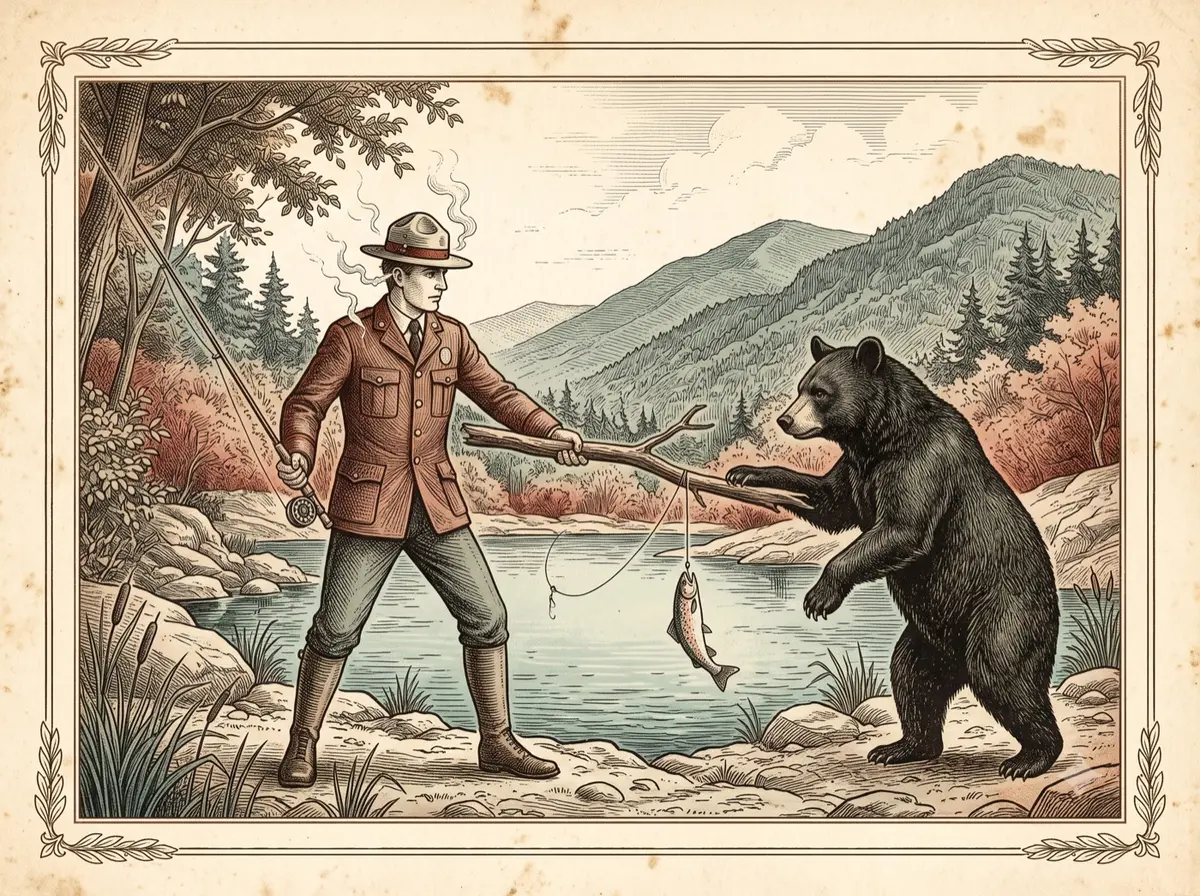
Roy Sullivan was fishing in a quiet Shenandoah Valley pool in June 1977 when the sky, without much warning, set his hair on fire again. As he staggered toward his car, a black bear wandered up and tried to steal the trout off his line. Sullivan — head still smoking — grabbed a branch and swatted it away. It was, by his own count, the seventh time in 35 years that lightning had hit him directly. He would later say it was also the twenty-second time in his life he'd had to hit a bear with a stick.
By the Curiosities Desk · · 5 min read · Filed under Physics · Today’s round
Part of The Version Everyone Remembers
What happened: Struck by Lightning Seven Times
Roy Cleveland Sullivan worked as a park ranger in Virginia’s Shenandoah National Park from 1936 onward, patrolling the same stretch of the Blue Ridge Mountains for decades. Between 1942 and 1977, he was struck by lightning — and survived — seven separate times, a record Guinness World Records recognizes as the most confirmed lightning strikes endured by one person.
The first strike came in April 1942, when Sullivan took shelter from a storm inside a newly built fire lookout tower that, lacking a lightning rod, was hit repeatedly and caught fire around him. He fled outside and was struck again a few feet from the tower, burning a strip along his leg and blowing a hole in his shoe. The next came in July 1969: lightning hit trees beside a mountain road and deflected through the open window of his moving truck, knocking him unconscious and setting his hair alight — unusual, since a vehicle’s metal shell normally acts as a Faraday cage, a conductive enclosure that channels electrical charge around the people inside rather than through them. A year later, in his own front yard, a bolt struck a nearby power transformer and arced to his shoulder. In the spring of 1972, lightning found him inside a ranger station and ignited his hair again. In August 1973, he watched a storm cloud he believed was tracking him, left his truck too soon, and was struck a fifth time. A sixth strike in June 1976 injured his ankle. The seventh, in June 1977, is the one with the bear.
All seven incidents were logged at the time by Shenandoah’s park superintendent, and Sullivan’s story ran in newspapers across the country during his lifetime; he also appeared on the television program To Tell the Truth. It’s worth noting, in the spirit of separating legend from record-keeping, that some later researchers have questioned how consistently each strike was independently verified in the moment — Sullivan himself was the source for most incident details, recalling them well after the fact. Still, no one disputes that Sullivan carried scars from repeated lightning burns, and Guinness has stood by the seven-strike record for decades.
Sullivan died in 1983 at age 71, by suicide, after what acquaintances described as a difficult period unrelated to any new lightning encounter — he was never struck again after 1977. Colleagues also said that in his later years, people sometimes avoided standing near him during storms, which he found isolating.
Why it was strange: Struck by Lightning Seven Times
“Lightning never strikes the same place twice” is one of the most repeated weather sayings in English, usually deployed as a metaphor: bad luck doesn’t return. Sullivan’s life was a direct, embodied contradiction of it — not once, but seven times over.
Even without the folk saying, the math is startling. The National Weather Service puts the lifetime odds of any one American being struck by lightning at roughly 1 in 15,300. Being struck seven times isn’t simply seven separate long-shot events layered on top of each other, because Sullivan’s occupation — an outdoor ranger on exposed ridgelines — pushed his personal odds well above average. But even accounting for that, colleagues nicknamed him the “Human Lightning Rod” for a reason: whatever the true probability, it felt like he’d been singled out.
The same thread — Meteorology — continues in The Bathtub That Took 24 Hours to Drain to Test a Myth.
What scientists learned: Struck by Lightning Seven Times
Sullivan’s case is really a vivid, uncomfortable illustration of what meteorologists already knew about where lightning goes. Lightning doesn’t seek out unlucky individuals; it favors height, pointed shape, and isolation — the same physical setup that makes a lone tree, a radio tower, or an exposed ridge get struck again and again. A person standing alone on high, open ground during a storm is, electrically, not so different from that tree. Sullivan’s job put him in exactly those conditions repeatedly: fire towers, open fields, mountain roads, isolated patrol routes.
His case also undercuts the “it never strikes twice” logic at the level of physics, not just anecdote. A lightning strike doesn’t “use up” a location’s risk — the atmospheric conditions that made a spot a likely target (its height and exposure, not some cosmic quota) are still there the next storm. The National Weather Service states this directly: lightning often strikes the same place repeatedly, especially tall, pointed, isolated objects. The Empire State Building, for comparison, is struck an average of 23 times a year.
Another story that outran the evidence: The Duck Borrowed From a Farm to Prove That Quacks Do Echo.
How it reaches us today: Struck by Lightning Seven Times
Modern lightning safety guidance — the kind posted at pools, golf courses, and stadiums — grew out of exactly this understanding: risk is about terrain and exposure, not personal luck or a one-strike limit. Engineers design lightning rods and grounding systems for skyscrapers, aircraft, and power infrastructure around the same principle that made Sullivan’s fire tower and ridge routes so dangerous: tall, isolated, conductive paths draw strikes, and the job of protective design is to give the current somewhere safe to go. Real-time lightning-detection networks, now standard at outdoor venues and airports, exist because “wait and see” is a bad strategy against a hazard that returns to the same vulnerable spots.
Another claim that stuck harder than the correction: The Army Captain Who Asked Congress to Fund a Trip Inside the Earth.
Fun fact: Struck by Lightning Seven Times
Two of Sullivan’s ranger hats — scorched from separate strikes — are preserved on public display at Guinness World Records exhibit halls in New York City and South Carolina.
Sources: Struck by Lightning Seven Times
- “Roy Sullivan,” Wikipedia — https://en.wikipedia.org/wiki/Roy_Sullivan
- Vicki Newman, “Incredible story of man who survived being struck by lightning SEVEN times,” Guinness World Records, Jan. 26, 2023 — https://www.guinnessworldrecords.com/news/2023/1/incredible-story-of-man-who-survived-being-struck-by-lightning-seven-times-733932
- “Lightning Myths and Facts,” National Weather Service (NOAA) — https://www.weather.gov/safety/lightning-myths
- “Severe Weather 101: Lightning FAQ,” NOAA National Severe Storms Laboratory — https://www.nssl.noaa.gov/education/svrwx101/lightning/faq/
- Tom Dunkel, “Lightning strikes: A man hit seven times,” The Washington Post, Aug. 15, 2013 — https://www.washingtonpost.com/lifestyle/magazine/inside-the-life-of-the-man-known-as-the-spark-ranger/2013/08/15/947cf2d8-ea40-11e2-8f22-de4bd2a2bd39_story.html
A note on the topic of suicide: if you or someone you know is struggling, the 988 Suicide & Crisis Lifeline (call or text 988 in the U.S.) offers free, confidential support around the clock.
Related stories: Struck by Lightning Seven Times
- The Moon Rocket Struck by Lightning Twice — and the Switch Nobody in Mission Control Had Heard Of — Lightning hit Apollo 12 twice, and one obscure switch saved it
- Spontaneous Human Combustion: The Myth That Refused to Burn Out — The myth of people bursting into flame, and the physics behind it
- The Bathtub That Took 24 Hours to Drain to Test a Myth — A physicist drained a bathtub for a day to test the Coriolis myth