The Scientist Behind It · Space
The Moon Rocket Struck by Lightning Twice — and the Switch Nobody in Mission Control Had Heard Of
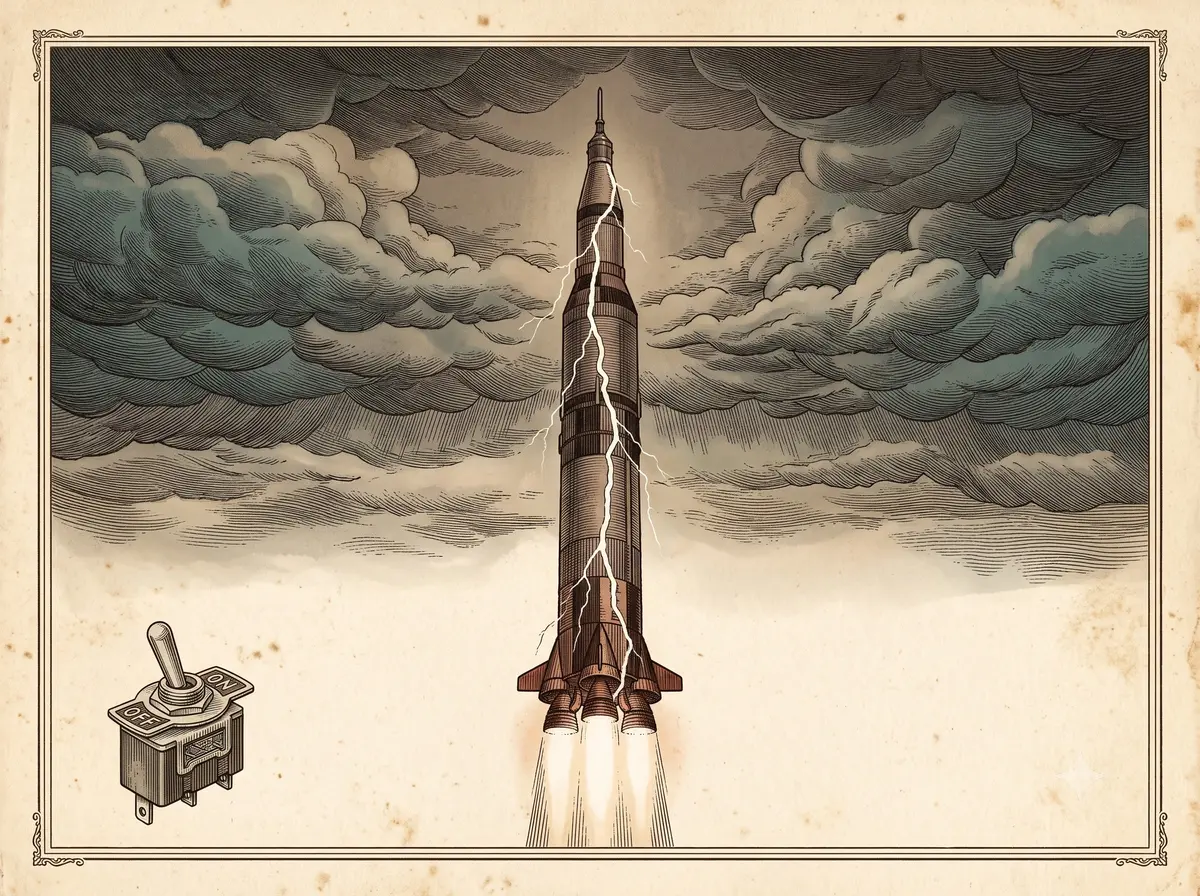
Thirty-six and a half seconds after Apollo 12 left the pad in a rainstorm, with President Nixon watching from the soaked viewing stands, a bolt of lightning ran down the Saturn V and out through its exhaust. Nearly every warning light in the command module came on at once. "Okay, we just lost the platform, gang," commander Pete Conrad reported. "I don't know what happened here; we had everything in the world drop out."
By the Curiosities Desk · · 5 min read · Filed under Space · Today’s round
Part of The Person Who Would Not Drop It
What happened: The Moon Rocket Struck by Lightning Twice — and the Switch Nobody in
Apollo 12 lifted off from Launch Complex 39A at Kennedy Space Center on 14 November 1969. The weather was poor but, by the rules of the day, legal: rain, a cold front moving through, cloud tops reported between 18,000 and 23,000 feet. NASA already forbade launching into a thunderstorm. There wasn’t one. No lightning had been seen anywhere near the Cape before liftoff.
At 36.5 seconds into the flight, with the vehicle at about 6,400 feet, a discharge hit. Inside the command module, three fuel cells — the devices that made the spacecraft’s electricity by combining hydrogen and oxygen — abruptly disconnected themselves from the electrical buses. Two re-entry batteries were suddenly left carrying a 75-amp load on their own. Voltage on the main bus sagged to roughly 18 or 19 volts before recovering. Undervoltage alarms lit. The guidance computer restarted five times.
And the telemetry went to nonsense. The culprit was a black box called the signal conditioning equipment, or SCE — the unit that takes raw readings from sensors all over the spacecraft and converts them into the neat numbers that appear on consoles in Houston. The voltage drop pushed it below its operating range. It didn’t stop sending data. It kept sending data that was garbage.
At 52 seconds, at about 14,400 feet, it happened again. This second discharge tumbled the inertial platform — the gyroscope assembly that tells the spacecraft which way it is pointing. When data came back, the gimbals were spinning at roughly 35 degrees per second.
One thing did not fail: the Saturn V itself. The rocket’s own guidance system lived in a ring called the Instrument Unit, up near the third stage, and it rode out both strikes without blinking. The rocket kept flying a textbook trajectory while the spacecraft riding on top of it lost its mind.
In Houston, at the EECOM console — the flight controller responsible for electrical, environmental and communications systems — sat John Aaron. He was a physics graduate from rural western Oklahoma who had joined NASA in 1964, still in his twenties. And he had seen this exact pattern of gibberish before.
Roughly a year earlier, Aaron had been watching a command module power test when the spacecraft’s voltage dropped and the telemetry landed on the same strange, useless intermediate values. Nothing required him to chase it down. He chased it down anyway, and learned that the SCE had a second, auxiliary power supply that would keep it working at low voltage. (Accounts differ on whether the earlier event was a ground test at the Cape or a simulation; Aaron’s own recollection places it at a spacecraft test.)
So he said the line: “Flight, EECOM. Try SCE to AUX.”
Flight director Gerry Griffin — running his first mission in that chair — later said he had never heard of the switch. Neither had CAPCOM Gerald Carr, who passed it up anyway. Neither had Conrad, who replied, “Try FCE to auxiliary. What the hell is that?”
Alan Bean, the lunar module pilot, knew. The switch was on the panel beside his couch. He reached over and flipped it from NORM to AUX, and clean numbers reappeared in Houston — which meant controllers could finally see that the spacecraft was, in fact, healthy. The fuel cells were reconnected by hand. Apollo 12 reached orbit, spent two revolutions checking systems and realigning the tumbled platform against the stars, and was cleared for the Moon. Conrad and Bean landed in the Ocean of Storms on 19 November.
Why it was strange: The Moon Rocket Struck by Lightning Twice — and the Switch Nobody in
The strangeness isn’t that a rocket was hit by lightning. It’s that the rocket caused the lightning.
NASA’s investigation concluded that the atmosphere over the Cape that morning had an electric field far too weak to produce a natural bolt. What changed the arithmetic was the vehicle itself: a 363-foot metal tower trailing a column of hot, ionized exhaust. Together they formed a single conductor hundreds of feet long, moving upward through a charged cloud. The Saturn V didn’t fly into a lightning strike. It flew into a place where no lightning existed, and made one.
The same thread — Spaceflight — continues in The Spaceship That Was Supposed to Ride Atomic Bombs to Saturn.
What scientists learned: The Moon Rocket Struck by Lightning Twice — and the Switch Nobody in
The phenomenon is now called triggered lightning: a discharge initiated by a long conducting object entering an electric field that would otherwise have stayed quiet. The Apollo 12 report worked through the numbers — the length and width of the conducting plume, the capacitance of the whole flying object — and concluded the vehicle had “effectively extended” itself into a lightning rod. Researchers have since produced triggered lightning deliberately, by firing small rockets trailing grounded wires into storm clouds.
The second lesson was quieter and just as durable. The only permanent damage Apollo 12 suffered was to nine instrumentation sensors — five thermocouples and four pressure and temperature transducers — and every one was solid-state. The delicate semiconductor circuits that made 1960s spacecraft possible were also the parts least able to shrug off an induced surge.
Another person who would not drop the question: The Farm Boy Who Discovered Pluto — and Now Sails Past It Forever.
How it reaches us today: The Moon Rocket Struck by Lightning Twice — and the Switch Nobody in
Modern launch weather rules exist largely because of this flight and its sequel. In March 1987, an Atlas-Centaur rocket carrying a Navy satellite triggered lightning 49 seconds after liftoff from the Cape and was lost. The investigation that followed produced NASA’s Lightning Advisory Panel and the Lightning Launch Commit Criteria — the reason a launch today can be scrubbed by an anvil cloud drifting past on an otherwise pleasant afternoon, with no storm in sight. It looks like excessive caution. It’s Apollo 12’s bill, paid in advance.
John Aaron stayed at his console. Five months later, when Apollo 13’s crew had to bring a nearly dead command module back to life on a starved battery, it was Aaron who wrote the power-up sequence. Around Mission Control, the highest available compliment attached itself to him permanently: a steely-eyed missile man.
Another scientist, told from the human side: The Astronomer With a Metal Nose and a Beer-Drinking Elk.
Fun fact: The Moon Rocket Struck by Lightning Twice — and the Switch Nobody in
Richard Nixon was the first sitting U.S. president to watch a crewed launch in person. He picked the one that got hit by lightning, and he watched it in the rain.
Sources: The Moon Rocket Struck by Lightning Twice — and the Switch Nobody in
- Analysis of the Apollo 12 Lightning Incident (MSC-01540), NASA Manned Spacecraft Center, February 1970 — the primary technical report, including the vehicle-triggered lightning theory and the full list of damaged systems.
- Apollo Flight Journal: The Apollo 12 Lightning Strike Incident (NASA History Division) — annotated air-to-ground transcript of the launch.
- NASA Johnson Space Center Oral History Project: John W. Aaron — Aaron’s own account of how he came to know about the SCE auxiliary setting.
- NASA Safety Message: Atlas/Centaur AC-67 Lightning Strike Mishap, 1987 — the loss that led to today’s Lightning Launch Commit Criteria.
- NASA Science: Lightning Strikes Twice — NASA’s summary of the launch-day imagery and events.
Related stories: The Moon Rocket Struck by Lightning Twice — and the Switch Nobody in
- The Park Ranger Struck by Lightning Seven Times — A park ranger who survived seven lightning strikes
- The Corned Beef Sandwich That Got NASA Hauled Before Congress — A smuggled sandwich in orbit triggered a congressional hearing
- The Rocket That Exploded on Live TV and Got Called ‘Kaputnik’ — A rocket that exploded on live television and earned a nickname