The Scientist Behind It · Space
The Farm Boy Who Discovered Pluto — and Now Sails Past It Forever
In July 2015, a piano-sized spacecraft hurtled past Pluto at roughly 14 kilometers a second and sent home the first close-up portrait of that distant, frozen world. Tucked inside the spacecraft was about an ounce of human ashes. They belonged to the man who had spotted Pluto in the first place — a Kansas farm boy who built his own telescopes out of spare parts and was, in a sense, finally getting to visit the planet he found.
By the Curiosities Desk · · 5 min read · Filed under Space · Today’s round
Part of The Person Who Would Not Drop It
What happened: The Farm Boy Who Discovered Pluto — and Now Sails Past It Forever
Clyde William Tombaugh was born on February 4, 1906, near Streator, Illinois, and raised on farms in Kansas. College was out of reach: a hailstorm in June 1928 wiped out the family’s crops and, with them, his savings for tuition. So he taught himself. Working from books and magazine articles, he ground his own mirrors and lenses by hand and built telescopes out of spare parts and cast-off farm machinery. To test his mirrors in still, temperature-stable air, he dug a pit on the farm — 24 feet long, 8 feet deep, 7 feet wide — that doubled as the family’s root cellar and storm shelter.
He sketched what he saw of Jupiter and Mars through his homemade instruments and mailed the drawings to Lowell Observatory in Flagstaff, Arizona, hoping for feedback. Instead, the observatory offered him a job. He arrived in 1929, in his early twenties and with no degree, and was handed one of the most tedious assignments in astronomy: hunt for “Planet X,” a ninth planet that observatory founder Percival Lowell had predicted lay beyond Neptune.
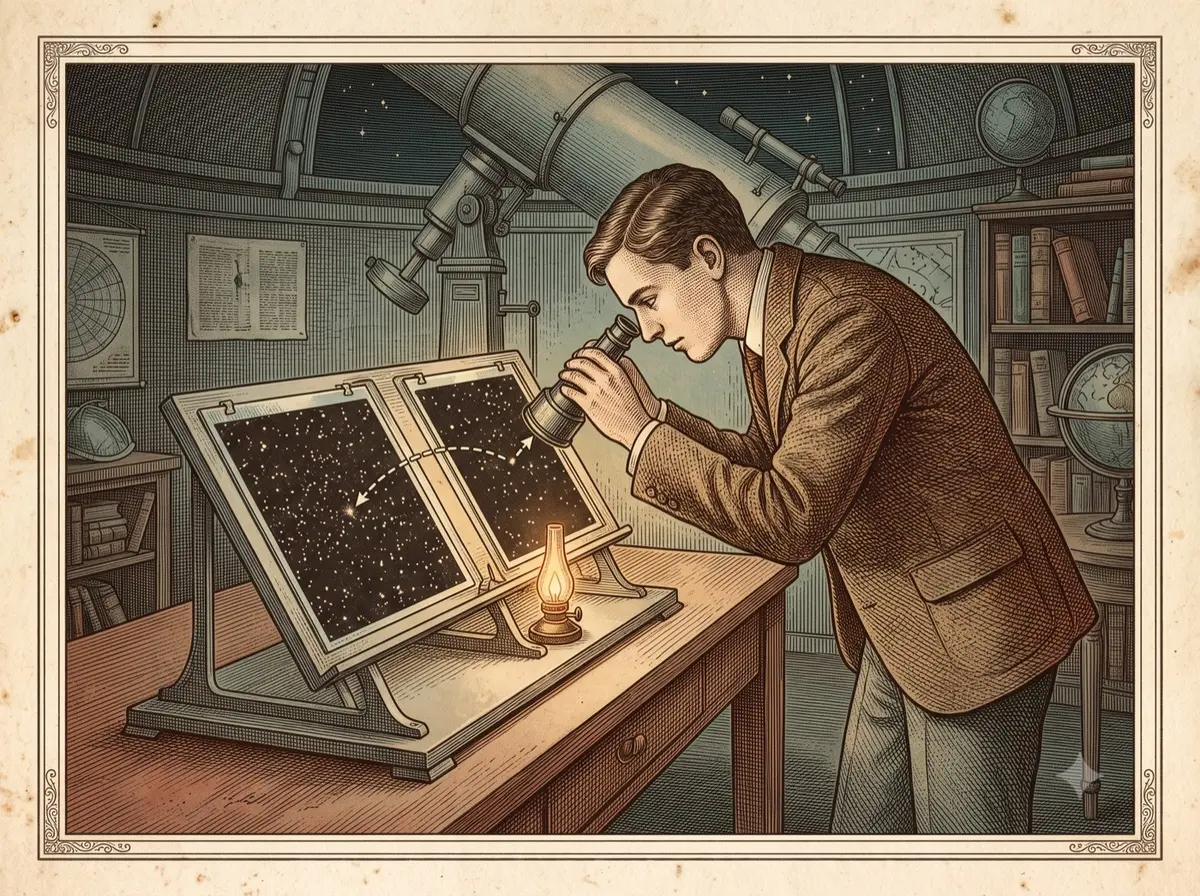
The method was grueling. Using the observatory’s 13-inch astrograph, Tombaugh photographed the same patch of sky on different nights, then loaded pairs of glass plates into a device called a blink comparator. It flicked between the two images in quick succession. Stars stayed put; anything that had moved against them — a planet, an asteroid, a comet — appeared to jump back and forth. Each plate held a dense field of stars. Tombaugh blinked through them for the better part of a year.
On February 18, 1930, comparing plates taken the previous month, he caught a faint speck hopping between frames near where Lowell had predicted. He had found the ninth planet. The name came from an 11-year-old English girl, Venetia Burney, who suggested “Pluto” after the Roman god of the underworld; by happy coincidence, its first two letters were Percival Lowell’s initials. The name was made official on May 1, 1930.
Why it was strange: The Farm Boy Who Discovered Pluto — and Now Sails Past It Forever
Almost nothing about this discovery fit the script. A planet — the only one ever found by an American — was discovered not by a credentialed professor at a great university but by a 24-year-old farm hand who had never set foot in a college classroom. He didn’t find it through elegant mathematics. He found it by sheer, eye-straining patience, blinking through plate after plate until one dot refused to hold still.
And the punchline kept getting stranger. After more than 75 years as the ninth planet, Pluto was demoted. In 1992 astronomers began finding other icy bodies out past Neptune, and it became clear Pluto wasn’t a lonely planet but the brightest member of a whole swarm — the Kuiper Belt. On August 24, 2006, the International Astronomical Union reclassified Pluto as a “dwarf planet,” and the Solar System officially dropped to eight planets.
Another person who would not drop the question: The Moon Rocket Struck by Lightning Twice — and the Switch Nobody in Mission Control Had Heard Of.
What scientists learned: The Farm Boy Who Discovered Pluto — and Now Sails Past It Forever
Here’s the twist that rescues the story from disappointment: Tombaugh hadn’t found a small ninth planet so much as the first known object of an enormous, unexplored region. The Kuiper Belt is a vast ring of frozen leftovers from the Solar System’s birth, and Pluto was our first glimpse of it. As planetary scientist Hal Levison later put it, “Clyde Tombaugh discovered the Kuiper Belt. That’s a helluva lot more interesting than the ninth planet.”
That reframing matters. Studying Pluto and its neighbors gives scientists a deep-frozen sample of the raw material that built the planets — chemistry that’s been sitting in cold storage for over four billion years. Tombaugh’s widow, Patricia, said that although her husband had defended Pluto’s planetary status in life, as a scientist he would have accepted the demotion: “He was a scientist. He would understand they had a real problem when they start finding several of these things flying around the place.”
Another scientist, told from the human side: The Astronomer With a Metal Nose and a Beer-Drinking Elk.
How it reaches us today: The Farm Boy Who Discovered Pluto — and Now Sails Past It Forever
In August 1992, a JPL scientist named Robert Staehle phoned the elderly Tombaugh to ask, in effect, for permission to send a probe to his planet. Tombaugh said yes. By his own recollection, he told Staehle he was “welcome to it,” though the probe “has got to go one long, cold trip.” That call helped seed the mission that became New Horizons.
Tombaugh died on January 17, 1997, at age 90. He didn’t live to see the spacecraft fly. So the mission took him along. New Horizons launched on January 19, 2006, carrying about 30 grams of his ashes in a small container inscribed with words that begin: “Interred herein are remains of American Clyde W. Tombaugh, discoverer of Pluto and the Solar System’s ‘third zone.’” On July 14, 2015 — 85 years after he first spotted that wandering dot — the spacecraft swept within about 12,500 kilometers of Pluto and beamed back images of a world with ice mountains and a vast, pale, heart-shaped plain. Mission scientists named that plain Tombaugh Regio. The man who found Pluto with a hand-ground mirror became the first person whose remains were sent beyond the orbit of the planet he discovered, still riding outbound through the very “third zone” he opened up.
A close cousin: The Newspaper That Took 49 Years to Admit Rockets Work in Space.
Fun fact: The Farm Boy Who Discovered Pluto — and Now Sails Past It Forever
Tombaugh’s family tree reaches all the way to a modern pitcher’s mound: through his youngest brother’s line, he is the great-uncle of Los Angeles Dodgers ace Clayton Kershaw — who has publicly grumbled at the astronomers who demoted his great-uncle’s planet.
Sources: The Farm Boy Who Discovered Pluto — and Now Sails Past It Forever
- Wikipedia, “Clyde Tombaugh” (cross-referenced with David H. Levy’s biography and the American Academy of Achievement profile) — https://en.wikipedia.org/wiki/Clyde_Tombaugh
- Wikipedia, “New Horizons” (launch date, flyby, and the ~30 g of ashes aboard) — https://en.wikipedia.org/wiki/New_Horizons
- Lowell Observatory, “The Discovery of Pluto” — https://lowell.edu/discover/the-discovery-of-pluto/
- S. Alan Stern, “Clyde Tombaugh (1906–97): Astronomer who discovered the Solar System’s ninth planet,” Nature 385, 778 (1997) — doi:10.1038/385778a0
Related stories: The Farm Boy Who Discovered Pluto — and Now Sails Past It Forever
- The Planet That Was Officially Named ‘George’ for 67 Years — Uranus spent 67 years officially named after a king
- The Graduate Student, the ‘Little Green Men,’ and the Nobel That Got Away — She found pulsars; the Nobel went to her supervisor
- The Astronomer Who Saw Canals on Mars That Weren’t Real — An astronomer mapped canals on Mars that were never there