The Scientist Behind It · Space
The Backyard Dish the Neighbors Thought Could Control the Weather — and the Man Who Used It to Hear the Milky Way
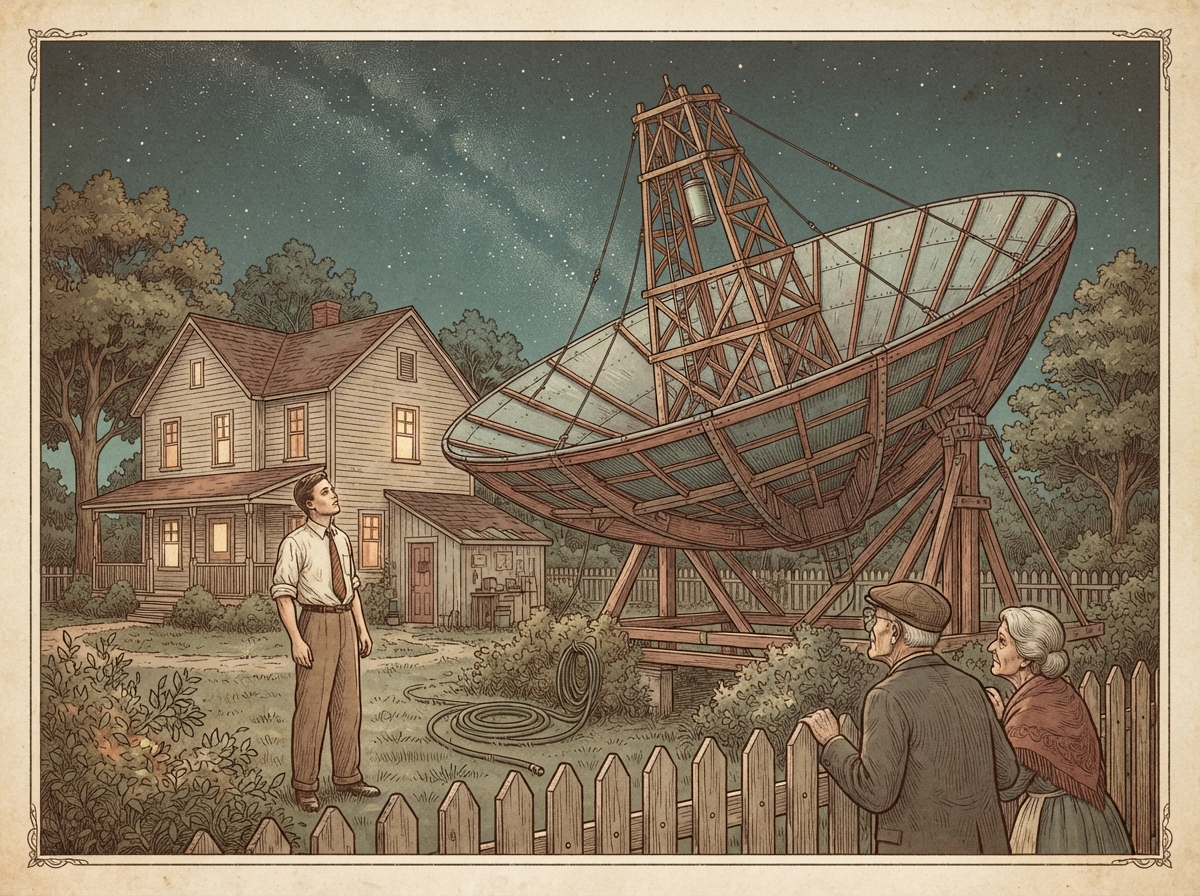
In the summer of 1937, a giant metal bowl rose on the lot beside a schoolteacher's house in Wheaton, Illinois. It was 31 feet across, built from wooden rafters and galvanized sheet metal, and it pointed at nothing anyone could see. According to a later retelling by radio astronomer John Kraus, the neighbors had theories: it was for collecting rainwater, or maybe it was a machine for controlling the weather. It was neither. It was the world's first dish-shaped radio telescope, and the 25-year-old who built it with his own money was about to listen to the galaxy.
By the Curiosities Desk · · 5 min read · Filed under Space · Today’s round
What happened?
Grote Reber was born in Chicago in 1911 and grew up in Wheaton, a suburb west of the city. He got his amateur radio license at 16 and earned an electrical engineering degree from the Armour Institute of Technology (now the Illinois Institute of Technology) in 1933. By his own account, he had made contact with radio operators in more than 50 countries and felt there were “no more worlds to conquer” in radio.
Then he read about Karl Jansky. In 1932, Jansky, an engineer at Bell Telephone Laboratories, had been hunting for the source of static that crackled through transatlantic radio calls. He traced one faint hiss to the sky itself, coming from the direction of the center of the Milky Way. Newspapers loved the story. Professional astronomers mostly shrugged, and Bell Labs moved Jansky on to other work.
Reber didn’t shrug. He decided to build an instrument designed to catch these signals on purpose, and since no one was offering to fund it, he paid for it himself: about $2,000, roughly a year’s salary. He took the summer of 1937 off from his job designing radio receivers in Chicago and built the dish next to his mother’s house. According to the National Radio Astronomy Observatory, some of the parts came from a Ford Model T truck.
The design was clever and simple. A curved metal mirror gathered faint radio waves and focused them onto a receiver held up on a wooden tower above the bowl. The dish could tilt only north and south. To scan the sky, Reber set it at an angle and let the turning Earth sweep it across the heavens.
Then it heard nothing. His first receiver, tuned to 3,300 megahertz (a frequency, or rate of wave vibration, far higher than Jansky’s), found no signal. A second try at about 910 megahertz also came up empty. Reber rebuilt again for 160 megahertz, and in the spring of 1939 the galaxy finally answered.
There was a catch. At that frequency, the spark plugs of passing cars produced a loud popping static. So Reber kept a punishing schedule. He worked his day job, ate supper, slept until about midnight, then sat in the basement beside his receiver and wrote down the meter reading once a minute until it was time to go back to work.
When he sent his results to the Astrophysical Journal, the editor, Otto Struve, didn’t know what to make of an engineer with no university post claiming to have mapped the sky by radio. Struve sent astronomers to Wheaton to inspect the setup. They found it credible, and the paper ran in 1940. A fuller map followed in 1944, showing radio “hot spots” across the sky, including sources later identified as Cygnus A and Cassiopeia A. For several years, Reber was very nearly the only radio astronomer on the planet.
Why was it strange?
Astronomy in the 1930s meant light: lenses, mirrors, photographic plates, and professionals at large observatories. The idea that the universe might be “loud” in a part of the spectrum human eyes can’t see sat awkwardly between fields. Engineers knew radio but not stars; astronomers knew stars but not radio. Reber happened to be fluent in both, working alone in a suburban yard.
It also broke an expectation about what the sky should sound like. If the radio glow came from hot material, it should have been stronger at higher frequencies. Reber’s failures at 3,300 and 910 megahertz, followed by success at 160, hinted that something else was going on.
Another accidental radio find that rewrote astronomy: The Pigeon Mess That Turned Out to Be the Echo of the Big Bang.
What did scientists learn?
That mismatch turned out to be a clue. The radio noise from our galaxy is mostly non-thermal radiation, meaning it doesn’t come from something simply being hot. Much of it is synchrotron radiation, produced when electrons moving at nearly the speed of light spiral through magnetic fields. Reber’s measurements helped physicists recognize that the Milky Way is threaded with these high-energy particles and magnetic fields, something no optical telescope could reveal.
His maps also showed that some of the brightest radio sources don’t line up with bright stars. Cygnus A, for instance, was later identified as a distant galaxy hundreds of millions of light-years away, blasting out radio waves from jets powered by a giant black hole.
Radio astronomy went on to produce one of its most famous surprises in a field Reber helped open: The Graduate Student, the ‘Little Green Men,’ and the Nobel That Got Away.
How does it affect us today?
Every big radio dish descends from the one in Wheaton. After World War II, wartime radar experts turned their skills to the sky, and radio astronomy grew into a major science. It has since detected pulsars, quasars, and the cosmic microwave background, and in 2019 a worldwide network of radio dishes produced the first image of a black hole.
Reber himself kept going his own way. He moved to Hawaii in 1951, then to Tasmania in 1954, where the long, quiet winter nights let very long radio waves slip through the upper atmosphere. He built a large antenna array in a pasture near Bothwell and stayed there until his death in 2002, two days before his 91st birthday. Part of his ashes were placed at Jodrell Bank Observatory in England in 2004.
His original dish still stands, rebuilt under his supervision in the early 1960s, at the Green Bank Observatory in West Virginia, a historical monument in front of telescopes thousands of times more sensitive.
Even household appliances have fooled radio astronomers since: The Kitchen Microwave That Impersonated a Signal From Deep Space.
Fun fact
Reber’s mother, Harriet, taught seventh and eighth grade in Wheaton. One of her students was Edwin Hubble, the astronomer who discovered that the universe is expanding. Years later, her son and her former pupil traded views on cosmology.
Sources
- National Radio Astronomy Observatory. “Grote Reber’s First Radio Telescope”, NRAO.
- National Radio Astronomy Observatory. “Grote Reber, Radio Astronomy Pioneer, Dies”, NRAO press release, December 23, 2002.
- “Grote Reber (1911–2002)”, Bulletin of the American Astronomical Society obituary, December 2003.
- Kraus, John. “The First 50 Years of Radio Astronomy, Part 2: Grote Reber and the First Radio Maps of the Sky”, Cosmic Search 4, no. 1 (Issue 13), 1982.
- Green Bank Observatory. “Reber Telescope”.