The Scientist Behind It · Space
The Newspaper That Took 49 Years to Admit Rockets Work in Space
On July 17, 1969, three astronauts were already a day into their trip to the Moon when *The New York Times* ran a small item headlined "A Correction." It concerned an editorial the paper had published in 1920, mocking a Massachusetts physics professor named Robert Goddard for believing a rocket could fly in the vacuum of space. "The Times regrets the error," it concluded. Goddard had been dead for 24 years.
By the Curiosities Desk · · 5 min read · Filed under Space · Today’s round
What happened?
Robert Hutchings Goddard was born in Worcester, Massachusetts, in 1882. At 17, sent up a cherry tree in his family’s backyard to prune it, he started daydreaming instead. He later wrote in his diary about imagining “how wonderful it would be to make some device which had even the possibility of ascending to Mars.” For the rest of his life he marked October 19 — the date of that afternoon in the tree — as his private “Anniversary Day.”
He grew up to be a physicist at Clark University in Worcester, and he spent years quietly working out the math of rocket propulsion. In 1917 the Smithsonian Institution gave him a $5,000 grant, and it then published his findings as a 79-page pamphlet with a wonderfully understated title: A Method of Reaching Extreme Altitudes. Dated 1919, it reached the public in January 1920.
The pamphlet was mostly dense equations and test results. But near the very end, Goddard added a short thought experiment. How would anyone prove a rocket had reached a truly extreme altitude? One way, he suggested, would be to send a load of flash powder to the dark side of the Moon, where its flare on impact could be seen through telescopes on Earth.
According to the Smithsonian’s National Air and Space Museum, a Smithsonian press release played up that Moon idea. Reporters saw the words “rocket” and “Moon” side by side, and within two weeks the story had spread around the world. Cartoonists drew him as a moon-shooting eccentric.
On January 13, 1920, The New York Times weighed in with an unsigned editorial titled “A Severe Strain on Credulity.” It argued that once a rocket left Earth’s atmosphere, it would have nothing to push against, so it could not possibly keep accelerating. Goddard, it said, only seemed “to lack the knowledge ladled out daily in high schools.”
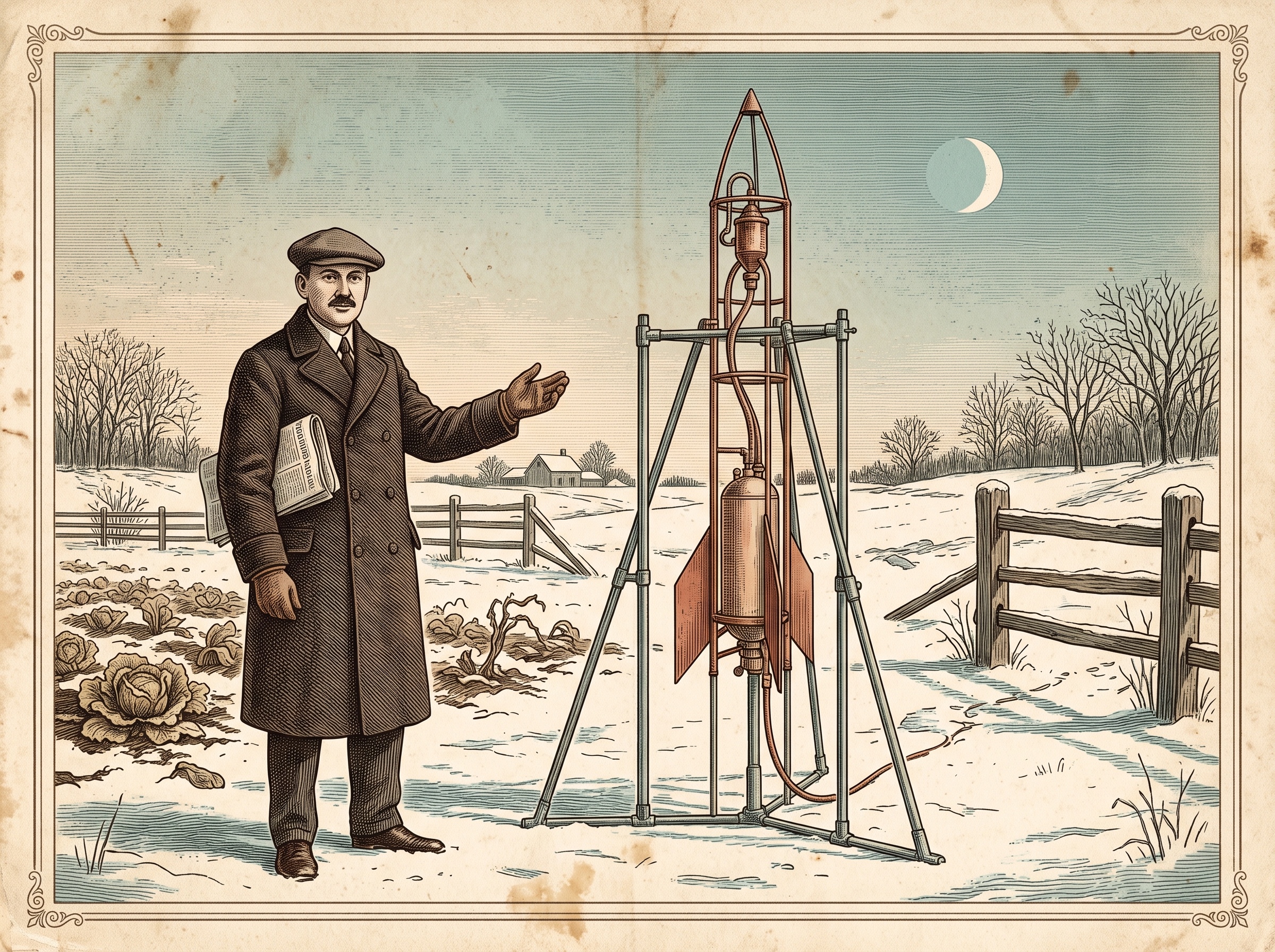
Goddard was stung, and he became famously private about his work. But he didn’t stop. On March 16, 1926, on his Aunt Effie’s snowy farm in Auburn, Massachusetts, he launched the world’s first liquid-fueled rocket — a spindly contraption he later named Nell, burning gasoline and liquid oxygen. NASA’s history office records the flight: it rose 41 feet, lasted 2.5 seconds, and landed 184 feet away in a cabbage field.
His last Auburn launch, on July 17, 1929, carried a barometer, a thermometer, and a camera — the first rocket to carry scientific instruments. It was loud enough, and its crash landing fiery enough, that alarmed neighbors called for help and the story made the papers. A Worcester newspaper is widely reported to have run the headline “Moon Rocket Misses Target by 238,799 1/2 Miles.” The state fire marshal then banned his tests in Massachusetts.
Oddly, that fuss is what saved his career. The aviator Charles Lindbergh read about the professor and his rockets, came to see him, and helped persuade the Guggenheim family to fund him. Goddard moved his whole operation to the open desert near Roswell, New Mexico, where he kept launching for most of the next decade.
Why was it strange?
The editorial wasn’t wrong about a hard technical detail. It was wrong about one of the oldest and most basic ideas in physics.
Isaac Newton’s third law — for every action, there is an equal and opposite reaction — was published in 1687. A rocket doesn’t push against the air. It pushes against its own exhaust: hot gas blasted out the back shoves the rocket forward, the way a skateboarder who throws a heavy ball falls backward. There is no air required anywhere in that exchange.
The irony runs deeper. Goddard’s own pamphlet described firing rockets inside a vacuum chamber to test exactly this. The man accused of skipping high school physics had already done the experiment the editorial said was impossible.
The same thread — Apollo 11 — continues in The Airstream Trailer That Was Supposed to Save Earth From Moon Germs.
What did scientists learn?
Rockets don’t just work in a vacuum — they work slightly better there. In the atmosphere, the surrounding air pressure pushes back against the exhaust leaving the nozzle (the bell-shaped opening at the rocket’s tail). In space, that back-pressure disappears, so the same engine produces more thrust.
Goddard’s real contribution was turning that principle into working hardware. Burning a liquid fuel with liquid oxygen packed far more energy per pound than the gunpowder rockets of his day. Over the following years he added steering vanes in the exhaust and gyroscopes (spinning wheels that resist tilting) to keep rockets pointed straight. NASA notes that his highest flight reached only about 9,000 feet. But the basic layout — pumped liquid propellants, a cooled combustion chamber, active steering — became the template for nearly every large rocket that followed.
Another person who would not drop the question: The Moon Rocket Struck by Lightning Twice — and the Switch Nobody in Mission Control Had Heard Of.
How does it affect us today?
Goddard died on August 10, 1945, before any rocket reached space. His widow, Esther, then spent years securing patents on his work; he is credited with 214 in total, 131 of them awarded after his death. In 1960 the U.S. government paid $1 million to settle claims covering his basic inventions in rockets, guided missiles, and space exploration.
In 1959, the newly created NASA named the Goddard Space Flight Center in Greenbelt, Maryland, after him. And Wernher von Braun, whose Saturn V carried Apollo 11 to the Moon, said in 1963 that Goddard’s rockets “blazed the trail.”
The Times correction has since become a favorite example among scientists and journalists alike — a reminder that “obviously impossible” is a claim worth double-checking, and that a graceful correction is better late than never.
Elsewhere in the space stories: The Rocket That Exploded on Live TV and Got Called ‘Kaputnik’.
Fun fact
The 1969 correction was just three short paragraphs. Its final lines noted that “further investigation and experimentation” had “confirmed the findings of Isaac Newton in the 17th Century” — a polite way of saying the paper had finally caught up to 1687.
Sources
- NASA History — “95 Years Ago: Goddard’s First Liquid-Fueled Rocket”
- Smithsonian National Air and Space Museum, Pioneers of Flight — “Robert Goddard Published ‘A Method of Reaching Extreme Altitudes’”
- Clark University Archives — Goddard in the Press: Editorial Cartoons and Illustrations (1920–1929)
- Mass Moments (Mass Humanities) — “Robert Goddard Launches Space Age”
- Aerospace America (AIAA) — “Esther Goddard: Keeper of Her Husband’s Legacy”